
Walk into a high-end hotel lobby in December and there is a reasonable chance you will look up and see a Christmas tree hanging from the ceiling, tip pointing at the floor, fully lit and covered in ornaments. The first reaction is almost always the same: a double take, then a question. Is that a real decorating idea, or is somebody just being clever?
The upside down Christmas tree is one of the most polarizing holiday decorating choices out there. Some people find it genuinely striking, a sculptural piece that turns a room’s focal point into something unexpected. Others think it looks like a mistake nobody fixed. Both reactions are fair, and both miss the more useful question, which is not whether upside-down trees are good or bad but where they actually work and who should consider one.
This guide covers the real history behind hanging trees, why they exploded in popularity again, how to decorate one properly, what the safety considerations look like, and how they stack up against a traditional tree. If you are weighing one for your own home, the aim here is that by the end you will know whether it fits your space or whether your money is better spent elsewhere. For more decorating guides across every tree type and style, MyChristmasTrees.online covers the full range.
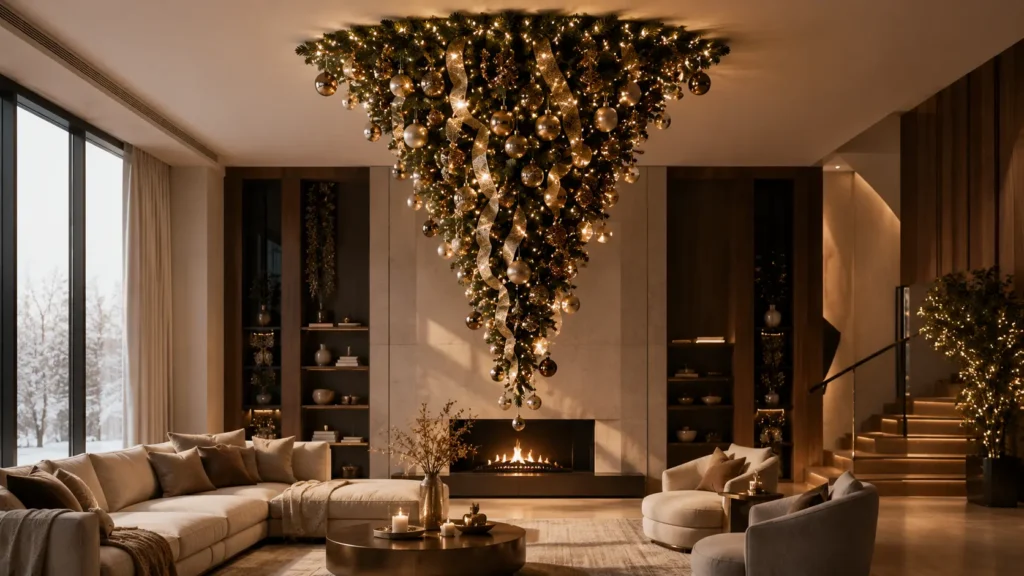
Are Upside-Down Christmas Trees Worth Buying?
For most families with a standard living room, no. For people with specific space constraints, a modern interior, or a desire for a genuine conversation piece, yes.
An upside-down Christmas tree creates a dramatic visual statement that a conventional tree simply cannot match. It frees up floor space when ceiling-mounted, which matters enormously in small apartments and entryways. It also photographs beautifully, which is a large part of why it spread the way it did.
The catch is that it costs more, takes longer to install, requires structural consideration in your ceiling, and works against most traditional holiday decor. Ornaments hang differently. Skirts and gift displays do not really apply to a ceiling-mounted version. And if your household includes a tree that gets decorated by children each year, an upside-down tree removes a lot of that ritual.
Value depends almost entirely on your decorating goals and available space, not on whether the trend is fashionable.
| Question | Short Answer |
|---|---|
| Do they save floor space? | Yes, if ceiling-mounted. Floor-standing versions save very little. |
| Are they safe? | Yes, when mounted into a ceiling joist with proper hardware. Not safe with drywall anchors alone. |
| Are they harder to decorate? | Yes. Ornaments need secure attachment and weight planning. |
| Do they cost more? | Typically 30 to 60 percent more than a comparable traditional artificial tree. |
| Good for families with young kids? | Ceiling-mounted versions, yes for safety. No for tradition and participation. |
| Are they a passing fad? | No. They have existed for centuries and have a permanent niche in commercial display. |
| Best environment? | Retail, hotels, restaurants, modern homes, narrow entryways. |
| Worth it for a standard living room? | Usually not. A well-lit traditional tree delivers more for less effort. |
What Is An Upside-Down Christmas Tree?
An upside-down Christmas tree is exactly what the name suggests: a Christmas tree displayed with the trunk at the top and the narrow tip pointing toward the floor. The wide base of the tree becomes the crown, and what would normally be the topper position sits at eye level or below.
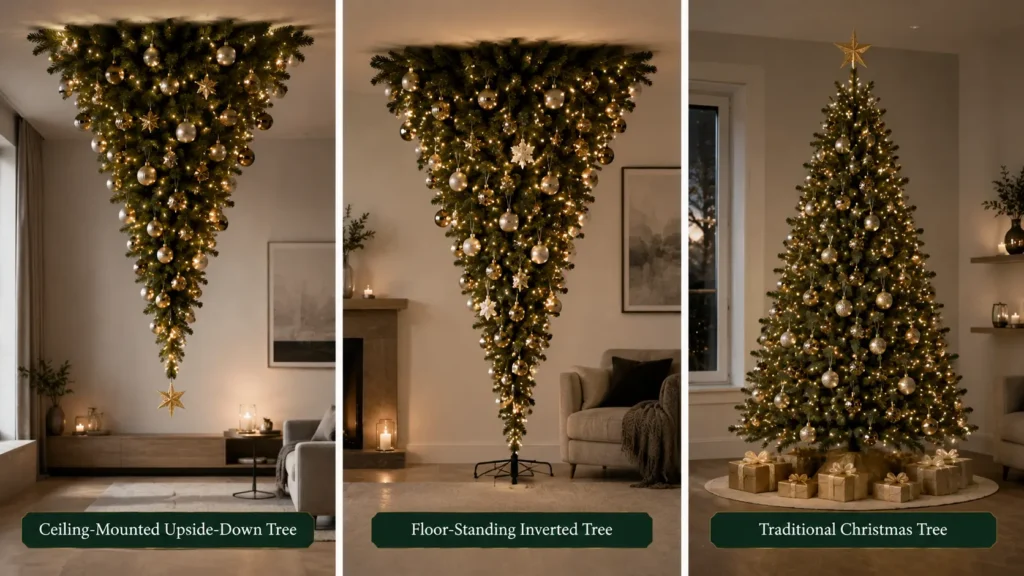
There are three common configurations, and they behave quite differently.
Ceiling-mounted (hanging) trees. The tree is suspended entirely from a ceiling anchor or mounting bracket, with no floor contact at all. This is the version most people picture when they hear “hanging Christmas tree,” and it is the only version that truly frees up floor space. Installation requires locating a ceiling joist and using rated hardware.
Floor-standing inverted trees. These use a weighted base and an inverted pole, so the tree stands on the floor but is oriented upside down. The visual effect is similar from a distance, but the base still occupies floor area. These are far easier to install and are the practical choice for renters who cannot drill into ceilings.
Wall-mounted half trees. A hybrid. A half tree mounts flush to the wall in an inverted orientation. These work well in hallways and narrow rooms where even a slim tree feels intrusive.
Commercial display trees. Retail and hospitality installations are usually custom-built, often oversized, and frequently rigged from structural steel rather than residential ceiling framing. These are what most people have actually seen in person, and they are not directly comparable to a home setup.
The History Of Upside-Down Christmas Trees
This is where a lot of internet content gets sloppy, so it is worth separating what is documented from what is repeated.
The most commonly cited origin story traces to medieval Central and Eastern Europe, where evergreen boughs were sometimes hung from ceiling rafters during winter celebrations. Hanging greenery from the ceiling was practical as much as symbolic, since it kept branches out of the way in cramped dwellings and dried them evenly. In parts of Poland, Slovakia, and Ukraine, the tradition of suspending a decorated evergreen from the rafters, sometimes called a podłaźniczka, persisted well into the modern era.
There is also a religious tradition frequently associated with the practice. The story goes that a missionary in the seventh or eighth century used a fir tree’s triangular shape to explain the Trinity, and that hanging the tree point-down emphasized this. This account circulates widely, though the specific link to inverting trees is far weaker in the historical record than the general association of the fir with the Trinity. It is worth being honest about that gap rather than repeating it as settled fact.
What is clearly documented is the modern commercial revival. Beginning in the early 2000s, upside-down trees appeared in North American department stores and shopping malls, initially as a merchandising solution. Hanging a tree freed up valuable floor space for product, while placing ornaments at eye level made them easier for shoppers to see and buy. Retailers noticed that the trees themselves generated attention, and the display became the point rather than a side effect.
Luxury hotels adopted the format for the same reason. A tree suspended above a lobby reads as intentional and expensive, and it does not obstruct traffic flow through the space. From there it spread to restaurants, event venues, and eventually residential design.
So the honest summary is this: hanging evergreens from ceilings is genuinely old. The modern upside-down Christmas tree as a decorative product is a retail-driven revival that borrowed an old idea and turned it into a category.
Why Have Upside-Down Trees Become Popular?
Several forces converged, and none of them individually explains the whole picture.
Social media rewarded the unusual. A conventionally decorated tree, no matter how beautifully executed, is visually familiar. A hanging tree stops the scroll. Platforms that surface novel imagery gave upside-down trees a reach far beyond what their actual adoption rate would suggest. This is a pattern that repeats constantly in holiday decor, and the way viral formats spread and then fade is covered in more depth in this look at viral Christmas tree trends on TikTok.
Interior design moved toward sculptural objects. Contemporary and minimalist interiors treat holiday decor less as accumulated tradition and more as a seasonal design intervention. An inverted tree reads as an installation rather than a decoration, which suits that sensibility.
Retail normalized the look. After a decade of seeing hanging trees in stores and hotels, the format stopped registering as strange. Familiarity in commercial settings made it feel plausible at home.
Small-space living created real demand. Urban apartments genuinely do not have room for a full traditional tree. A ceiling-mounted tree solves an actual problem, not just an aesthetic one.
They function as conversation pieces. For people who host during the holidays, a hanging tree does reliable work. Every guest comments on it.
Are Upside-Down Trees Practical?
Practicality depends on which version you choose and what you are trying to accomplish. Here is the honest breakdown.
Advantages
The floor space savings on a ceiling-mounted tree are real and substantial. A 7.5 foot traditional tree with a 45 inch base occupies roughly 11 square feet of floor once you account for the skirt and clearance. A hanging tree occupies zero.
Ornaments display more prominently. Because branches angle downward, ornaments hang away from the foliage rather than nestling into it. Decorations that would disappear on a traditional tree stay fully visible.
Pets and small children cannot reach the tree. This is not a minor consideration. Cats climbing trees and toddlers pulling ornaments are among the most common holiday decorating frustrations, and a ceiling-mounted tree eliminates both entirely.
The visual impact is genuinely strong. In a room with a high ceiling, a hanging tree creates vertical drama that a floor tree cannot produce.
Disadvantages
Installation is a real project. You need to locate a joist, mount rated hardware, and lift a weighted tree overhead. This is a two-person job at minimum.
Cost runs higher across the board. Both the trees themselves and the mounting hardware carry a premium.
Renters often cannot install one. Drilling into a ceiling is usually prohibited by lease terms, which pushes most renters toward floor-standing inverted models that sacrifice the main benefit.
Gift placement becomes awkward. There is no natural space beneath a hanging tree, and stacking gifts under a suspended object with a pointed tip is not ideal.
Traditional decorating loses coherence. Tree skirts, collar bases, and train sets do not apply. If your holiday setup includes those elements, an upside-down tree fights them.
Storage is bulkier. The mounting hardware and reinforced pole take up more room than a standard tree stand.
Maintenance
Dust accumulation is heavier on an inverted tree because branches present their upper surface to the room. Plan on a gentle dusting with a microfiber cloth or a low-setting hair dryer partway through the season. Reaching the tree requires a stepladder, which makes casual adjustment less convenient than with a floor tree.
Comparison Table
| Factor | Ceiling-Mounted | Floor-Standing Inverted | Traditional Tree |
|---|---|---|---|
| Floor space used | None | 6 to 10 sq ft | 8 to 12 sq ft |
| Installation time | 60 to 120 minutes | 30 to 60 minutes | 30 to 90 minutes |
| Requires drilling | Yes | No | No |
| Renter friendly | Rarely | Yes | Yes |
| Pet and child safe | Excellent | Moderate | Poor without precautions |
| Gift display beneath | Not practical | Limited | Excellent |
| Typical cost premium | 40 to 60 percent | 20 to 40 percent | Baseline |
| Decorating difficulty | High | Moderate | Low |
| Visual drama | Very high | High | Moderate |
| Storage footprint | Larger | Larger | Standard |
Do Upside-Down Trees Save Space?
Sometimes substantially, sometimes not at all, and the difference matters more than most articles admit.
They save real space in:
Studio and one-bedroom apartments where the living area doubles as everything else. Removing 10 square feet of obstruction from a 300 square foot room is meaningful.
Entryways and foyers, where a floor tree blocks circulation but ceiling height is often generous.
Narrow rooms and hallways, where anything on the floor creates a pinch point.
Retail floors, where every square foot of floor is revenue-generating.
Restaurants and bars, where table capacity is the constraint.
They do not meaningfully save space in:
Rooms with 8 foot ceilings. A hanging tree in a standard apartment ceiling ends up occupying the eye-level zone, which is arguably worse than a floor tree tucked into a corner.
Homes where the tree would go in an unused corner anyway. If the floor space was not being used, freeing it accomplishes nothing.
Any application using a floor-standing inverted model, since the weighted base is typically as large as a conventional tree stand.
This is the honest position: if you are in a small apartment and specifically want to reclaim floor area, a slim tree in a corner usually delivers 80 percent of the benefit at 30 percent of the effort. A ceiling-mounted tree is the right call when you also want the visual statement, not just the square footage. There is a broader look at the options in this guide to small space and apartment Christmas trees.
Decorating An Upside-Down Christmas Tree
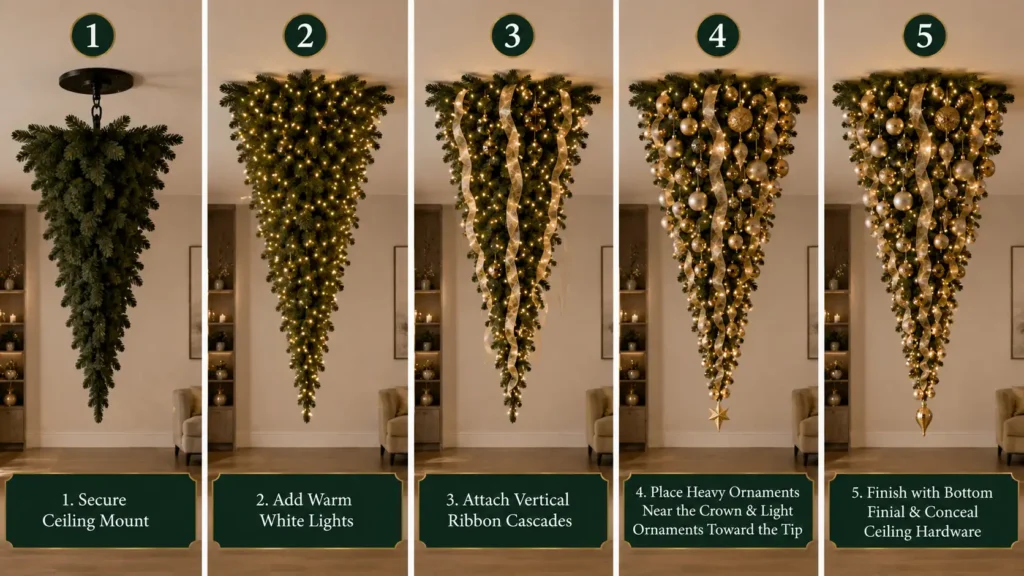
This is where most people underestimate the project. Decorating an inverted tree is not the same task performed in a different orientation. Gravity works against you in ways that change the approach entirely.
The Core Difference
On a traditional tree, ornaments rest against branches and the foliage supports them. On an inverted tree, branches angle downward, so ornaments swing freely away from the tree and every hook is under direct tension. Anything that would slip off a traditional branch will fall from an inverted one.
Use ornament wire or floral wire instead of standard hooks. Twist wire around the branch and through the ornament cap. This single change prevents the majority of ornament losses.
Ornament Placement
Work from the crown (the wide part, now at the top) downward toward the tip. Place your largest and heaviest ornaments in the upper third, closest to the mounting point. This keeps the center of gravity high and reduces swing. Medium ornaments fill the middle. Small, light ornaments go toward the tip.
This is the reverse of traditional practice, where large ornaments go low, and it is the single most common mistake people make.
Ornament quantity follows the same benchmarks as a traditional tree of the same height. A 7.5 foot tree wants 75 to 100 ornaments for a full look. A 6 foot tree wants 50 to 75. Because inverted branches display ornaments more prominently, you can often land at the lower end of the range and still look complete.
Ribbon
Ribbon behaves better on an inverted tree than most people expect, because it drapes naturally downward instead of needing to be tucked. Run ribbon in vertical cascades from the crown toward the tip rather than in horizontal wraps. Horizontal ribbon on an inverted tree tends to slide.
Plan on 30 to 40 feet of ribbon for a 7.5 foot tree, 15 to 25 feet for a 6 foot tree.
The Topper Problem
There is no topper position on an inverted tree, or rather, the topper position is at the bottom pointing at the floor. Options:
Attach a weighted finial or large ornament cluster at the tip. This is the most common solution and it anchors the design visually.
Skip a topper entirely and let the tip taper cleanly. Works well for minimalist treatments.
Place a decorative element at the ceiling mount to conceal hardware. A fabric collar, a ring of greenery, or a decorative canopy hides the bracket and finishes the top.
Weight Distribution
This matters more than aesthetics. Distribute ornament weight evenly around the circumference. An unbalanced inverted tree will hang at an angle, and the correction is not subtle. Rotate the tree as you decorate and check the vertical line from several angles.
Keep total decoration weight well under the mount rating. A reasonable target is decorations totaling no more than 25 percent of the tree’s own weight.
Decorating Sequence Table
| Step | Traditional Tree | Upside-Down Tree |
|---|---|---|
| 1 | Assemble and fluff | Mount hardware and test load |
| 2 | Install lights base to top | Assemble and fluff tree |
| 3 | Add ribbon | Hang tree and verify level |
| 4 | Place large ornaments low | Install lights crown to tip |
| 5 | Place medium ornaments | Add vertical ribbon cascades |
| 6 | Place small ornaments high | Place heavy ornaments at crown |
| 7 | Add topper | Fill mid and tip with lighter ornaments |
| 8 | Add skirt and gifts | Add tip finial and conceal ceiling mount |
Best Lighting For Upside-Down Trees
Lighting carries more weight on an inverted tree than on a traditional one, because the tree is often viewed from below and from a distance rather than up close. Get the lighting right and the tree works even with modest ornaments. Get it wrong and no amount of decoration rescues it.
Use LED lights, not incandescent. This is not a preference on an inverted tree, it is close to a requirement. LEDs run cool, weigh less, and draw far less current, which matters when the entire assembly hangs from a single anchor point. The weight difference across a 750 light set is meaningful.
Warm white is the default for a reason. Warm white reads as inviting and flatters both greenery and metallic ornaments. Cool white works for Scandinavian and contemporary treatments where you want the tree to read as sculptural rather than cozy. Multicolor is harder to pull off on an inverted tree because the format already demands attention and competing color can tip it into chaos.
Density matters. The standard benchmark of 100 lights per foot of tree height applies here. A 7.5 foot tree wants roughly 750 lights. For the luxury look that suits most upside-down installations, push to 150 lights per foot. The math and reasoning are laid out in detail in this Christmas tree lights and lighting guide, and if you want the quick version for your specific tree size, how many lights do you need for a Christmas tree breaks it down by height. For exact counts, run your numbers through the Christmas tree light calculator.
Layer your lighting. The technique that separates professional installations from amateur ones is depth. Run one string deep against the central pole to create interior glow, then a second string on the outer branch tips. On an inverted tree this is especially effective because viewers look up into the tree and see the interior lighting directly.
Hide the wiring. This is the hardest part of an upside-down installation. Wire naturally wants to hang away from the branches, and a visible power cord running to the ceiling ruins the effect. Solutions in order of preference: use a battery-powered or rechargeable light set to eliminate the cord entirely, route the cord along the mounting chain and paint or wrap it to match the ceiling, or install a ceiling outlet during mounting. A pre-lit tree solves most of this problem before it starts.
Consider professional installation for large or high installations. Anything above 10 feet or mounted over a stairwell is worth handing to someone with the right ladder and rigging experience.
Which Decorating Styles Work Best?
Upside-down trees are not style-neutral. Some aesthetics adapt easily and some fight the format.
Luxury. This is the strongest match. The inverted format already signals intentional design, and luxury decorating rewards that. Deep jewel tones, generous ribbon cascades, mixed metallics, and a dense light count all suit the format. The vertical cascade of ribbon on an inverted tree is genuinely more elegant than horizontal wrapping on a traditional one. The principles carry over from these luxury Christmas tree decorating ideas.
Scandinavian. Also an excellent match. The restraint of Scandinavian styling suits a format that already demands attention. Natural wood ornaments, simple white lighting, and a great deal of negative space between decorations let the shape do the work. The approach translates well from this Scandinavian Christmas tree style guide.
Minimalist. Arguably the best fit of all. A sparsely decorated inverted tree reads as a design object rather than a holiday decoration, which is precisely what minimalist treatment aims for. Fewer ornaments in a single finish, warm white lighting, no ribbon at all. The logic is the same one covered in these minimalist Christmas tree ideas.
Rustic. The weakest match. Rustic decorating relies on accumulation, warmth, and a sense of tradition. An inverted tree reads as modern and deliberate, which works against rustic cues. It can be done with burlap ribbon, wooden ornaments, and heavy greenery, but you are working uphill.
Contemporary. Strong match. Geometric ornaments, monochrome palettes, and clean lighting all suit the format. Contemporary rooms with high ceilings and open plans are where hanging trees look most at home.
| Style | Fit | Key Adjustment |
|---|---|---|
| Luxury | Excellent | Vertical ribbon cascades, high light density |
| Minimalist | Excellent | Fewer ornaments, single finish, no ribbon |
| Scandinavian | Excellent | Natural materials, generous negative space |
| Contemporary | Strong | Geometric shapes, monochrome palette |
| Traditional | Moderate | Heavier ornaments at crown, warm lighting |
| Rustic | Weak | Requires natural textures to offset modern shape |
Upside-Down Trees vs Traditional Christmas Trees
| Factor | Upside-Down Tree | Traditional Tree |
|---|---|---|
| Visual impact | Very high, unusual and memorable | Moderate to high, familiar and warm |
| Floor space required | None if ceiling-mounted | 8 to 12 sq ft for a 7.5 ft tree |
| Typical cost | 40 to 60 percent premium | Baseline |
| Installation | 60 to 120 minutes, two people, drilling required | 30 to 90 minutes, one person |
| Decorating difficulty | High, requires wire and weight planning | Low, forgiving of mistakes |
| Ornament visibility | Excellent, hangs clear of foliage | Good, some ornaments nest into branches |
| Child and pet safety | Excellent when ceiling-mounted | Requires anchoring and lower-shelf planning |
| Gift display | Not practical | Excellent |
| Family tradition value | Low, limited participation | High, everyone can decorate |
| Storage | Larger, includes hardware | Standard |
| Reusability | Same as any artificial tree, 7 to 20 years | 7 to 20 years |
| Best environment | Modern homes, commercial spaces, entryways | Almost any home |
Where Upside-Down Trees Work Best
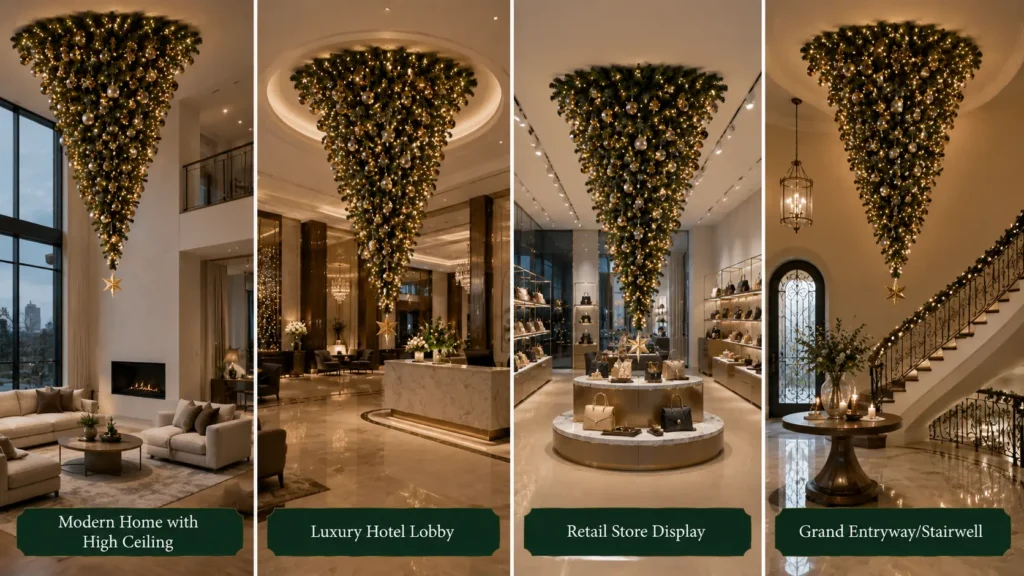
Retail stores. The original commercial use case and still the strongest. Floor space is revenue, ornaments at eye level are shoppable, and the display draws people in from outside.
Shopping centers. Large atriums with high ceilings and heavy foot traffic are ideal. A suspended tree can be enormous without obstructing anything.
Hotels. Lobby installations benefit from every advantage at once: high ceilings, traffic flow, guest impressions, and no need for gifts underneath.
Restaurants and bars. Table capacity is the binding constraint. A hanging tree adds seasonal atmosphere without costing a single cover.
Modern homes with high ceilings. In a 10 to 12 foot ceiling with open-plan living, a hanging tree looks intentional rather than eccentric. This is the residential sweet spot.
Event venues. Temporary installations where visual impact matters more than practicality.
Entryways and stairwells. Often the best residential application. The space is vertical, underused, and visible to everyone entering.
Why They Are Uncommon In Family Living Rooms
The reasons are not aesthetic. They are functional.
Decorating a tree is a shared family activity, and a ceiling-mounted tree can only be decorated by an adult on a ladder. Children cannot participate, which removes a large part of the point for many households.
Gifts go under the tree. That is not a small tradition to abandon.
Standard 8 foot ceilings do not give the format room to work. The tree ends up crowding eye level.
Most family living rooms have accumulated ornaments with sentimental value in mismatched sizes and weights, which is exactly the kind of collection that is hardest to balance on an inverted tree.
None of this makes the format bad. It makes it wrong for that specific room.
Are They Safe?
They are safe when installed correctly and genuinely dangerous when they are not. This is the section to read carefully.
Mount into structure, never into drywall alone. Locate a ceiling joist with a stud finder and confirm it by drilling a small pilot hole. A drywall anchor rated for 50 pounds in a wall is not rated for 50 pounds of sustained downward load in a ceiling. Use a lag screw or eye bolt driven at least 1.5 inches into solid joist material.
Understand the real load. A 7.5 foot artificial tree weighs 25 to 45 pounds. Add lights, ornaments, and ribbon, and a fully decorated tree can reach 60 to 80 pounds. Then account for dynamic load, since anything that swings or gets bumped momentarily exerts more force than its static weight. Your hardware should be rated for at least three times the total decorated weight.
Test before you decorate. Hang the bare tree and leave it for 24 hours. Check the mount for any sign of movement, cracking, or drywall deformation. Only then start decorating.
Verify level. A tree hanging even slightly off vertical will look wrong and will also concentrate load unevenly. Check with a level along the central pole.
Keep the tip above head height in traffic areas. A pointed tree tip at forehead level is a genuine hazard. Leave at least 6 feet of clearance beneath the tip in any walkway, or position the tree where people do not pass directly beneath.
Children. Ceiling-mounted trees are safer than traditional trees for toddlers, since nothing is reachable. The remaining risk is falling ornaments, so use wire attachment rather than hooks and check periodically.
Pets. Cats cannot climb a hanging tree, which solves the single biggest holiday pet problem. If the tip hangs low, however, a cat may still bat at it, so raise the tip out of jumping range.
Electrical. Use LED lights on a single circuit, avoid daisy-chaining more than three strings, and put the tree on a timer rather than leaving it lit unattended overnight.
Rental properties. Check your lease. Ceiling penetration is prohibited in most standard leases, and repair costs at move-out can be significant. Floor-standing inverted models exist specifically for this situation.
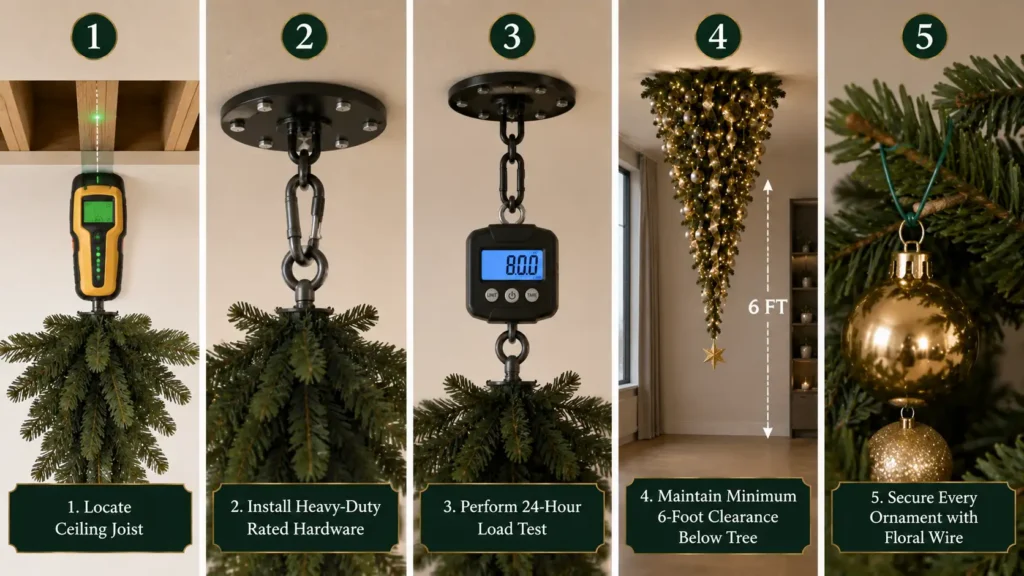
Safety Checklist
| Check | Requirement | Why |
|---|---|---|
| Joist located and confirmed | Stud finder plus pilot hole | Drywall alone cannot carry sustained load |
| Hardware rating | 3x decorated tree weight | Accounts for dynamic load and swing |
| Screw penetration | Minimum 1.5 inches into joist | Prevents pull-out under load |
| 24-hour bare load test | Complete before decorating | Reveals mount failure before it matters |
| Vertical level verified | Level along central pole | Prevents uneven load and visual tilt |
| Tip clearance in walkways | Minimum 6 feet | Prevents head-height impact |
| Ornament attachment | Wire, not open hooks | Prevents falling decorations |
| Lighting type | LED only | Reduces weight, heat, and current draw |
| Timer installed | Yes | Avoids unattended overnight operation |
| Lease reviewed if renting | Before drilling | Ceiling penetration often prohibited |
Alternative Unique Christmas Tree Ideas
If what actually appeals to you about an upside-down tree is the departure from convention rather than the inversion specifically, there are gentler ways to get there. Wall-mounted trees, ladder trees, driftwood and branch constructions, floating shelf arrangements, and light-only wall silhouettes all deliver an unconventional result without ceiling anchors or a load calculation. Several of these also cost dramatically less.
A collection of these approaches is gathered in this piece on unique Christmas tree ideas you’ve never seen before, and it is worth reading before committing to a hanging installation. Many people discover that what they wanted was a different silhouette, not a suspended one.
Choosing The Right Tree
If you have decided an upside-down tree is right for your space, the tree selection itself matters.
Pre-lit trees are strongly recommended here. On a traditional tree, pre-lit is a convenience. On an inverted tree, it solves the wiring visibility problem, removes the weight of separately strung lights, and eliminates the awkward job of stringing lights on a suspended object. The extra cost is more justified here than in almost any other application. The selection criteria are covered in this guide on how to choose the perfect pre-lit Christmas tree, with the fuller picture on maintenance and longevity in the ultimate guide to pre-lit Christmas trees.
Slim profiles hang better than full ones. A 30 to 45 inch slim tree has less mass, less swing, and a cleaner inverted silhouette than a 60 to 70 inch full tree. It also reduces load on your mount considerably. If you like the format but are nervous about weight, this is the answer. The trade-off is fewer ornament positions, which is discussed in this guide to slim and pencil Christmas trees for small spaces.
Artificial only. A real tree cannot be hung upside down safely or practically. Water supply is impossible, needle drop increases dramatically without water, and the weight of a fresh-cut tree is far beyond what residential ceiling mounts should carry. This is one category where artificial is not a preference but a requirement.
Check the mounting design before buying. Some inverted trees are purpose-built with reinforced central poles and integrated hanging hardware. Others are standard trees sold with an aftermarket bracket. The purpose-built versions are worth the difference.
Planning Decorations
Planning matters more on an inverted tree than a traditional one, because correcting a mistake means going back up a ladder and rebalancing weight. Working out your quantities before you start is not optional here.
Decide on your total ornament count first, then divide it by thirds: heavy ornaments in the upper third near the crown, medium in the middle, light near the tip. Buy accordingly. The most common failure is arriving at the tip with only heavy ornaments left, which unbalances the tree and looks bottom-heavy in a way that reads as an error.
Work out your ribbon, ornament, and light totals in advance using the Christmas tree decoration calculator, and if you want to focus specifically on ornament counts by tree size, the Christmas tree ornament calculator handles that directly.
One additional planning note specific to inverted trees: buy roughly 20 percent fewer ornaments than the standard benchmark suggests. Because branches angle downward and ornaments hang clear of the foliage, the same count reads as denser. Overloading is the more common mistake here, which is the reverse of the usual advice.
Common Mistakes
Overloading the branches. Inverted branches carry decoration weight in direct tension rather than resting it. Branches that would hold three ornaments on a traditional tree may only hold one or two here. The fix: distribute widely rather than clustering, and test branch flex before committing.
Mounting into drywall. The single most dangerous mistake. Drywall anchors fail under sustained downward load, often weeks after installation. The fix: locate a joist, always, without exception.
Uneven ornament distribution. An inverted tree hangs freely and will rotate or tilt toward the heavy side. The fix: rotate as you decorate and check the vertical from multiple angles.
Too many decorations. The format is already a statement. Adding a maximalist decoration scheme on top produces visual noise. The fix: reduce your ornament count 20 percent below the standard benchmark and let the shape carry the design.
Ignoring room proportions. A hanging tree in an 8 foot ceiling occupies eye level and dominates a room in an unpleasant way. The fix: a hanging tree wants a minimum 9 foot ceiling, and 10 feet or more is where the format actually shines. Below that, a slim floor tree is the better decision.
Using standard ornament hooks. They slip off inverted branches. The fix: wire every ornament.
Visible power cords. Nothing undermines the effect faster. The fix: pre-lit tree, or route and conceal the cord along the mounting chain.
Skipping the load test. Decorating first and discovering the mount is inadequate second is how ceilings get damaged. The fix: 24 hours bare, every time.
Expert Perspective
Upside-down Christmas trees are neither purely a gimmick nor a must-have trend. They are a niche decorating option that works exceptionally well in the right environment and poorly in the wrong one, and the environment matters far more than the trend cycle does.
For homeowners seeking a dramatic focal point in a modern space with high ceilings, or for businesses creating memorable holiday displays where floor space carries real cost, they can be highly effective. The format solves genuine problems: floor space, pet damage, ornament visibility, and traffic flow. Those are not imaginary benefits.
For traditional family homes, a classic Christmas tree usually remains the more practical and timeless choice. Not because the upside-down tree looks bad, but because the traditional tree does things the inverted one cannot. Gifts underneath, children decorating the lower branches, ornaments accumulated across decades, the ritual of the whole thing. Those are the reasons most families decorate a tree in the first place, and an inverted tree quietly removes several of them.
The most useful way to think about it: an upside-down tree is a design decision, not a holiday tradition. If you want a design object, it is an excellent one. If you want a tradition, buy a traditional tree and spend the price difference on better lighting. A well-lit conventional tree beats a poorly executed inverted one every time, and the reverse is also true.
Final Verdict: Trend Or Gimmick?
Neither, and that is the honest answer.
A gimmick is something that exists purely for attention and disappears once the novelty wears off. Upside-down trees do not fit that description. They have documented historical precedent, they solve real spatial problems, and they have held a permanent place in commercial display for more than two decades. Retail and hospitality did not adopt them because they were fashionable. They adopted them because hanging a tree freed up floor space and drew attention, and both of those remain true.
But calling it a trend overstates residential adoption. The format has never crossed into mainstream home decorating and there is no strong reason to expect it will. The constraints that keep it niche, standard ceiling heights, gift placement, family participation, and installation complexity, are structural rather than fashion-driven. They will not resolve.
The accurate description is a permanent niche. Upside-down Christmas trees are a legitimate decorating option with a specific and durable use case, not a passing fad and not a broad trend.
They are best suited for: modern homes with 10 foot or higher ceilings, apartments where floor space is genuinely scarce, entryways and stairwells, households with cats or curious toddlers, retail and hospitality spaces, and anyone whose priority is a striking design statement over holiday tradition.
They are a poor fit for: standard 8 foot ceilings, renters who cannot drill, families who decorate together as a ritual, households with large sentimental ornament collections, and anyone who places gifts under the tree.
Conclusion
The upside-down Christmas tree has a longer history than its reputation suggests, running from ceiling-hung evergreens in medieval Central Europe to department store displays in the 2000s to the social-media-driven visibility it has today. Along the way it picked up a reputation as a novelty, which undersells what it actually does.
The advantages are real. Zero floor space when ceiling-mounted. Ornaments that hang clear of the foliage and display far better. Complete protection from pets and small children. A visual impact that no conventional tree matches. The disadvantages are equally real: higher cost, meaningful installation work, ceiling requirements that rule out most standard rooms, no practical place for gifts, and a decorating process that demands wire, weight planning, and a ladder.
Decorating one well means reversing your instincts. Heavy ornaments go at the top near the crown, ribbon cascades vertically rather than wrapping horizontally, LED lights are close to mandatory, and you want roughly 20 percent fewer ornaments than a comparable traditional tree. Safety comes down to one rule above all others: mount into a joist, never into drywall, and load-test the bare tree for a full day before a single ornament goes on.
If the appeal is doing something different rather than the inversion itself, there are simpler routes to an unconventional result, from wall-mounted trees to branch constructions to light silhouettes, most of which cost less and install in an afternoon.
The decision comes down to what you want the tree to be. A design statement in a modern space with the ceiling height to support it, or a gathering point for a family tradition. Upside-down trees are genuinely excellent at the first and genuinely poor at the second. Knowing which one you are after answers the question far more reliably than any trend forecast will.
Frequently Asked Questions
Are upside-down Christmas trees a real tradition or a modern invention?
Both, in different ways. Hanging evergreens from ceiling rafters is a documented practice in parts of Central and Eastern Europe going back centuries. The upside-down Christmas tree as a purchasable product, however, is a modern retail development that emerged in North American department stores in the early 2000s. The old tradition and the current product are connected by idea rather than by direct lineage.
Why do people hang Christmas trees upside down?
The practical reasons are floor space savings, better ornament visibility, and keeping the tree out of reach of pets and children. The aesthetic reason is visual impact, since an inverted tree reads as a design installation rather than a conventional decoration. In commercial settings, the driver is almost always floor space, since suspended trees do not consume sellable area.
Do upside-down Christmas trees actually save space?
A ceiling-mounted version saves genuine floor space, typically 8 to 12 square feet for a 7.5 foot tree. A floor-standing inverted model saves very little, since the weighted base occupies roughly the same footprint as a conventional stand. If floor space is your only goal, a slim tree in a corner achieves most of the benefit with far less effort.
Are upside-down Christmas trees safe with children and pets?
Ceiling-mounted trees are considerably safer than traditional trees for both, because nothing is within reach. Cats cannot climb them and toddlers cannot pull them over. The remaining risks are falling ornaments, which wire attachment solves, and the tree tip hanging at head height, which is avoided by keeping at least 6 feet of clearance in any walkway.
What ceiling height do you need for a hanging Christmas tree?
Nine feet is the practical minimum, and 10 feet or more is where the format genuinely works. In a standard 8 foot ceiling, a hanging tree crowds eye level and dominates the room uncomfortably. If your ceiling is 8 feet, a slim floor tree is almost always the better decision.
How much weight can a ceiling hold for an upside-down tree?
The correct approach is not asking what the ceiling holds but what your hardware and joist can carry. A fully decorated 7.5 foot tree can reach 60 to 80 pounds, and hardware should be rated for at least three times that to account for dynamic load. Mount into a joist with a lag screw or eye bolt penetrating at least 1.5 inches into solid wood. Drywall anchors alone are not adequate under any circumstances.
Can you hang a real Christmas tree upside down?
Practically, no. Real trees cannot be watered in an inverted position, needle drop accelerates dramatically without water, and a fresh-cut tree weighs far more than residential ceiling mounts should carry. Upside-down trees should be artificial, and preferably purpose-built with a reinforced central pole.
How do you decorate an upside-down Christmas tree?
Reverse the usual order. Place heavy ornaments in the upper third near the wide crown, medium ornaments in the middle, and light ornaments toward the tip. Use ornament wire instead of hooks, since standard hooks slip off inverted branches. Run ribbon in vertical cascades rather than horizontal wraps. Distribute weight evenly around the circumference and check the tree hangs level from several angles.
How many ornaments does an upside-down tree need?
Start with the standard benchmark for the tree height, 75 to 100 ornaments for a 7.5 foot tree or 50 to 75 for a 6 foot tree, then reduce by about 20 percent. Because inverted branches hold ornaments clear of the foliage, the same count reads as denser than it would on a traditional tree.
Are upside-down Christmas trees more expensive?
Yes. Expect a 40 to 60 percent premium over a comparable traditional artificial tree for a ceiling-mounted model, and 20 to 40 percent for a floor-standing inverted one. Mounting hardware adds cost on top. Pre-lit versions are more expensive still, though on this format the pre-lit upgrade is more justified than usual because it solves the visible wiring problem.
Can renters install an upside-down Christmas tree?
Usually not a ceiling-mounted one, since most standard leases prohibit ceiling penetration and repair costs at move-out can be substantial. Floor-standing inverted models exist specifically for this situation and require no drilling, though they sacrifice the floor space benefit that makes the format appealing in the first place.
Are upside-down Christmas trees going out of style?
There is no strong evidence either way, largely because they never entered mainstream residential decorating to begin with. Their position in commercial and hospitality display has been stable for over twenty years, driven by practical floor-space economics rather than fashion. The realistic outlook is continued niche use rather than either mass adoption or disappearance.