
Every Christmas tree tells a story. Some tell the story of a family that has collected ornaments for thirty years. Some tell the story of a first apartment and a twenty dollar budget. And some, unfortunately, tell the story of a box bought in a hurry that could belong to anyone.
Most homes still decorate the same way they always have: red and green, a string of lights, whatever ornaments survived last year’s storage. There is nothing wrong with that. But the trees people remember, the ones guests photograph and mention months later, almost always have a point of view. They were built around an idea rather than assembled out of habit.
This guide collects genuinely different Christmas tree concepts that work in real homes with real budgets. Not impossible art installations, not ideas that require a designer’s warehouse. Practical themes you can execute in a weekend, with color palettes, ornament suggestions, difficulty ratings, and honest cost estimates for each. For more decorating guides, tree comparisons, and planning tools, browse the full library at MyChristmasTrees.online.
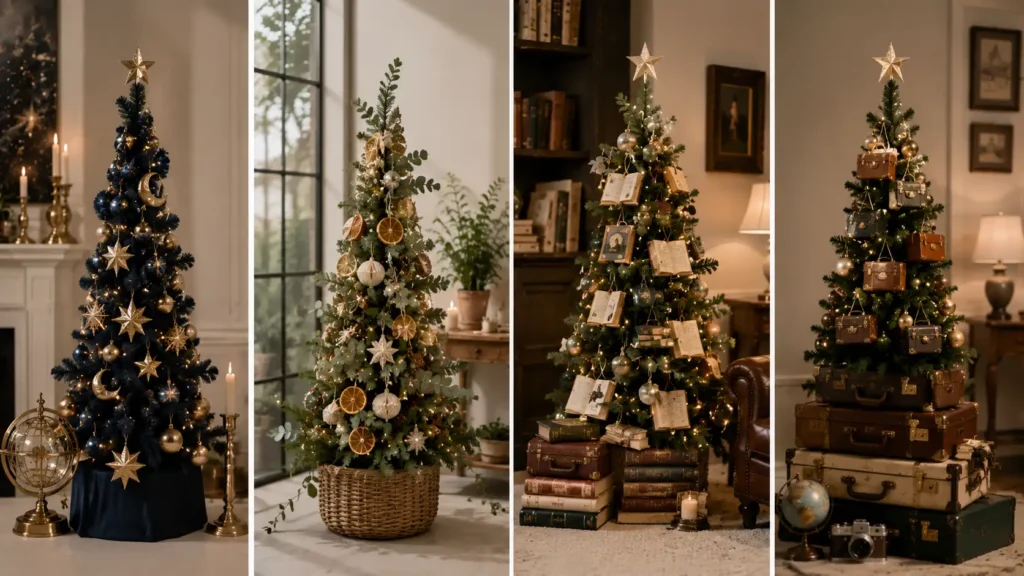
What Are Some Truly Unique Christmas Tree Ideas?
If you want the fast version, here are ten concepts that consistently produce memorable trees:
| Idea | The Concept | Palette | Difficulty | Rough Budget |
|---|---|---|---|---|
| Floating ornament tree | Clear ornaments and invisible thread create suspended, weightless clusters | Clear, silver, ice blue | Medium | Low to medium |
| Book lover’s tree | Paper ornaments, folded pages, miniature books, sepia tones | Cream, kraft, brass | Easy | Low |
| Vintage travel tree | Luggage tags, maps, globes, postcards from real trips | Tan, brass, faded blue | Medium | Low |
| Botanical tree | Dried florals, eucalyptus, preserved greenery, terracotta | Sage, cream, rust | Medium | Medium |
| Celestial tree | Moons, stars, constellations, brass and deep navy | Navy, gold, ivory | Easy | Medium |
| Monochrome tree | One color in many finishes and textures | Any single hue | Easy | Low to medium |
| Ombre color tree | Color graduating from deep at the base to pale at the top | Any gradient | Medium | Medium |
| Memory tree | Only ornaments with a personal story attached | Whatever you own | Easy | Free |
| Cozy reading corner tree | Small tree styled as part of a reading nook with warm lighting | Amber, cream, wood | Easy | Low |
| Nature-inspired tree | Pinecones, dried citrus, bare branches, wood, twine | Brown, cream, green | Easy | Very low |
Notice how many of these cost very little. Originality in holiday decorating comes from having an idea, not from having a bigger budget.
What Makes a Christmas Tree Feel Unique?
Before the ideas, it helps to understand what actually creates the effect. Six things separate a memorable tree from a generic one.
Personal storytelling. The strongest trees say something specific about the people who live there. A tree covered in ornaments from places you have actually been will always beat a tree covered in ornaments that were on sale.
A cohesive color palette. This is the single biggest differentiator, and it is free. Two or three colors, held consistently, will make an inexpensive tree look designed. Eight colors will make an expensive tree look accidental.
A clear theme. A theme gives you a decision-making rule. When you are standing in a store wondering whether to buy something, the theme answers the question for you.
Layered decorating. Depth comes from placing decorations at multiple distances from the trunk, not just on the branch tips. Most amateur trees are decorated only on their outer shell.
Handmade elements. Even two or three handmade pieces change the character of a tree. They introduce imperfection, which reads as warmth.
Meaningful ornaments. The ones that came from a grandmother, a first apartment, a child’s kindergarten class. These are the pieces guests actually ask about.
Here is the useful conclusion: none of these six things requires money. Originality comes from thoughtful design, not from expensive decorations. A tree with forty dollars of ornaments and a clear vision beats a tree with four hundred dollars of ornaments and no plan, every single time.
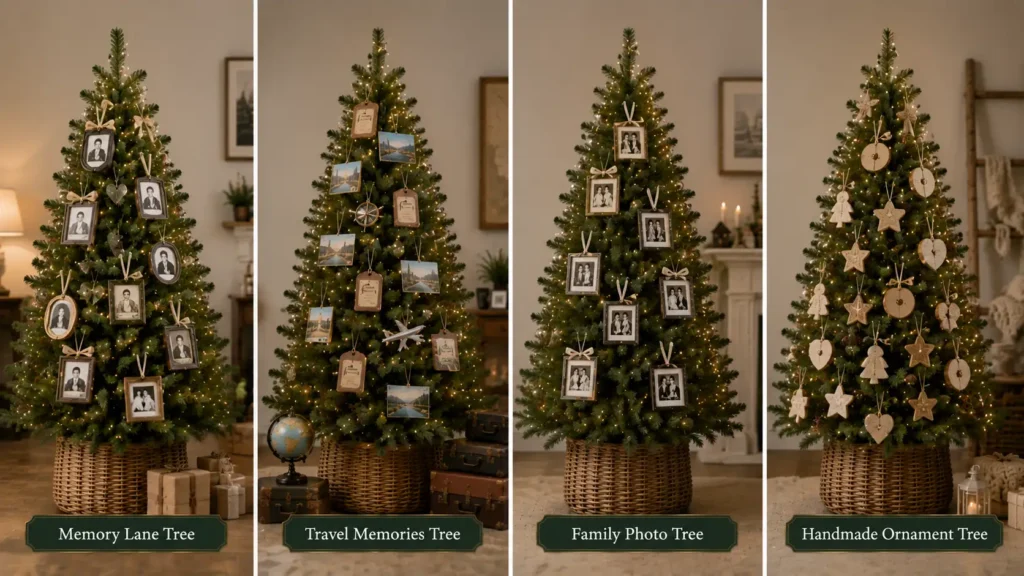
25+ Unique Christmas Tree Ideas
Each idea below includes why it works, the palette that suits it, what to put on it, which homes it fits, how hard it is, and roughly what it costs.
1. Memory Lane Tree
Why it works: This is the most emotionally powerful tree on the list and the cheapest. The rule is simple: nothing goes on the tree unless it has a story. The ornament from your honeymoon. The one your child made from a pinecone. The one that came from a house you no longer live in.
Palette: Whatever you already own. The lack of color coordination becomes part of the character, not a flaw.
Decorations: Existing sentimental ornaments, small framed photos, handwritten tags describing each ornament’s origin, ticket stubs in clear glass baubles.
Best for: Family homes, multigenerational households, anyone who has been collecting for years.
Difficulty: Easy Budget: Free to very low
Styling tip: Unify the chaos with lighting and ribbon. Dense warm white lights and a single ribbon color pull mismatched ornaments together surprisingly well.
2. Vintage Suitcase Tree
Why it works: Instead of a tree skirt, the tree sits on or among stacked vintage suitcases. It solves two problems at once: it raises a small tree to a better height, and it turns the base into part of the design rather than an afterthought.
Palette: Tan, cognac leather, brass, cream, faded navy.
Decorations: Leather luggage tags, small brass compasses, rolled maps tied with twine, sepia photographs, amber glass baubles.
Best for: Entryways, studies, and small apartments where a tabletop tree needs elevation.
Difficulty: Easy Budget: Low to medium, depending on how you source the suitcases
Styling tip: Three suitcases in graduated sizes, largest at the bottom. Thrift stores and estate sales are the obvious source.
3. Botanical Greenhouse Tree
Why it works: It brings a conservatory feeling indoors. Dried and preserved botanicals have far more textural interest than glass ornaments, and the palette is naturally sophisticated.
Palette: Sage, eucalyptus green, cream, terracotta, dusty rose.
Decorations: Preserved eucalyptus stems, dried hydrangea heads, pampas fronds, small terracotta pots hung as ornaments, bundles of lavender, dried ferns, brass plant markers.
Best for: Plant-filled homes, modern interiors, bohemian spaces.
Difficulty: Medium Budget: Medium
Styling tip: Tuck the botanicals in at varied depths so they look like they are growing from the tree rather than sitting on it. Skip glitter entirely; this look depends on matte natural texture.
4. Literary Book Lover Tree
Why it works: Paper is one of the most underrated decorating materials. It is inexpensive, it takes light beautifully, and it introduces a soft matte texture among reflective ornaments.
Palette: Cream, kraft brown, sepia, aged gold, black.
Decorations: Folded paper stars, miniature books strung as ornaments, paper rosettes, small brass bookmarks, typewriter key ornaments, ribbon printed with text, a tree topper made from a folded book star.
Best for: Studies, libraries, reading nooks, apartments.
Difficulty: Easy Budget: Very low
Styling tip: Use damaged or discarded books rather than cutting up anything you love. Charity shops sell them for almost nothing.
5. Celestial Moon and Stars Tree
Why it works: Deep navy against warm brass is one of the most striking color combinations in holiday decorating, and it is far less common than gold-on-white or red-on-green.
Palette: Navy, midnight blue, warm brass, ivory, a touch of pale gold.
Decorations: Brass crescent moons, star garlands, constellation discs, mirrored ornaments, sun and moon faces, navy velvet ribbon.
Best for: Modern homes, dark-walled rooms, anywhere with a moody interior.
Difficulty: Easy Budget: Medium
Styling tip: Warm white lights only. Cool white kills the warmth of the brass and makes navy look flat and grey.
6. Winter Forest Tree
Why it works: Rather than decorating a tree to look festive, you decorate it to look like it is still in the woods. Restraint is the entire technique.
Palette: Deep green, brown, grey, white, silver birch.
Decorations: Pinecones of varied sizes, small carved wooden animals, birch bark stars, moss accents, antler shapes, feathers, snow-dusted branches.
Best for: Cabins, rustic homes, houses with wood beams or stone.
Difficulty: Easy Budget: Low, especially if you forage the pinecones
Styling tip: Bake foraged pinecones at low heat for a couple of hours to remove insects and open the scales before bringing them anywhere near your tree.
7. Cottagecore Christmas Tree
Why it works: Cottagecore has stayed popular because it feels handmade and unhurried, which is the opposite of most retail holiday decorating.
Palette: Soft cream, butter yellow, dusty rose, sage, faded red gingham.
Decorations: Crocheted snowflakes, gingham fabric bows, dried flower posies, small ceramic mushrooms, embroidered fabric ornaments, wooden beads, popcorn and cranberry garland.
Best for: Cottages, older homes, anyone with a soft traditional interior.
Difficulty: Medium Budget: Low
Styling tip: Fabric bows in mismatched patterns work here in a way they would not on a formal tree. The slight inconsistency is the point.
8. Coffee Lover Tree
Why it works: Highly specific themes create genuine surprise, and they are usually easy to shop for because the props are things you already use.
Palette: Espresso brown, cream, copper, warm caramel.
Decorations: Miniature ceramic mugs, burlap coffee sack ribbon, coffee bean filled clear baubles, small wooden spoons, copper accents, cinnamon stick bundles.
Best for: Kitchens, breakfast nooks, small trees in a coffee corner.
Difficulty: Easy Budget: Low
Styling tip: This works best as a small secondary tree rather than the main living room tree. A 3 to 5 foot tabletop tree in the kitchen is the perfect scale.
9. Music Theme Tree
Why it works: Musical shapes have a natural rhythm and repetition that reads well from a distance, which is not true of every themed ornament.
Palette: Black, cream, brass, aged gold.
Decorations: Brass instrument miniatures, sheet music rosettes, treble clef ornaments, vinyl record discs, ribbon printed with staves, small tuning forks.
Best for: Music rooms, homes with instruments on display, black-and-brass interiors.
Difficulty: Medium Budget: Medium
Styling tip: Roll sheet music into cones or fold it into fans rather than hanging it flat. Flat paper turns and disappears edge-on.
10. Black and Gold Modern Tree
Why it works: Black on a Christmas tree is still rare enough to feel bold, and it makes gold read as far richer than gold on white does.
Palette: Matte black, glossy black, champagne gold, warm brass.
Decorations: Matte black baubles, gold geometric shapes, black velvet ribbon, brass stars, smoked glass ornaments.
Best for: Modern and contemporary interiors, dark accent walls, formal spaces.
Difficulty: Medium Budget: Medium
Styling tip: Black absorbs light, so increase your light count by roughly 50 percent over what you would use on a lighter tree. Under-lit black trees look like a void.
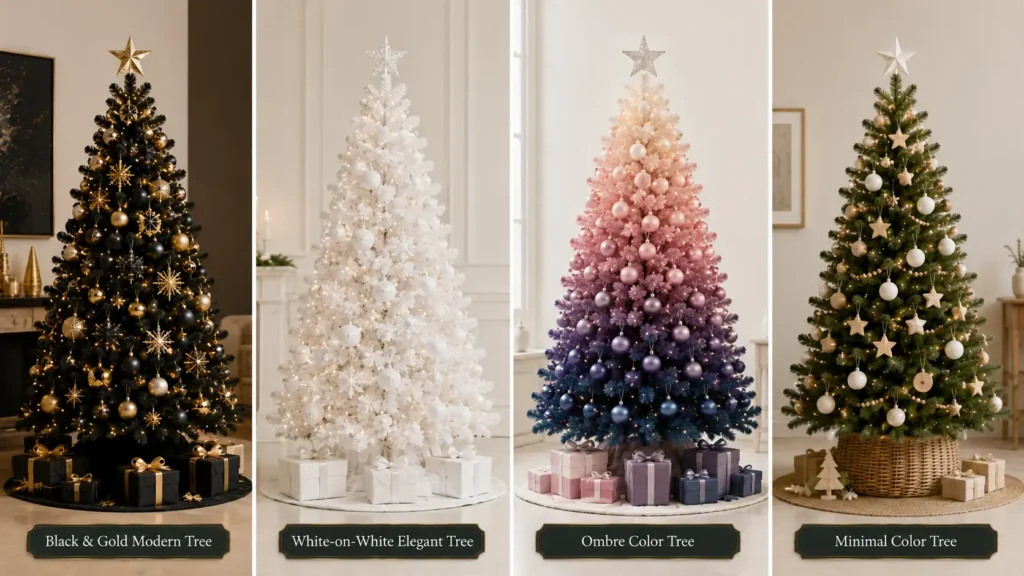
11. Copper and Terracotta Tree
Why it works: Warm earth tones are underused in holiday decorating and they suit the warm neutral interiors that have dominated home design for years.
Palette: Copper, terracotta, rust, cream, warm sand.
Decorations: Copper baubles in mixed finishes, terracotta clay ornaments, rust velvet ribbon, dried orange slices, natural raffia, clay bead garland.
Best for: Warm-toned interiors, homes with leather or wood furniture, Mediterranean styling.
Difficulty: Easy Budget: Low to medium
Styling tip: Air-dry clay ornaments are extremely cheap to make and they read as expensive artisan pieces once they are on the tree.
12. Scandinavian Nature Tree
Why it works: Pale wood against white with almost no color creates calm rather than excitement, which is exactly what many people want in December.
Palette: White, pale birch, oatmeal, soft grey.
Decorations: Unpainted wooden ornaments, straw stars, felt shapes, paper snowflakes, linen ribbon, clear glass, wooden bead garland.
Best for: Modern neutral homes, small apartments, minimalist interiors.
Difficulty: Easy Budget: Low
Styling tip: Swap the tree skirt for a woven basket or a length of loose linen. The base is where this style most often falls apart.
13. White-on-White Elegant Tree
Why it works: Removing color forces the eye to notice texture instead, which is far more sophisticated than most people expect.
Palette: Pure white, ivory, cream, pearl, frost.
Decorations: Matte white baubles, pearl finishes, white feathers, frosted glass, white velvet ribbon, mercury glass in silver.
Best for: Formal living rooms, flocked trees, contemporary interiors.
Difficulty: Medium Budget: Medium
Styling tip: You need at least four distinct white finishes for this to work. Matte, glossy, pearlescent, and frosted. All-glossy white looks like plastic.
14. Rainbow Ornament Tree
Why it works: Done deliberately, with the colors organized rather than scattered, a rainbow tree is joyful instead of chaotic. Organization is what separates it from a mess.
Palette: Full spectrum, arranged in bands or spirals.
Decorations: Solid colored baubles in a consistent finish, colored ribbon, felt shapes.
Best for: Children’s rooms, playful interiors, family trees.
Difficulty: Medium Budget: Medium
Styling tip: Keep the finish consistent across every color. Mixed matte, glitter, and glossy across a rainbow palette becomes visual noise.
15. Ombre Color Tree
Why it works: The gradient gives the eye a path to follow from base to tip, which makes a tree look taller and more intentional than random distribution ever will.
Palette: Any single hue graduating from deep to pale. Deep forest to mint, burgundy to blush, and navy to ice blue all work well.
Decorations: Baubles in four or five shades of one color, arranged in horizontal bands with the darkest at the bottom.
Best for: Modern interiors, slim trees, anywhere you want a strong graphic effect.
Difficulty: Medium Budget: Medium
Styling tip: Blend the transitions between bands rather than making hard lines. Mix the two adjacent shades where they meet.
16. Travel Memories Tree
Why it works: Similar to the memory tree, but with a geographic organizing principle that keeps it visually coherent.
Palette: Kraft, brass, faded blue, aged white.
Decorations: Ornaments collected on actual trips, small flags, map paper rosettes, luggage tag labels, foreign coins in clear baubles, postcards.
Best for: Frequent travelers, anyone who has been collecting ornaments from destinations.
Difficulty: Easy Budget: Free to low
Styling tip: Add a small handwritten tag with the year and place to each ornament. It turns the tree into a conversation piece rather than a display.
17. Handmade Ornament Tree
Why it works: A fully handmade tree has a warmth that manufactured decorations cannot replicate, and it becomes an annual tradition rather than a one-time purchase.
Palette: Whatever materials you choose, but keep it to three colors.
Decorations: Salt dough shapes, air-dry clay discs, felt cutouts, folded paper stars, wooden slice ornaments, embroidery hoop scenes, pressed flower baubles.
Best for: Families with children, crafters, anyone on a tight budget.
Difficulty: Medium, but forgiving Budget: Very low
Styling tip: Add a few purchased glass ornaments among the handmade pieces. The contrast makes the handmade items look intentional rather than like a compromise.
18. Family Photo Tree
Why it works: Nothing else generates the same reaction from visitors. It is genuinely personal in a way no purchased theme can be.
Palette: Whatever frames you use. Brass, wood, or white all work.
Decorations: Small photo frames, photos printed in black and white for consistency, ribbon-hung prints, clear baubles with rolled photos inside.
Best for: Family homes, entryway trees, secondary trees.
Difficulty: Easy Budget: Low
Styling tip: Print everything in black and white or all in sepia. Mixed color photos from different decades fight each other visually.
19. Cozy Cabin Tree
Why it works: It reads as warm and inhabited rather than styled, which is exactly the feeling most people want in the darkest month of the year.
Palette: Deep red, forest green, cognac, cream, black buffalo check.
Decorations: Plaid ribbon, small wool blankets tucked at the base, wooden skis and sleds in miniature, leather straps, brass bells, pinecones.
Best for: Homes with fireplaces, wood-heavy interiors, mountain and rural properties.
Difficulty: Easy Budget: Low to medium
Styling tip: Use an actual folded wool blanket instead of a tree skirt. It costs about the same and looks considerably better.
20. Snowy Woodland Tree
Why it works: A flocked tree with woodland decorations creates immediate atmosphere with fewer ornaments than a green tree would require.
Palette: White, grey, pale wood, silver, icy blue.
Decorations: Frosted pinecones, white ceramic animals, silver birch discs, glass icicles, white feathers, mercury glass.
Best for: Flocked trees, cool-toned interiors, homes in cold climates.
Difficulty: Easy Budget: Medium
Styling tip: Flocking does half the decorating for you. Use roughly 30 percent fewer ornaments than the standard count for your tree height.
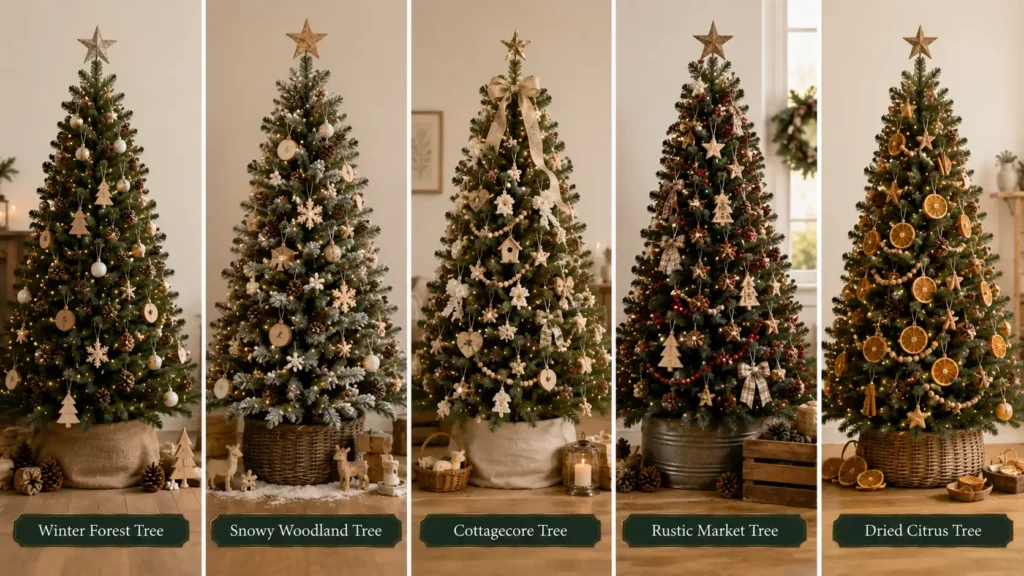
21. Minimal Color Tree
Why it works: Strict restriction produces sophistication. Two colors, nothing else, no exceptions.
Palette: Pick exactly two. Green and brass, black and white, and navy and cream all work.
Decorations: Baubles in the two colors only, varied in size and finish but never in hue.
Best for: Modern interiors, slim and pencil trees, anyone whose previous trees felt cluttered.
Difficulty: Easy Budget: Low
Styling tip: The discipline is the whole point. If you find yourself wanting to add a third color, add a third texture instead.
22. Rustic Market Tree
Why it works: It looks like a European Christmas market stall, with the abundance and warmth that suggests, rather than a curated retail display.
Palette: Kraft, deep red, warm green, brass, natural twine.
Decorations: Miniature wooden crates, dried fruit garlands, gingerbread-look ornaments, brass bells, tiny paper cones filled with faux treats, hand-lettered wooden signs.
Best for: Kitchens, dining rooms, homes with a traditional feel.
Difficulty: Medium Budget: Low to medium
Styling tip: Abundance is the aesthetic here. This is one of the few themes where more decorations genuinely improve the result.
23. Glass Ornament Gallery Tree
Why it works: Treating a small number of beautiful glass pieces as a collection rather than a covering turns the tree into a display case.
Palette: Clear, amber, smoke, pale green, with brass hardware.
Decorations: A curated set of 25 to 40 quality glass ornaments, generously spaced, with strong interior lighting behind them.
Best for: Slim trees, formal rooms, collectors.
Difficulty: Medium Budget: Medium to high
Styling tip: Push lights deep behind each glass piece. Glass ornaments only come alive when they are lit from behind rather than in front.
24. Dried Citrus Christmas Tree
Why it works: Dried orange slices glow when backlit, they smell wonderful for weeks, and they cost almost nothing. Very few decorations do all three.
Palette: Amber, orange, cinnamon brown, cream, deep green.
Decorations: Dried orange and grapefruit slices, cinnamon stick bundles tied with twine, star anise clusters, whole dried limes, kraft paper tags.
Best for: Kitchens, warm interiors, anyone who wants scent as part of the decorating.
Difficulty: Easy Budget: Very low
Styling tip: Slice citrus thin, roughly a quarter inch, and dry in a low oven for three to four hours. Hang them where lights sit directly behind them so the light passes through.
25. Sustainable Upcycled Tree
Why it works: It solves a real problem, costs nothing, and produces a tree nobody else has.
Palette: Whatever your materials give you, unified with spray paint if needed.
Decorations: Repainted old ornaments, fabric scrap bows, cardboard cutouts, wine cork stars, broken jewelry, sheet music, tin can stars, thrift store finds sprayed in a single color.
Best for: Anyone on a tight budget, environmentally minded households, renters.
Difficulty: Medium Budget: Nearly free
Styling tip: Matte spray paint in one color is the great equalizer. Twenty mismatched thrifted ornaments sprayed the same shade become a coordinated set.
26. Floating Ornament Tree
Why it works: Clear ornaments hung on invisible thread at varied depths appear to hover inside the tree. It is the most unusual effect on this list and almost nobody does it.
Palette: Clear, silver, ice white, pale blue.
Decorations: Clear glass and acrylic baubles, fishing line or clear thread, crystal drops, glass icicles.
Best for: Slim trees, modern interiors, anyone who wants a genuinely unusual effect.
Difficulty: Hard Budget: Medium
Styling tip: Hang from branches above and behind rather than directly on the branch the ornament sits near. The suspension distance is what creates the floating illusion.
27. Cozy Reading Corner Tree
Why it works: Instead of treating the tree as an isolated object, it becomes part of a whole styled vignette with a chair, a lamp, a blanket, and books.
Palette: Amber, cream, warm wood, soft green.
Decorations: Warm fairy lights, paper ornaments, small brass pieces, a wool throw at the base, stacked books, a candle nearby.
Best for: Small apartments, corners, bedrooms, home offices.
Difficulty: Easy Budget: Low
Styling tip: A 4 to 5 foot tree beside a reading chair with warm lighting creates more atmosphere than a full tree in the middle of a room.
Theme Selection at a Glance
| Theme | Best Home Style | Difficulty | Budget | Standout Feature |
|---|---|---|---|---|
| Memory Lane | Family homes | Easy | Free | Emotional impact |
| Vintage Suitcase | Entryways, studies | Easy | Low | Elevated base |
| Botanical Greenhouse | Modern, bohemian | Medium | Medium | Texture depth |
| Literary | Studies, apartments | Easy | Very low | Cheapest sophisticated look |
| Celestial | Dark, modern rooms | Easy | Medium | Unusual color pairing |
| Winter Forest | Cabins, rustic | Easy | Low | Foraged materials |
| Cottagecore | Cottages, older homes | Medium | Low | Handmade warmth |
| Black and Gold | Contemporary, formal | Medium | Medium | Boldest palette |
| Copper and Terracotta | Warm neutral homes | Easy | Low to medium | Earth tone rarity |
| White-on-White | Formal, flocked trees | Medium | Medium | Pure texture play |
| Ombre | Modern, slim trees | Medium | Medium | Strong graphic effect |
| Handmade | Families, crafters | Medium | Very low | Annual tradition |
| Dried Citrus | Kitchens | Easy | Very low | Scent plus glow |
| Upcycled | Renters, tight budgets | Medium | Nearly free | Zero cost |
| Floating Ornament | Modern, slim trees | Hard | Medium | Most unusual effect |
DIY Decorations That Make Any Tree Unique
You do not need to commit to a fully handmade tree to benefit from handmade pieces. Three or four DIY ornaments among purchased ones change the whole character.
Salt dough shapes. Flour, salt, and water. Cut into shapes, bake at low heat, then leave natural or paint in one color. Extremely cheap and surprisingly durable if kept dry.
Air-dry clay discs. Roll thin, cut circles, press in botanicals or a texture, and let dry. These read as expensive artisan ornaments and cost pennies each.
Paper rosettes and folded stars. Accordion-fold paper strips and join the ends. Kraft paper, sheet music, book pages, and wallpaper offcuts all work.
Wooden slice ornaments. Cut a branch into quarter-inch discs, sand lightly, drill a hole, and add twine. Leave natural or wood-burn a design.
Dried fruit. Orange, grapefruit, apple, and lime all dry well. Thin slices, low oven, several hours. They glow when backlit and last for years if stored dry.
Fabric bows. A roll of wired ribbon makes many bows for the cost of a few pre-made ones, and fabric scraps make bows for free. Bows are one of the strongest decorating trends and among the cheapest to produce.
Pressed flowers in clear baubles. Open a clear ornament, drop in pressed flowers or dried petals, and close. Takes under a minute each.
Cinnamon and star anise bundles. Tie with twine. Free scent, natural texture, and they cost very little.
Common Mistake
Making a large batch of one identical handmade ornament. Vary the size and shape within the same technique instead. Repetition of a technique reads as intentional. Repetition of an exact item reads as filler.
How Lighting Changes the Entire Look
Every theme in this article depends on lighting more than it depends on ornaments. This is the section most people skim and it is the one that matters most.
Warm white LEDs are the default. The 2700K to 3000K range flatters wood, brass, cream, terracotta, and every natural material. It makes a modest tree look expensive.
Layered lighting creates depth. Instead of one string on the outside, run lights at three depths: close to the trunk, along the middle of the branches, and out at the tips. Light falling off gradually from the center outward is what makes a tree look three-dimensional rather than flat.
Fairy lights add a second texture. Thin copper wire fairy lights woven among your main string create tiny points of light that read differently from standard bulbs. They are especially effective on botanical and glass-gallery trees.
Twinkle effects should be used sparingly. A small proportion of twinkling lights adds life. A whole tree of them is distracting and gets tiring by week two.
Spot lighting from outside the tree. A single warm floor lamp or uplight aimed at the tree from a low angle adds dimension that internal lights cannot produce, and it makes matte textures like velvet, wood, and dried botanicals visible in a way they otherwise are not.
The fundamentals of wattage, wrapping technique, and safety are covered in the complete Christmas tree lighting guide. If you are unsure which color temperature suits your palette, the direct comparison of warm white vs cool white lights will settle it.
Lighting Density by Tree Height
| Tree Height | Standard (100 per ft) | Rich look (150 to 200 per ft) | Minimal (50 to 75 per ft) |
|---|---|---|---|
| 4 ft | 400 | 600 to 800 | 200 to 300 |
| 6 ft | 600 | 900 to 1,200 | 300 to 450 |
| 7.5 ft | 750 | 1,125 to 1,500 | 375 to 560 |
| 9 ft | 900 | 1,350 to 1,800 | 450 to 675 |
| 10 ft | 1,000 | 1,500 to 2,000 | 500 to 750 |
For a fuller explanation of these benchmarks, see how many lights you need for a Christmas tree, and run your exact tree measurements through the Christmas tree light calculator before you shop.
Most People Should Do This
Buy more lights than you think you need and put the surplus deep inside the tree near the trunk. It is the least expensive upgrade in holiday decorating and the one that changes the most.
Decorating Techniques That Make Any Tree Look Designer-Made
A great idea executed poorly still looks amateur. These techniques apply to every theme above.
Fluff first, always. An artificial tree straight from the box has flat, compressed branches with visible gaps. Separating and angling every branch tip takes 30 to 120 minutes and it is the single most important step. No amount of decoration fixes a badly fluffed tree. The full method is in how to fluff an artificial Christmas tree.
Layer ribbon vertically. Wide wired ribbon, at least 2.5 inches, tucked in and out down the tree in four to six cascades. Vertical ribbon adds height and fullness in a way horizontal garland does not.
Use picks and sprays as filler. Berry stems, glittered branches, eucalyptus, and magnolia leaves fill gaps and add texture between ornaments. They are usually cheaper per unit of visual coverage than ornaments.
Place ornaments at three depths. Small filler pieces near the trunk, standard ornaments mid-branch, statement pieces slightly deeper than the tips. Decorating only the outer shell is the most common reason trees look flat.
Cluster in threes. Group ornaments in odd-numbered clusters instead of spacing them evenly. Even spacing looks mechanical; clusters look designed.
Check balance from a distance. Step back ten feet every fifteen minutes. Problems that are invisible up close are obvious from across the room.
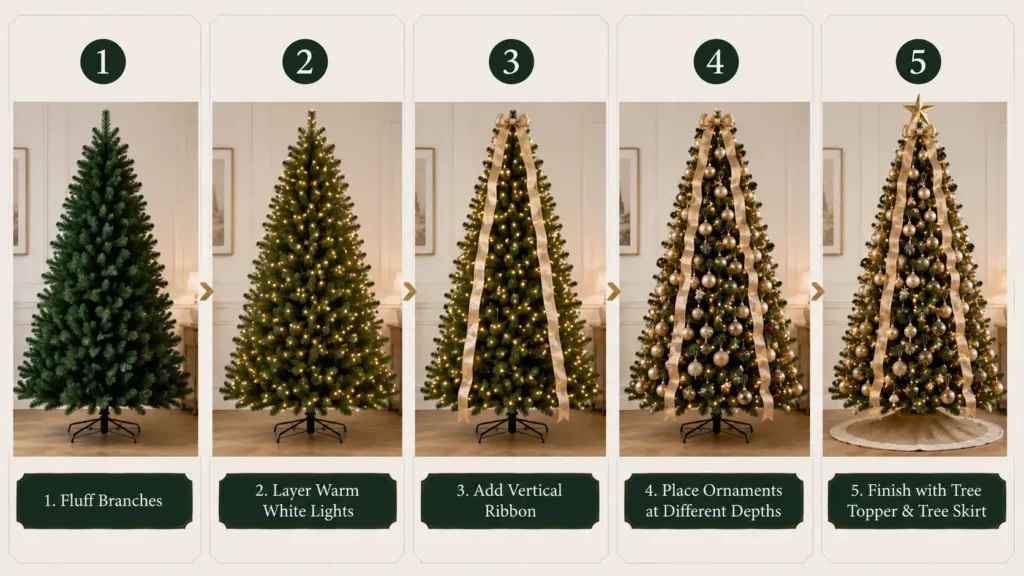
The complete approach to building density and eliminating gaps is covered in how to decorate a Christmas tree to look full.
The Correct Order
- Assemble and fluff
- Lights, wrapped trunk to tip
- Ribbon cascades
- Picks and florals
- Statement ornaments, placed deep
- Standard ornaments in clusters
- Filler ornaments in remaining gaps
- Tree topper
- Tree skirt or basket
Working out of order means undoing work. Ribbon added last knocks ornaments off. Lights added after ornaments is nearly impossible to do well.
Which Tree Style Works Best?
The tree itself influences which ideas will succeed.
| Tree Type | Best Themes | Why | Watch Out For |
|---|---|---|---|
| Flocked | Snowy Woodland, White-on-White, Winter Forest, Celestial | Built-in texture means fewer ornaments needed | Shedding, messier storage |
| Pre-lit full | Black and Gold, Rustic Market, Memory Lane, Glass Gallery | Even lighting and dense branches hold heavy ornaments | Fixed light color, harder to repair |
| Slim | Ombre, Floating Ornament, Minimal Color, Scandinavian | Vertical emphasis suits graphic and restrained themes | Fewer ornaments fit |
| Pencil | Literary, Minimal Color, Coffee Lover | Fits almost anywhere, forces discipline | Very limited capacity |
| Tabletop | Coffee Lover, Dried Citrus, Vintage Suitcase, Family Photo | Perfect for a focused single-theme display | Needs elevation to read properly |
Flocked trees are ideal for anything with a winter or neutral palette. The snow effect does a lot of the work, which means you can finish the tree faster. The trade-offs, including shedding and how to judge flocking quality before buying, are covered in the guide to flocked Christmas trees.
Pre-lit trees save 30 to 90 minutes at setup and deliver more consistent lighting than most people achieve by hand. The catch is reduced flexibility and harder repairs, both discussed in the ultimate guide to pre-lit Christmas trees.
Slim and pencil trees deserve more consideration than they usually get. A slim tree is typically 30 to 45 inches wide against 50 to 70 inches for a traditional tree, and it forces the kind of restraint that makes themed trees succeed. The differences between the two profiles are laid out in the comparison of slim and pencil Christmas trees.
Tabletop trees are the best vehicle for a highly specific theme, because a small tree with one clear idea always beats a large tree with a diluted one. The options are covered in the roundup of tabletop Christmas trees.
Best for Most People
A quality pre-lit tree in warm white. Lighting consistency solves the most common failure, and the time saved goes into styling instead of untangling.
Decorating for Small Spaces
Small homes are not a limitation on creativity. They often produce better trees, because constraints force clearer decisions.
Apartments. With a standard 8 foot ceiling, a 6 to 7.5 foot slim tree is the right size. Leave 6 to 12 inches between the topper and the ceiling. Height creates more impact in a small room than width does, which is the opposite of what most people assume.
Studios. A tabletop tree on a console, sideboard, or stack of books frees the floor entirely and puts the tree at eye level where it does more work.
Corners. Half trees and corner trees sit flush against a wall and use roughly half the floor space of a full tree. They look complete from the only angle anyone sees them.
Entryways. A pencil tree beside a door creates a strong first impression while using almost no space. Themes with vertical rhythm, like ombre or minimal color, are especially effective here.
Small Space Sizing
| Space | Recommended Tree |
|---|---|
| Studio apartment | 4 to 7 ft slim tree |
| Small apartment | 6 to 7.5 ft slim tree |
| Tiny home | Tabletop or slim tree |
| Dorm room | 2 to 4 ft tabletop tree |
| Home office | 3 to 5 ft tabletop tree |
The full breakdown of layouts, placement, and sizing is in the guide to small-space and apartment Christmas trees.
Planning Your Decorations
Most decorating disappointment traces back to buying before planning. People buy ornaments that do not work together, then buy more trying to fix it, and end up with an overcrowded tree and a storage box of unused decorations.
Fifteen minutes of planning prevents all of it:
- Measure the ceiling and subtract 6 to 12 inches for topper clearance
- Choose the tree height from that number
- Pick your theme and lock in two or three colors
- Calculate lights at 100 per foot minimum, more for dark palettes
- Calculate ornaments using the benchmarks below
- Calculate ribbon at roughly 30 to 40 feet for a 7.5 foot tree
- Buy extra lights only, never extra ornaments
Ornament Benchmarks
| Tree Height | Ornament Range |
|---|---|
| 4 ft | 25 to 40 |
| 6 ft | 50 to 75 |
| 7.5 ft | 75 to 100 |
| 9 ft | 100 to 150 |
| 10 ft | 150 to 200 |
Most sparse-looking trees have too few ornaments rather than the wrong ornaments, so count before you conclude the problem is styling. Work out your full decoration list with the Christmas tree decoration calculator, or get a precise ornament count for your specific tree with the Christmas tree ornament calculator.
Which 2026 Trends Are Worth Trying?
Social platforms have made decorating techniques visible in a way they never were before, which is genuinely useful. Watching someone build a tree from bare branches to finished display teaches sequence, and sequence is most of what separates a good tree from an average one.
The techniques worth borrowing from current trends are the durable ones: layered warm white lighting, ribbon cascading in place of garland, a small number of oversized statement ornaments, and tight palette discipline. All four work with every theme in this article and none of them will look dated in five years.
What is worth ignoring is the shopping list. A trending tree that depends on a specific ornament set from a specific season is a tree you cannot rebuild next year. A full breakdown of what is currently popular and which ideas have staying power is covered in the guide to viral Christmas tree trends.
The healthiest approach is to treat trends as vocabulary rather than instructions. Take the ribbon technique from one, the lighting density from another, and the palette from a third, then build something that fits your home and your existing ornaments. Copying a trend exactly produces a tree that looks like everyone else’s. Borrowing from several produces something that looks like yours.
Common Mistakes When Trying to Create a Unique Tree
| Mistake | Why It Fails | The Fix |
|---|---|---|
| Mixing too many themes | Competing ideas cancel each other out and read as clutter | One primary theme and one accent, maximum |
| Too many colors | Nothing dominates, so nothing looks intentional | Limit to two or three colors, add texture instead of hue |
| Ignoring lighting | Even a brilliant theme falls flat without depth of light | 100 lights per foot minimum, layered at three depths |
| Poor ornament spacing | Even spacing looks mechanical, random spacing looks careless | Cluster in threes, vary the depth |
| Overdecorating | Every surface covered means the eye has nowhere to rest | Follow the ornament benchmark, then stop |
| Forgetting the room | A tree that ignores its surroundings looks imported | Pull at least one color from the room into the tree |
| Decorating before fluffing | Gaps in the branch structure show through everything | Fluff completely first, budget up to two hours |
| Buying before planning | Produces mismatched decorations and wasted money | Fix the theme and palette first, shop second |
| All ornaments on the tips | Creates a hollow shell with no depth | Place roughly a third of ornaments deeper in the tree |
Expert Perspective
The most memorable Christmas trees are rarely the most expensive ones. They reflect the personalities, traditions, and creativity of the people decorating them.
Here is what a decade of looking at holiday displays makes obvious: a unique tree does not really require unusual ornaments. It requires a clear vision and thoughtful styling that feels authentic to the home. The floating ornament tree is technically the most unusual idea in this article, but the memory tree is almost always the one people find more moving, and it costs nothing.
If you are choosing between spending money on rare decorations and spending time on a good idea, choose the idea. A tightly held palette, generous warm lighting, and one honest theme will produce a better tree than any shopping trip. That is not a consolation for people without a budget. It is simply how good decorating works.
The other thing worth saying: your tree does not need to be unique to be good. If you love your traditional red and green tree with thirty years of accumulated ornaments, that tree is already telling a story, and it is a better story than most themed trees manage. Use these ideas where they genuinely appeal to you and leave the rest.
Final Verdict: What Makes a Christmas Tree Truly Unique?
Six things, in rough order of importance:
A personal theme. An organizing idea that means something to the people in the house, whether that is travel, books, family photos, or accumulated memory.
A cohesive color palette. Two or three colors held consistently. This is free and it does more than any purchase.
Quality lighting. Warm white, generous in quantity, layered at multiple depths. Nothing else changes a tree as much for as little.
Layered decorating. Ornaments and texture at three depths from the trunk outward, never just on the branch tips.
Creative storytelling. Handmade pieces, meaningful ornaments, small details that reward a closer look.
Meaningful decorations. The ones with history attached. These are what people remember and what makes a tree yours rather than a display.
Get those six right and the tree will be memorable whether you spent four hundred dollars or forty.
Frequently Asked Questions
What is a unique way to decorate a Christmas tree?
Pick a personal theme rather than a color scheme. A tree built around travel memories, books, family photographs, or dried natural materials will always feel more original than a tree built around a purchased ornament set, and it usually costs less.
How do I make my Christmas tree stand out?
Limit the palette to two or three colors, increase the light count well beyond what feels necessary, add wide wired ribbon in vertical cascades, and place a few oversized ornaments deep in the tree. Those four moves account for most of the visible difference between an ordinary tree and a memorable one.
What are the cheapest unique Christmas tree ideas?
The dried citrus tree, the literary paper tree, the memory tree, and the upcycled tree all cost very little or nothing. Dried orange slices, folded paper ornaments, foraged pinecones, and thrifted ornaments sprayed a single color produce distinctive results on almost no budget.
How many ornaments do I need for a themed Christmas tree?
Use 25 to 40 for a 4 foot tree, 50 to 75 for a 6 foot tree, 75 to 100 for a 7.5 foot tree, 100 to 150 for a 9 foot tree, and 150 to 200 for a 10 foot tree. Flocked and heavily ribboned trees can sit at the lower end of each range.
Can I mix two Christmas tree themes together?
One primary theme and one supporting accent works. Two full themes competing for attention does not. If you want variety, keep the theme and vary the texture instead, using matte, glossy, wood, and fabric within the same idea.
What color lights work best for themed trees?
Warm white in the 2700K to 3000K range suits nearly every theme in this guide, including neutral, natural, metallic, and dark palettes. Cool white is worth using only for deliberately icy winter themes, and it makes brass, wood, and terracotta look dull.
How do I make a small Christmas tree look impressive?
Elevate it. Place a tabletop tree on a console, a stack of books, or vintage suitcases so it sits closer to eye level. Then commit to a single tight theme, because small trees look best with one clear idea rather than a diluted version of a large tree.
What is the easiest unique Christmas tree to make?
The dried citrus tree or the memory tree. Both are easy, both cost almost nothing, and both produce a strong result without any special technique. The citrus tree needs a few hours of oven drying; the memory tree needs only the ornaments you already own.
Should I decorate my tree before or after fluffing?
Always fluff first. Fluffing takes 30 to 120 minutes on an artificial tree and it is the step that determines whether the finished tree looks full or gappy. Decorating a poorly fluffed tree wastes both the ornaments and the effort.
How do I choose a Christmas tree theme that fits my home?
Look at the colors already in the room and pull at least one of them into the tree. Warm neutral rooms suit copper, terracotta, and botanical themes. Modern dark interiors suit celestial and black-and-gold. Cottages and older homes suit cottagecore and rustic market styling.
Are handmade ornaments worth the time?
Yes, particularly a few of them mixed among purchased ornaments. Handmade pieces introduce imperfection and texture that manufactured decorations cannot, and they turn decorating into an annual tradition rather than a shopping task. Salt dough, air-dry clay, and folded paper are the easiest starting points.
Do I need to follow Christmas tree trends 2026 to have a good tree?
No. Borrow techniques from current trends, particularly layered lighting and ribbon cascading, because those improve any tree. Ignore trend-specific shopping lists, because they produce a tree you cannot rebuild next season and that looks like everyone else’s this one.
Conclusion
The best creative christmas tree ideas do not come from buying different things. They come from having an idea and then executing it with care.
Every concept in this guide, from the vintage suitcase base to the floating ornament effect to the dried citrus that glows and smells like December, works because it starts with a point of view. Some cost almost nothing. A few take a weekend. None of them require a designer’s budget.
The underlying principles matter more than any single theme. Fluff thoroughly. Light generously and warmly, layered at three depths. Hold your palette to two or three colors. Add texture through ribbon and natural materials. Place ornaments deep as well as on the tips. Plan before you shop so you do not overbuy. Those rules produce a beautiful tree regardless of which idea you choose, and they will still be true in ten years.
Then make it yours. Add the ornament your child made. Keep the one from a trip you took. Put in the handmade thing that is slightly crooked. A perfectly executed themed tree is impressive, but a tree that clearly belongs to a specific family in a specific home is the one people remember.
Take what appeals to you from this guide, leave the rest, and build a tree that looks like your house rather than a catalogue.