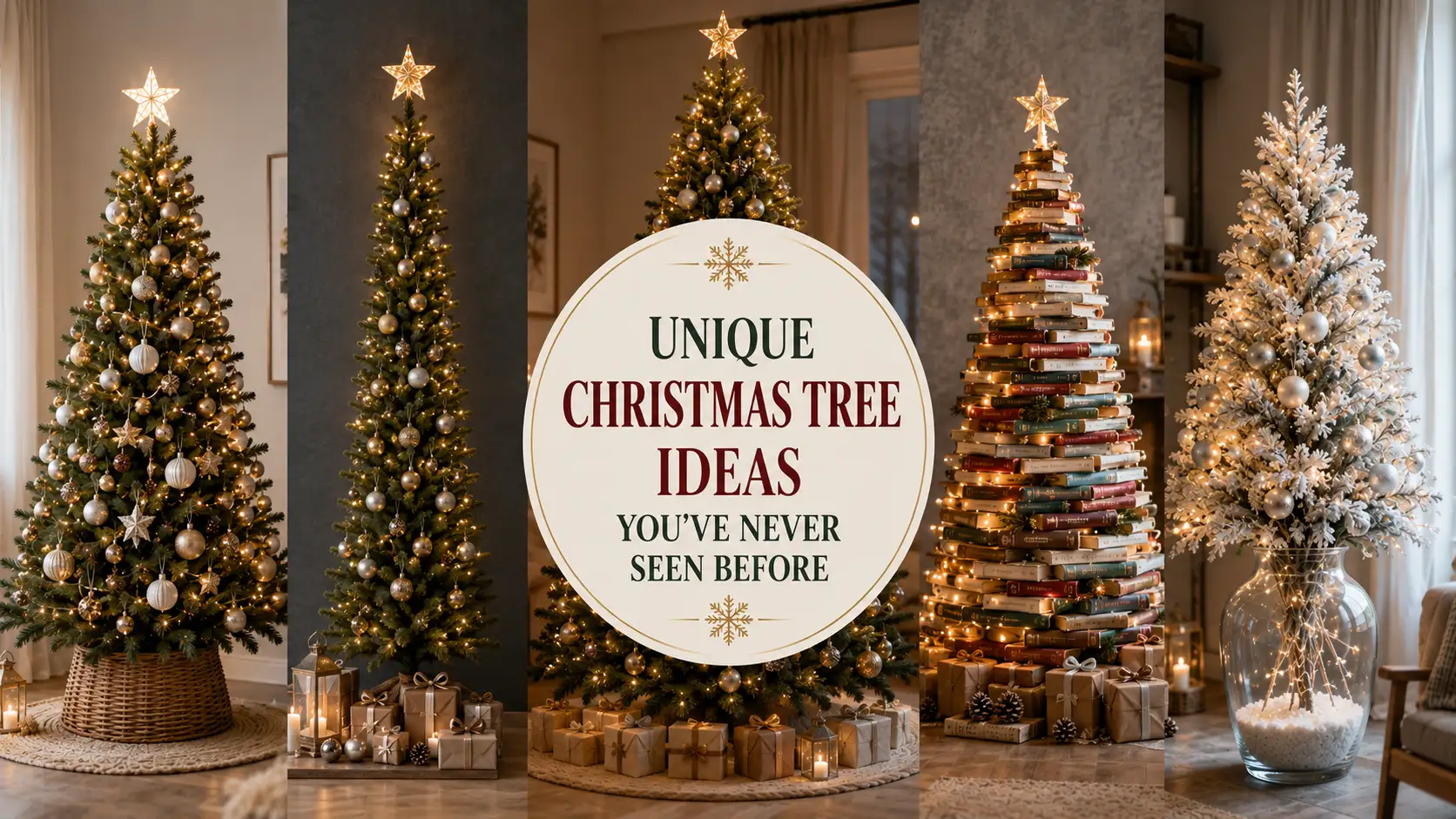


Scroll through holiday content for five minutes and you will notice something: the trees people are sharing in 2026 look different from the trees most of us grew up with. They are warmer, more layered, more textural, and far more deliberate. Ribbon has replaced garland. Lighting has become the star instead of the ornaments. And a surprising number of the most admired trees are slim trees squeezed into apartments rather than towering 9-footers in vaulted living rooms.
That shift did not happen by accident. Short-form video rewards transformation, and a Christmas tree is one of the most satisfying transformations you can film. Bare branches to finished centerpiece in thirty seconds. Because millions of people now watch that process instead of just seeing the finished result in a magazine, decorating techniques that used to belong to professional stylists have gone mainstream.
This guide breaks down the viral christmas tree trends shaping the 2026 season, why each one appeals to people, and exactly how to recreate the look at home without wasting money. You will get the trend list, the color palettes, the lighting formulas, the ornament counts, and the honest assessment of which trends are worth your time and which ones will look dated by next December. For more decorating guides, tree comparisons, and planning calculators, you can explore the full library at MyChristmasTrees.online.
What Are the Biggest Viral Christmas Tree Trends on TikTok in 2026?
The dominant christmas tree trends 2026 revolve around texture, warm lighting, and intentional restraint. Here is the fast version:
| Trend | The Look | Why It Appeals | Best For |
|---|---|---|---|
| Luxury hotel-inspired trees | Champagne gold, velvet ribbon, layered metallics | Looks expensive on camera and in person | Formal living rooms, entryways |
| Scandinavian minimalism | Neutral palette, wood, linen, soft glow | Calm, uncluttered, easy to live with | Modern and small homes |
| Modern minimalist trees | Fewer ornaments, deliberate negative space | Feels designed rather than decorated | Contemporary interiors |
| Ribbon layering | Wide ribbon cascading vertically through the tree | Instant fullness and movement | Any tree that looks sparse |
| Oversized ornaments | Large statement baubles anchoring the design | Creates scale and a boutique display feel | Full and traditional trees |
| Warm white lighting | 2700K to 3000K LED lights, layered in depth | Flattering, cozy, photographs beautifully | Every tree, without exception |
| Organic and nature-inspired decorating | Dried citrus, eucalyptus, pinecones, bare branches | Feels authentic and costs very little | Rustic and farmhouse homes |
| Bows | Oversized fabric bows used as ornaments | Soft, romantic, endlessly reusable | Traditional and cottage styles |
| Mixed textures | Matte, glass, velvet, wood, and metal together | Adds depth so the tree never looks flat | Designer-style trees |
| Flocked winter wonderland | Snow-dusted branches, tonal neutrals | Dramatic without needing many ornaments | Cabin and modern-neutral homes |
If you only take one thing from this article: fix the lighting first. Almost every tree that looks professional online is doing something specific with light, not with expensive ornaments.
Why Short-Form Video Reshaped Christmas Decorating
Holiday decorating trends used to travel slowly. A style would appear in a magazine, filter into retail displays the following year, and reach most homes the year after that. Video collapsed that timeline to weeks.
Three things about the format changed decorating behavior:
Transformations are visible. When you watch someone fluff a tree, add lights, then add ribbon, then add ornaments, you learn the sequence. Sequence is most of what separates an average tree from a great one, and it was previously invisible.
Technique became teachable. Ribbon cascading, ornament clustering, and light layering were once trade secrets. Now they are demonstrated repeatedly until they feel like common sense.
Real homes replaced showrooms. The trees that spread furthest are usually in normal rooms with normal ceilings and normal budgets, which makes them feel achievable rather than aspirational.
The result is a season where christmas tree aesthetic conversations are less about buying a specific ornament set and more about method. That is genuinely good news, because method is free.
Trend #1: Luxury Hotel-Inspired Christmas Trees
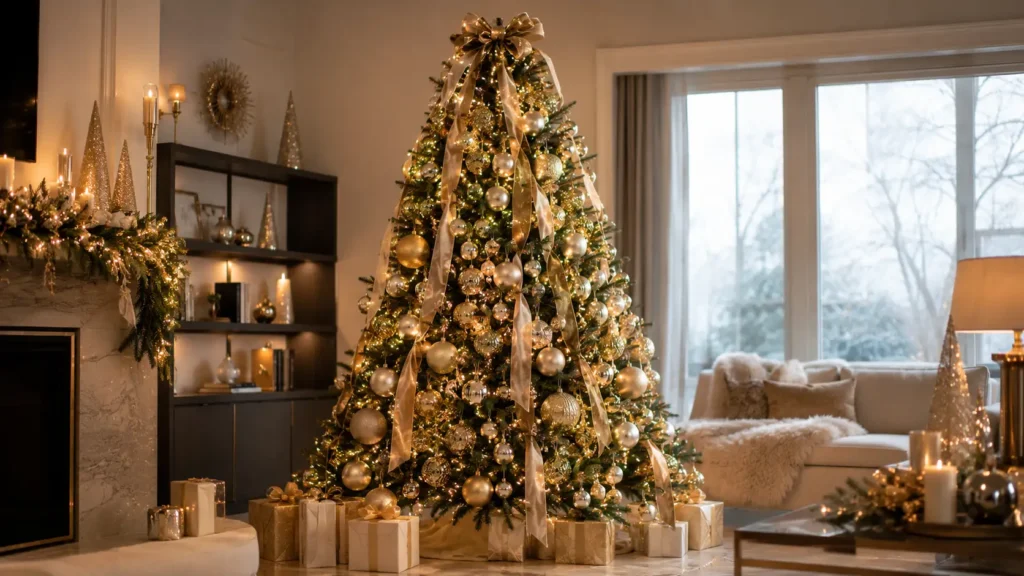
This is the tree you have seen in a grand lobby, and it is currently the most imitated look in holiday decorating. It relies on a tight, tonal palette and a lot of texture layered into a small color range.
The palette: champagne gold, warm brass, ivory, soft bronze, and a single deep accent such as burgundy or forest green. Note what is missing. There is no red-and-green primary color scheme, no multicolor lights, and no silver mixed randomly with gold.
The ornaments: three finishes minimum within the same color family. Matte gold, glossy gold, and glittered gold read as three distinct textures even though they are one color. That is the entire trick.
The ribbon: velvet ribbon in a 2.5 inch to 4 inch width. Velvet absorbs light where glass ornaments reflect it, and that contrast is what creates a sense of richness.
The lighting: warm white only, densely applied, with some lights pushed deep toward the trunk.
Expert Recommendation
If you want the hotel look on a normal budget, spend your money on ribbon and lighting, not ornaments. A tree with 40 inexpensive gold baubles, generous velvet ribbon, and dense warm lighting will outperform a tree with 40 expensive baubles and thin lighting every single time. For a deeper breakdown of the styling principles behind this look, see the full guide to luxury Christmas tree decorating ideas.
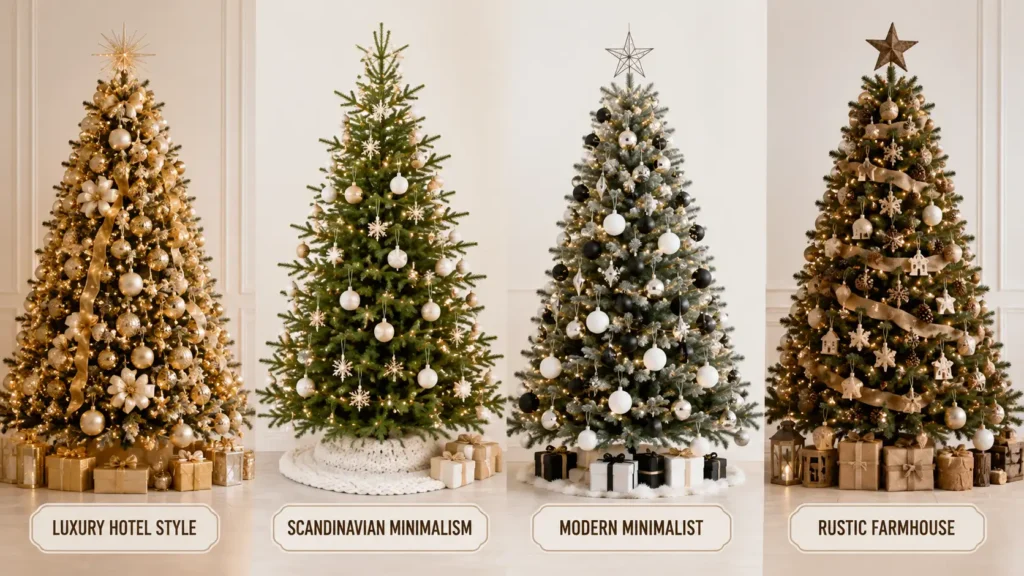
Who should skip it: homes with young children or pets. This style depends on glass ornaments hung low on the tree, which is a fragile combination.
Trend #2: Scandinavian Minimalism
Scandinavian design has influenced interiors for over a decade, and its holiday version has become one of the most reliable modern christmas tree ideas available.
The palette: white, cream, oatmeal, pale grey, natural wood, and occasionally a muted sage or dusty blue.
The materials: unpainted wooden ornaments, felt shapes, straw stars, paper snowflakes, glass in clear or frosted finishes, and linen or cotton ribbon rather than satin.
The lighting: soft and warm, and often slightly sparser than a traditional tree. Scandinavian styling wants a glow, not a blaze.
The finishing touch: many of these trees skip the tree skirt entirely in favor of a woven basket or a simple linen wrap at the base.
What makes this style so durable is that it does not fight with the rest of the room. If your home leans neutral, this tree will look intentional in every photograph you take of it. The complete styling framework, including palette combinations and ornament sourcing, is covered in the Scandinavian Christmas tree style guide.
The honest trade-off: Scandinavian trees can read as cold or unfinished if the lighting is too sparse or too blue. Warm white lighting is non-negotiable here.
Trend #3: Modern Minimalist Trees
Minimalism and Scandinavian styling overlap, but they are not the same thing. Scandinavian is about natural materials. Modern minimalism is about restraint and negative space.
A minimalist tree might use only two ornament shapes in one finish. It might use only 30 ornaments on a 7.5 foot tree where a traditional design would use 90. It might skip ribbon entirely and rely purely on lighting and silhouette.
How to do it well:
- Choose one shape and one finish, then vary only the size
- Leave visible gaps between clusters so the branch structure shows
- Use a tree with a well-defined silhouette, since the shape itself becomes the decoration
- Push lighting density higher than usual to compensate for the reduced ornament count
How it goes wrong: minimalism fails when a tree is under-decorated rather than deliberately decorated. The difference is rhythm. A minimalist tree still has an intentional pattern of placement, it just has fewer pieces in that pattern. The minimalist Christmas tree ideas guide walks through how to build that rhythm without the tree looking bare.
What We’d Choose
For a small apartment with a modern interior, minimalist styling on a slim tree is the strongest combination available. It respects the space, costs less, stores in a smaller box, and photographs well.
Trend #4: Cozy Rustic and Farmhouse Christmas Trees
While minimalism dominates modern interiors, the warm, textured, lived-in tree has stayed remarkably popular, and it is arguably the most budget-friendly trend on this list.
The elements:
- Pinecones, either natural or lightly frosted
- Burlap, buffalo check, and grain sack ribbon
- Wooden bead garland
- Dried orange slices and cinnamon bundles
- Galvanized metal and enamel accents
- Red used sparingly as an accent rather than a base color
The palette: warm neutrals with deep green, cranberry, and natural brown.
The reason this style keeps returning is emotional rather than visual. It looks like the holidays people remember. It also happens to be extremely forgiving, because rustic decorating tolerates imperfection in a way that luxury metallic styling does not.
For a full breakdown of materials and placement, see the guide to rustic Christmas tree decorations. And if you are wondering why this aesthetic keeps resurfacing season after season, there is a longer analysis of why farmhouse Christmas trees are having a moment.
Common mistake: overloading a farmhouse tree with novelty signs and text-based ornaments. The style works best when the texture does the talking.
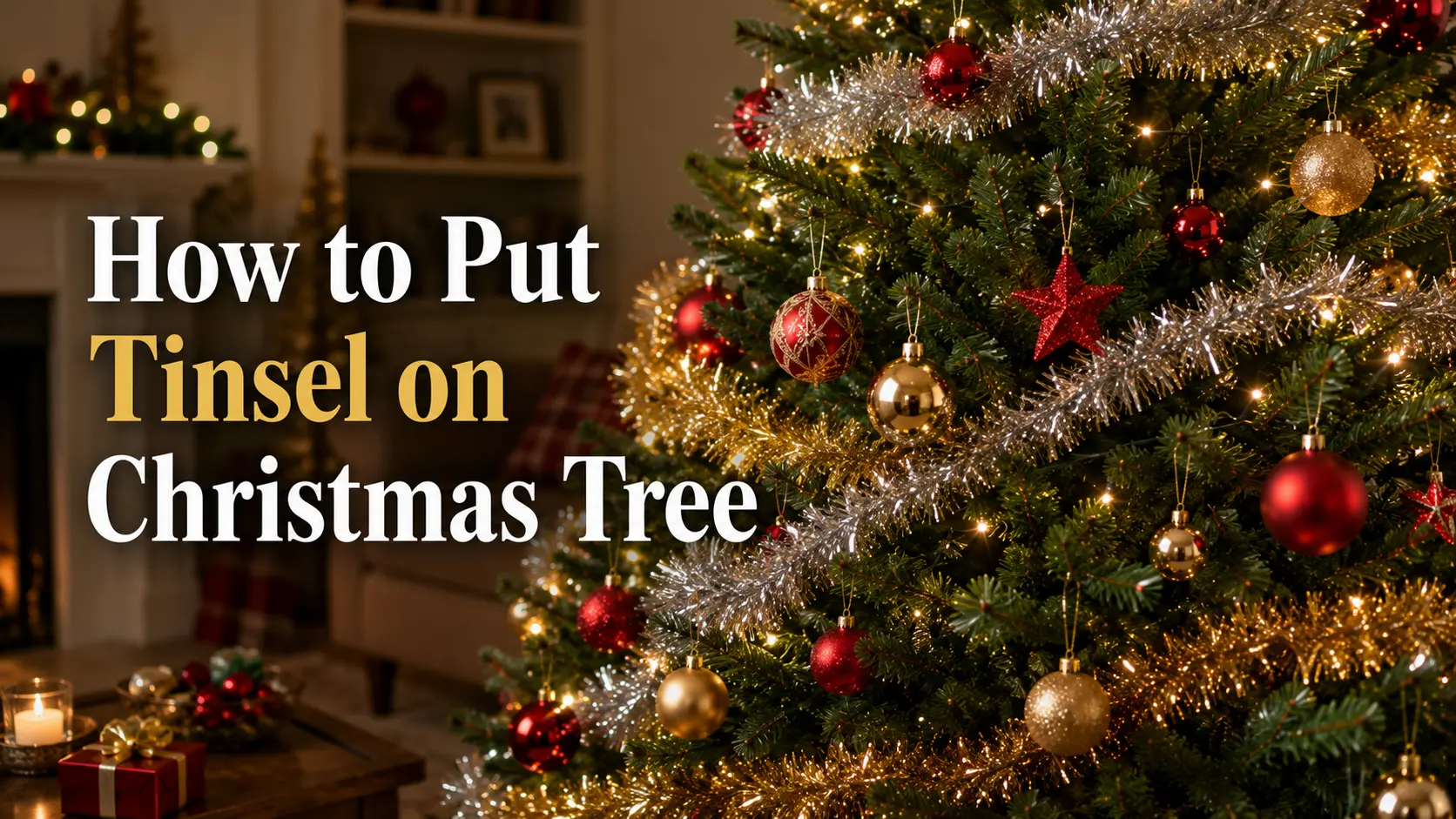
Trend #5: Ribbon Layering Instead of Garland
If there is one technique that defines trending christmas tree decorations in 2026, it is ribbon. Traditional beaded garland wrapped horizontally around a tree is quietly disappearing, replaced by wide ribbon worked vertically into the branches.
Why Ribbon Wins
Horizontal garland draws the eye around the tree and emphasizes width. Vertical ribbon draws the eye up and down, which makes a tree look taller and fuller. Ribbon also adds a soft, matte surface among all the reflective ornaments, which is what stops a tree from looking like a wall of glass.
The Three Main Techniques
| Technique | How It Works | Best For | Ribbon Needed (7.5 ft tree) |
|---|---|---|---|
| Vertical cascade | Ribbon tucked in and out down the tree in a wavy line, 4 to 6 cascades total | Slim and pencil trees | 30 to 40 feet |
| Diagonal spiral | Ribbon wound loosely at an angle from top to bottom | Traditional full trees | 30 to 40 feet |
| Tucked pouf | Short ribbon loops tucked between branches at intervals | Filling gaps and sparse spots | 20 to 30 feet |
Ribbon Guidelines by Tree Size
| Tree Height | Ribbon Needed |
|---|---|
| 6 ft | 15 to 25 feet |
| 7.5 ft | 30 to 40 feet |
| 9 ft | 40 to 60 feet |
| 10 ft | 60 to 75 feet |
Decorating Tip
Use wired ribbon at least 2.5 inches wide. Unwired ribbon collapses and thin ribbon disappears from more than a few feet away. Cut the ribbon into sections rather than working with one enormous roll, and tuck the cut ends deep into the branches so they vanish.
Add ribbon after lights but before ornaments. Adding it last means you will knock ornaments off while you work.
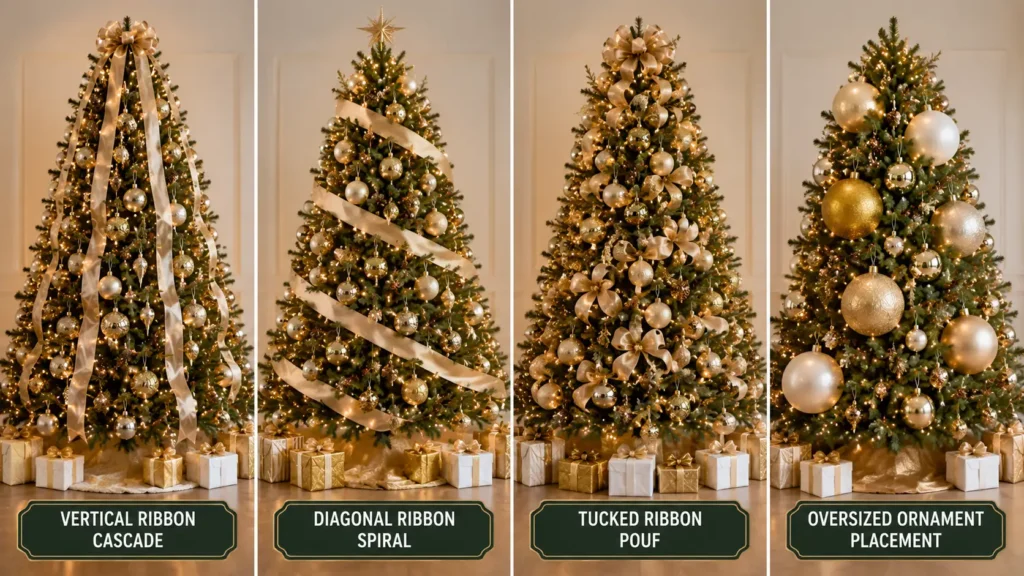
Trend #6: Oversized Ornaments
Large-scale ornaments have moved from department store displays into ordinary homes, and the effect is dramatic. A handful of 6 inch to 10 inch baubles placed deep in the tree creates a sense of scale that dozens of small ornaments cannot.
Why it works: the human eye needs a focal point. When every ornament is the same size, nothing anchors the design and the tree reads as busy. Oversized pieces give the eye somewhere to land and make the smaller ornaments look intentional by comparison.
How to place them:
- Use odd numbers, typically 5 to 9 on a 7.5 foot tree
- Place them deeper in the tree than your standard ornaments, not on the branch tips
- Distribute them in a loose triangle or zigzag rather than a ring
- Keep the largest pieces in the lower two thirds where the tree is widest
The budget version: oversized ornaments do not need to be expensive. Lightweight shatterproof baubles in matte finishes cost very little and read as premium once they are surrounded by warm lighting.
Ornament Quantity Benchmarks
| Tree Height | Total Ornaments | Suggested Oversized Count |
|---|---|---|
| 4 ft | 25 to 40 | 3 |
| 6 ft | 50 to 75 | 5 |
| 7.5 ft | 75 to 100 | 5 to 7 |
| 9 ft | 100 to 150 | 7 to 9 |
| 10 ft | 150 to 200 | 9 to 11 |
Most decorating mistakes happen because people use too few ornaments, not too many. If your tree looks sparse, count what you have before you assume the problem is styling. The Christmas tree ornament calculator will give you a precise number for your tree height and preferred density.
Trend #7: Full Designer Trees
The designer tree is the opposite of minimalism and it is thriving alongside it. These are dense, layered, magazine-style trees built with picks, florals, sprays, and multiple ornament layers.
The Layering Sequence
- Fluff thoroughly. Every branch tip separated and angled upward.
- Lights. Wrapped from trunk to tip, not draped on the surface.
- Ribbon. Vertical cascades placed first so they establish the vertical rhythm.
- Picks and florals. Berry sprays, glittered branches, eucalyptus stems, magnolia leaves. These fill gaps and add texture.
- Statement ornaments. The oversized pieces, placed deep.
- Standard ornaments. Clustered in groups of three rather than spaced evenly.
- Filler ornaments. Small pieces tucked into remaining gaps near the trunk.
That deep placement in step 5 is what creates the illusion of depth. A tree decorated only on its outer surface looks flat regardless of how much you spend.
Fluffing is the step people skip and it is the step that matters most. A poorly fluffed artificial tree cannot be rescued by ornaments. If you are unsure how much time this actually takes, the complete method is covered in how to fluff an artificial Christmas tree, and the broader techniques for building density are in how to decorate a Christmas tree to look full.
Time expectation: a proper designer tree takes 4 to 8 hours. That is not a flaw in your process. That is the actual requirement.
Trend #8: Layered Lighting
If one trend deserves more attention than it gets, this is it. Layered lighting is the single biggest difference between an amateur tree and a professional one, and it costs almost nothing to implement.
What Layered Lighting Means
Most people wrap one string of lights around the outside of the tree. Layered lighting uses two or three light sources at different depths:
- Interior lights: wrapped close to the trunk and along the inner third of each branch. These create the internal glow that makes a tree look like it is lit from within.
- Mid-depth lights: wrapped along the middle of the branches.
- Exterior lights: on the branch tips, providing sparkle.
The result is depth. Light falls off gradually from the trunk outward, which reads to the eye as dimension rather than as a flat lit surface.
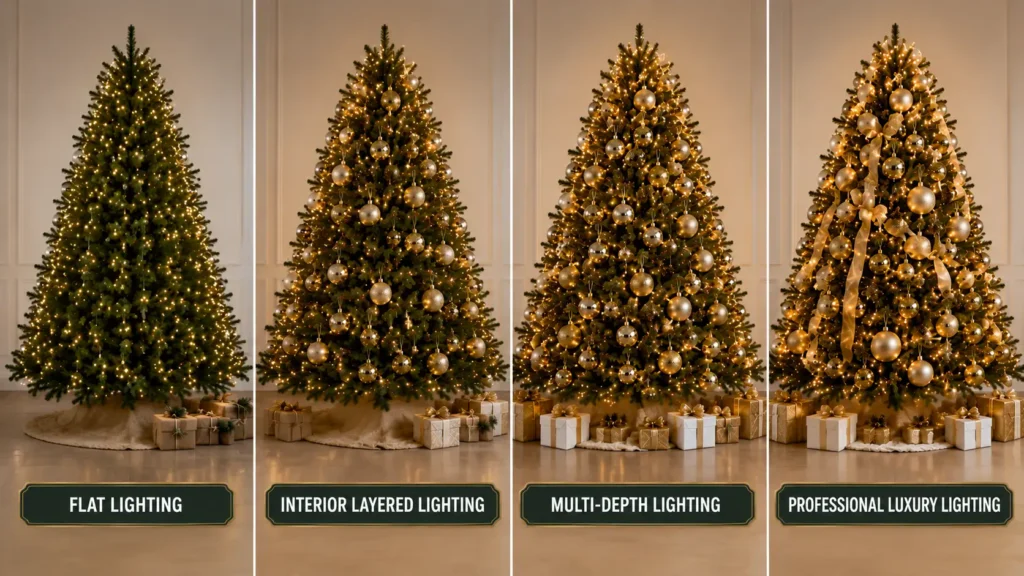
Lighting Density Benchmarks
| Tree Height | Standard (100/ft) | Luxury (150 to 200/ft) | Minimalist (50 to 75/ft) |
|---|---|---|---|
| 4 ft | 400 | 600 to 800 | 200 to 300 |
| 6 ft | 600 | 900 to 1,200 | 300 to 450 |
| 7.5 ft | 750 | 1,125 to 1,500 | 375 to 560 |
| 9 ft | 900 | 1,350 to 1,800 | 450 to 675 |
| 10 ft | 1,000 | 1,500 to 2,000 | 500 to 750 |
Color Temperature Matters More Than Quantity
Warm white LED lights in the 2700K to 3000K range are the standard for essentially every trend in this article. Cool white reads clinical and blue-tinted on camera and in person, which is why so few trending trees use it. There are legitimate exceptions, particularly for icy winter wonderland palettes, and the full comparison is laid out in warm white vs cool white lights.
For everything from wattage and safety to wrapping technique, the complete Christmas tree lighting guide covers the fundamentals. If you just want a fast answer on quantity, start with how many lights you need for a Christmas tree, then run your exact measurements through the Christmas tree light calculator.
Most People Should Do This
Add 50 percent more lights than you think you need, and put the extras deep in the tree. It is the cheapest upgrade in holiday decorating and the one people notice most.
Trend #9: Flocked Winter Wonderland Trees
Flocked trees have shifted from novelty to mainstream, and they are one of the most photographed styles of the season.
Why the appeal: flocking provides its own texture and contrast, which means the tree looks finished with far fewer ornaments. A flocked tree with warm lights, a few oversized pieces, and some white ribbon can look complete in under two hours.
Palettes that work:
- Tonal white on white with clear glass and silver
- Warm neutrals with pale wood and cream
- Deep green and cranberry against the snow for a cabin feel
- Icy blue and silver for a true winter wonderland
Honest trade-offs: flocking sheds, especially in the first season and especially during setup. It also makes storage messier and can be difficult to keep pristine in a home with pets or small children. Quality varies enormously between manufacturers, and cheap flocking looks like sprayed foam rather than snow. The guide to flocked Christmas trees covers how to judge flocking quality before you buy.
Worth it or not? Worth it if you want maximum visual impact with minimum decorating effort and you can tolerate some shedding. Not worth it if you rearrange or move your tree frequently.
Trend #10: Small Apartment Trees
Here is the trend nobody predicted a decade ago: some of the most admired trees online are in small apartments.
Housing has gotten smaller and more expensive in most major cities, and decorating content has adapted. Slim trees, pencil trees, corner setups, and tabletop trees are no longer treated as compromises. They are treated as a distinct style with its own aesthetic logic.
Why Small-Space Trees Photograph So Well
A slim tree fills the vertical frame of a phone screen almost perfectly. It also forces decorating discipline, because you physically cannot overload it. That constraint produces cleaner, more cohesive trees.
Tree Width Reference
| Tree Type | Typical Width | Floor Space Impact |
|---|---|---|
| Pencil | 20 to 30 inches | Minimal, fits in corners and hallways |
| Slim | 30 to 45 inches | Modest, works in most apartments |
| Traditional | 50 to 70 inches | Significant, needs a dedicated area |
| Full | 60 to 80+ inches | Large, requires an open room |
Small-Space Recommendations
| Space | Recommended Tree |
|---|---|
| Studio apartment | 4 to 7 ft slim tree |
| Small apartment | 6 to 7.5 ft slim tree |
| Tiny home | Tabletop or slim tree |
| Dorm room | 2 to 4 ft tabletop tree |
| Home office | 3 to 5 ft tabletop tree |
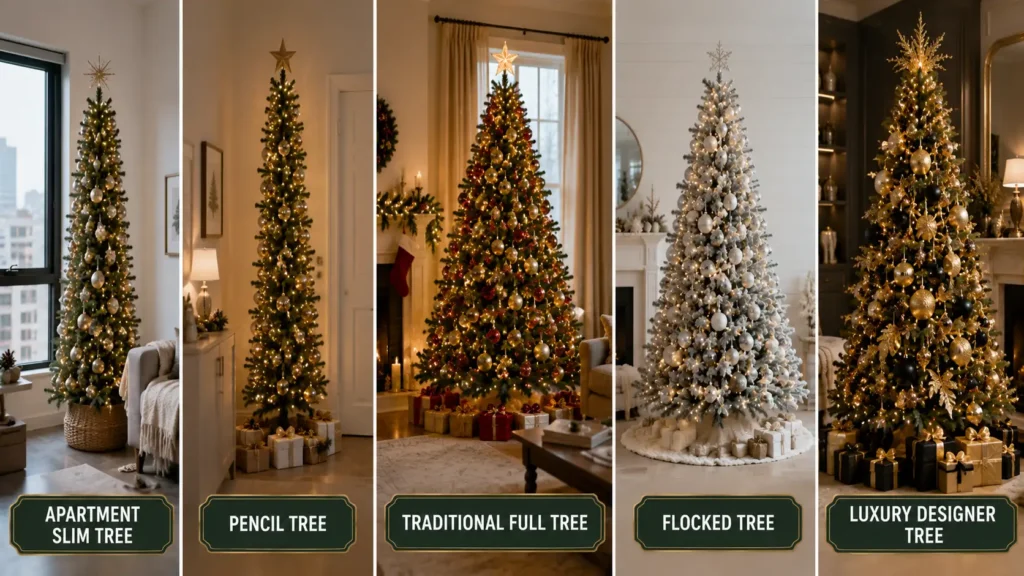
Expert Recommendation
In a small home, height creates more impact than width. A 7 foot slim tree makes a bigger impression than a 5 foot full tree while using less floor space. Most people get this backwards and choose a short, wide tree that eats the room.
Leave 6 to 12 inches between your topper and the ceiling. With a standard 8 foot apartment ceiling, that means a 6 to 7.5 foot tree.
For a complete overview of layouts and sizing, start with the guide to small-space and apartment Christmas trees. If you have narrowed things down to a narrow profile, the comparison of slim and pencil Christmas trees covers the differences in detail, and for very tight spaces the roundup of tabletop Christmas trees is the better starting point.
How to Recreate Viral Christmas Trees Without Overspending
The trees you admire online often cost less than you assume. Here is where the money actually needs to go and where it does not.
Spend Here First
Lighting. This is the highest-return purchase in holiday decorating. Doubling your light count transforms a tree. Doubling your ornament count barely registers.
Ribbon. Wired ribbon in a wide width costs very little per foot and delivers more visual change than any equivalent spend on ornaments.
A few oversized ornaments. Five large statement pieces do more work than thirty small ones.
Spend Here Last
Full designer ornament sets. These are the most expensive way to achieve a look you can get with mixed inexpensive pieces in a consistent palette.
Replacing a tree that still works. If your current artificial tree fluffs well and stands straight, a new one will not fix a styling problem.
Practical Budget Tactics
| Tactic | What It Saves | Notes |
|---|---|---|
| Shop clearance after Christmas | 50 to 75 percent | Buy next year’s palette in the first week of January |
| Mix price tiers | 30 to 50 percent | Cheap fillers deep in the tree, better pieces on the outside |
| DIY natural elements | Nearly everything | Dried citrus, pinecones, eucalyptus, cinnamon bundles cost almost nothing |
| Make your own bows | 60 to 80 percent | A roll of wired ribbon makes many bows for the price of a few pre-made ones |
| Reuse and repaint | Full cost of replacement | Matte spray paint updates dated ornaments to any current palette |
| Rotate rather than replace | Full cost of replacement | Alternate two palettes across seasons so both feel new |
Common Mistake
Buying the ornaments before deciding on the palette. This is how people end up with a box of decorations that do not work together and a tree that looks accumulated rather than designed. Decide on two or three colors first, then buy.
Which Christmas Tree Works Best for These Trends?
The tree itself matters more than most trend content admits. Here is how the main types perform against the styles above.
| Tree Type | Best Trends | Strengths | Limitations |
|---|---|---|---|
| Pre-lit full tree | Luxury, designer, oversized ornaments | Even lighting, saves 30 to 90 minutes of setup, dense branches | Harder to repair, less lighting flexibility, higher cost |
| Unlit full tree | Layered lighting, designer trees | Complete control over light density and color temperature | Requires significant time to light properly |
| Flocked tree | Winter wonderland, minimalist, Scandinavian | Instant texture, needs fewer ornaments | Sheds, messier storage, quality varies widely |
| Slim tree | Minimalism, ribbon layering, apartment styling | Space efficient, forces cohesive decorating | Displays fewer ornaments, less dramatic in large rooms |
| Pencil tree | Modern minimalist, tight corners | Fits almost anywhere | Very limited ornament capacity |
Best for Most People
A quality pre-lit tree in warm white. The lighting consistency alone solves the most common decorating failure, and the time savings are real. The main caveat is that pre-lit trees are harder to repair when a section fails, which makes build quality more important than usual. The buying criteria are covered in how to choose the perfect pre-lit Christmas tree, and the complete lifecycle including maintenance and repair is in the ultimate guide to pre-lit Christmas trees.
Best Long-Term Value
A mid-range to premium artificial tree, properly stored. Budget trees last 3 to 5 years. Mid-range trees last 7 to 10. Premium trees regularly last 10 to 20 years or more, and proper storage can roughly double the useful lifespan of any of them.
When Not to Buy
If your current tree fluffs into a full shape and the lights work, do not replace it because of a trend. Spend the same money on lighting and ribbon and you will see a bigger change.
Decorating Planning Tools
The most expensive decorating mistake is not buying the wrong thing. It is buying too much of the right thing.
Nearly everyone underestimates lights and overestimates ornaments. People buy three strings when they need eight, then buy 200 ornaments for a tree that needs 90 and store the excess for years.
Planning solves this in about ten minutes:
- Measure your ceiling height and subtract 6 to 12 inches for the topper clearance
- Choose your tree height from that number
- Calculate lights based on 100 per foot for standard density, more for luxury
- Calculate ornaments based on the benchmarks above
- Calculate ribbon based on the ribbon table
- Buy 10 percent extra lights only, not extra ornaments
Running your numbers through the Christmas tree decoration calculator before shopping will usually save more money than any sale you were planning to wait for.
Trends Likely to Continue Beyond 2026
Some of what is popular now will look dated quickly. These will not.
Natural textures. Wood, linen, dried botanicals, and pinecones have been part of holiday decorating for centuries. They are not going anywhere.
Layered lighting. This is a technique, not a fashion. Trees lit with depth have looked better than flat-lit trees for as long as electric lights have existed.
Sustainable decorating. Reusing, repairing, and buying fewer better pieces is both a values shift and an economic one. Expect it to strengthen.
Timeless neutral palettes. Cream, gold, green, and natural wood have never looked wrong. Palettes built on these age gracefully.
Quality over quantity. Fewer, better ornaments in a consistent palette will outlast any specific color trend.
What will date quickly: highly specific color combinations, novelty ornaments tied to current culture, and anything that depends on a single seasonal product being available again next year.
Common Mistakes When Copying Viral Trees
| Mistake | Why It Fails | The Fix |
|---|---|---|
| Buying too many ornaments | Overloaded trees look cluttered, not full | Use the ornament benchmark for your tree height, then stop |
| Ignoring tree size | An oversized tree makes the whole room look small | Measure the ceiling, subtract 6 to 12 inches, choose accordingly |
| Under-lighting | Flat lighting cannot be fixed with ornaments | Minimum 100 lights per foot, layered at multiple depths |
| Decorating before fluffing | Gaps in the branch structure show through everything | Fluff completely first, budget 30 to 120 minutes |
| Mixing too many styles | The tree reads as accumulated rather than designed | Choose one primary style and one accent, no more |
| Forgetting room scale | A tree that ignores its surroundings looks out of place | Match the tree’s visual weight to the room’s furniture scale |
| Copying a trend exactly | Trees that work in one home fail in another | Adapt the technique, not the specific product list |
| Placing all ornaments on branch tips | Creates a flat outer shell with a hollow center | Place roughly a third of your ornaments deeper in the tree |
Expert Perspective
The best Christmas tree trends are not necessarily the ones with the most views. Social platforms reward what looks striking in a fifteen second clip, and that is not always the same thing as what looks good in a living room for six weeks.
The trees that genuinely succeed combine timeless decorating principles with a small number of modern ideas that suit the actual home, the actual budget, and the actual person decorating. A luxury champagne-gold tree in a farmhouse-styled room looks confused. A minimalist tree in a home full of inherited ornaments feels like a denial rather than a design choice.
Use trends as vocabulary, not as instructions. Take the ribbon technique from one trend, the lighting density from another, and the palette discipline from a third. Then build something cohesive with what you already own and a few additions.
The reliable formula underneath every trend on this list is the same: fluff thoroughly, light generously and warmly, add texture through ribbon, anchor with a few large pieces, and keep the palette tight. That formula worked twenty years ago and it will work twenty years from now.
Final Verdict: Which Christmas Tree Trends Are Worth Trying in 2026?
Worth trying for almost everyone:
- Layered warm white lighting. The highest-impact, lowest-cost change available. Do this first regardless of your style.
- Ribbon layering. Transforms a sparse tree, works with every aesthetic, and reusable for years.
- Oversized ornaments. Five large pieces will do more than fifty small ones.
- Organic and natural textures. Nearly free, universally flattering, and never dates.
Worth trying if it suits your home:
- Luxury metallic styling. Excellent in formal rooms, difficult with children or pets.
- Scandinavian simplicity. Ideal for neutral modern interiors, less suited to traditional homes.
- Flocked trees. Enormous visual payoff, real shedding and storage trade-offs.
- Small-space and slim trees. Genuinely better than a full tree in most apartments.
Approach with caution:
- Anything requiring a complete ornament replacement
- Highly specific color trends unlikely to return next season
- Designer-tree density if you do not have four to eight hours to spend
If you make exactly two changes this year, add more warm white lights than feels necessary and add wide wired ribbon in vertical cascades. Those two moves account for most of the visible difference between an ordinary tree and one people stop to look at.
Frequently Asked Questions
What are the biggest Christmas tree trends for 2026?
Warm white layered lighting, ribbon layering in place of garland, oversized statement ornaments, luxury metallic palettes, Scandinavian and minimalist styling, natural organic textures, and slim trees for small spaces are the dominant looks this season.
What Christmas tree colors are trending in 2026?
Champagne gold, warm brass, cream, oatmeal, natural wood tones, sage green, and deep forest green lead the season. Mixed metallics are also popular, though they work best when one metal clearly dominates rather than splitting the palette evenly.
Is ribbon better than garland on a Christmas tree?
For most trees, yes. Wide wired ribbon worked vertically adds height, fullness, and a matte texture that balances reflective ornaments. Beaded garland wrapped horizontally emphasizes width and tends to make trees look shorter and busier.
How many lights should I put on my Christmas tree?
Use 100 lights per foot of tree height as the standard benchmark. That means 600 for a 6 foot tree, 750 for a 7.5 foot tree, and 900 for a 9 foot tree. For a luxury look, increase to 150 to 200 per foot. For minimalist styling, 50 to 75 per foot is enough.
Should I use warm white or cool white Christmas lights?
Warm white in the 2700K to 3000K range suits almost every trending style and flatters most interiors. Cool white works only for deliberately icy winter wonderland palettes and can look clinical in warm-toned rooms.
How many ornaments do I need for a 7.5 foot tree?
Between 75 and 100 ornaments for standard density, including roughly 5 to 7 oversized statement pieces. If your tree looks sparse, count what you have before assuming the issue is placement, because under-decorating is more common than over-decorating.
How much ribbon do I need for a Christmas tree?
Around 15 to 25 feet for a 6 foot tree, 30 to 40 feet for a 7.5 foot tree, 40 to 60 feet for a 9 foot tree, and 60 to 75 feet for a 10 foot tree. Choose wired ribbon at least 2.5 inches wide so it holds its shape.
Are flocked Christmas trees still in style for 2026?
Yes. Flocked trees remain one of the most popular styles because the snow effect provides its own texture and allows a finished look with fewer ornaments. The trade-offs are shedding and messier storage.
What size Christmas tree is best for an apartment?
With a standard 8 foot ceiling, a 6 to 7.5 foot slim tree is the best choice. Slim trees are typically 30 to 45 inches wide compared to 50 to 70 inches for a traditional tree, which preserves walking space while keeping the vertical impact that makes small rooms feel taller.
How do I make my Christmas tree look expensive on a budget?
Prioritize lighting density and wide ribbon over expensive ornaments, keep the palette to two or three colors, add five to seven oversized ornaments, and fluff the tree thoroughly before decorating. A well-lit tree with inexpensive ornaments consistently looks better than a poorly lit tree with expensive ones.
Why does my Christmas tree look sparse compared to the ones online?
Almost always one of three reasons: the tree was not fluffed properly, there are not enough lights, or ornaments are all placed on the branch tips instead of layered deeper. Fluffing alone takes 30 to 120 minutes on an artificial tree and it is the step most people rush.
Should I follow Christmas tree trends or stick with what I have?
Use trends as technique inspiration rather than shopping lists. If your tree fluffs well and your lights work, adding ribbon and increasing light density will deliver more visible improvement than replacing your decorations. Replacing a working tree because of a trend is rarely worth the expense.
Conclusion
The christmas tree trends 2026 story is really a story about technique overtaking product. The looks spreading fastest right now are built on ribbon layering, lighting depth, palette discipline, and thorough fluffing. All four are free or nearly free, and all four will still work long after this season’s specific color combinations have faded.
The styles worth your attention are the ones that suit your home rather than the ones with the most engagement. Luxury metallics reward formal rooms. Scandinavian and minimalist styling reward modern neutral spaces. Rustic and farmhouse styling rewards homes that already lean warm and textured. Slim and tabletop trees reward apartments, and reward them genuinely rather than as a compromise.
Plan before you shop. Measure your ceiling, calculate your lights and ornaments, decide on your palette, and buy against that plan. Then take the parts of these trends that fit and leave the rest.
The best tree in any given year is not the one that matches a trend most precisely. It is the one that looks like it belongs in the room it is standing in.