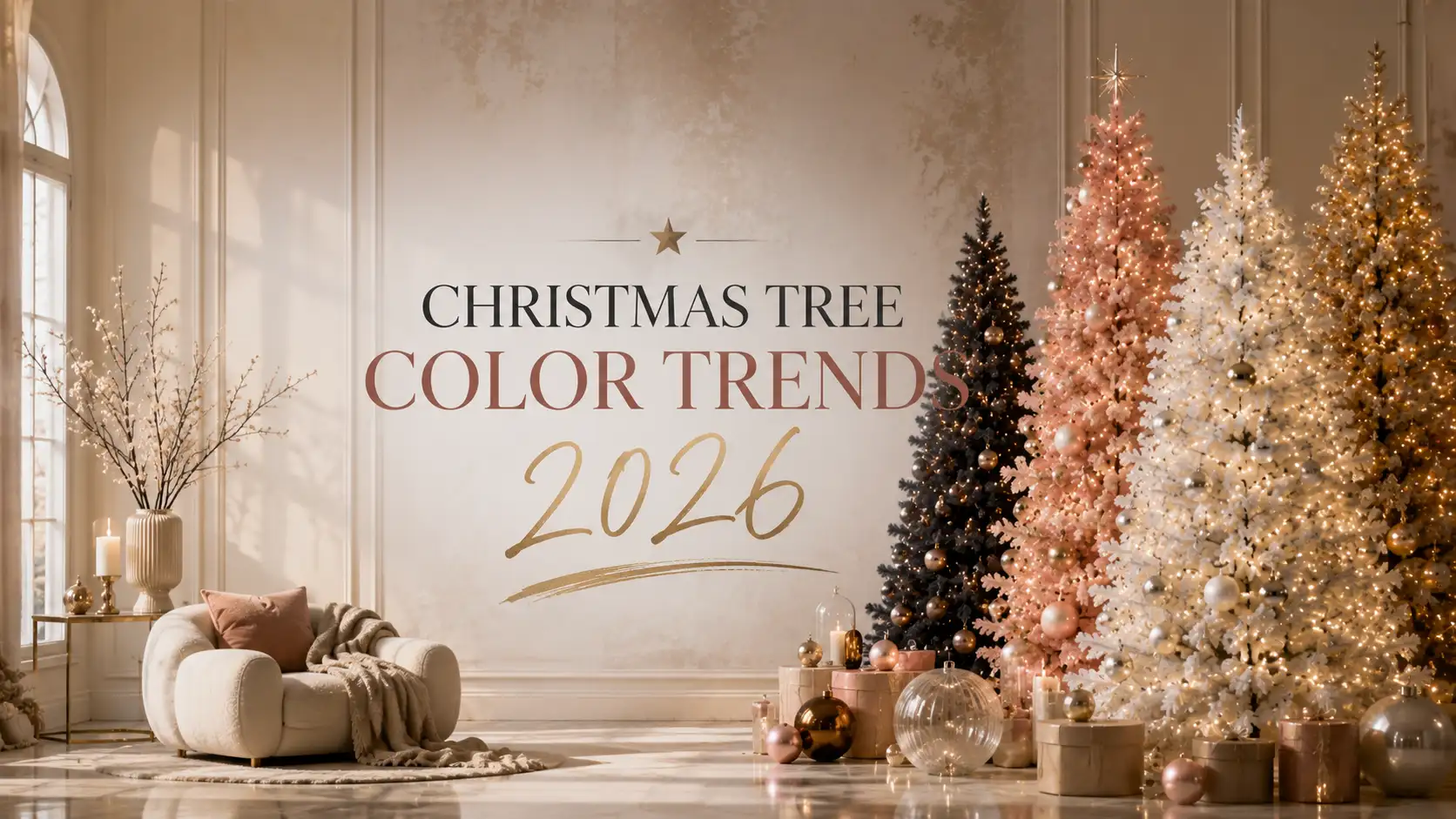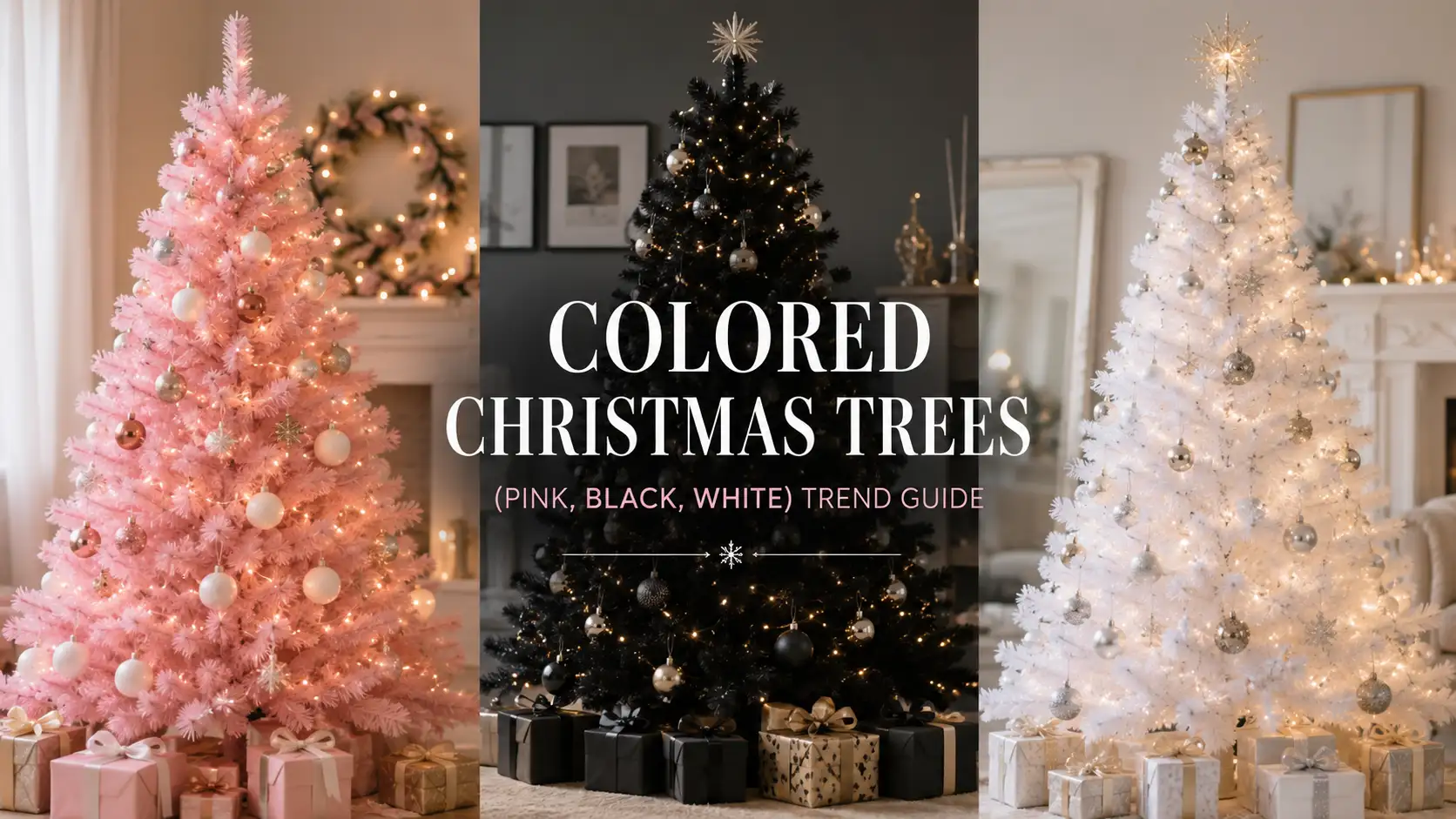

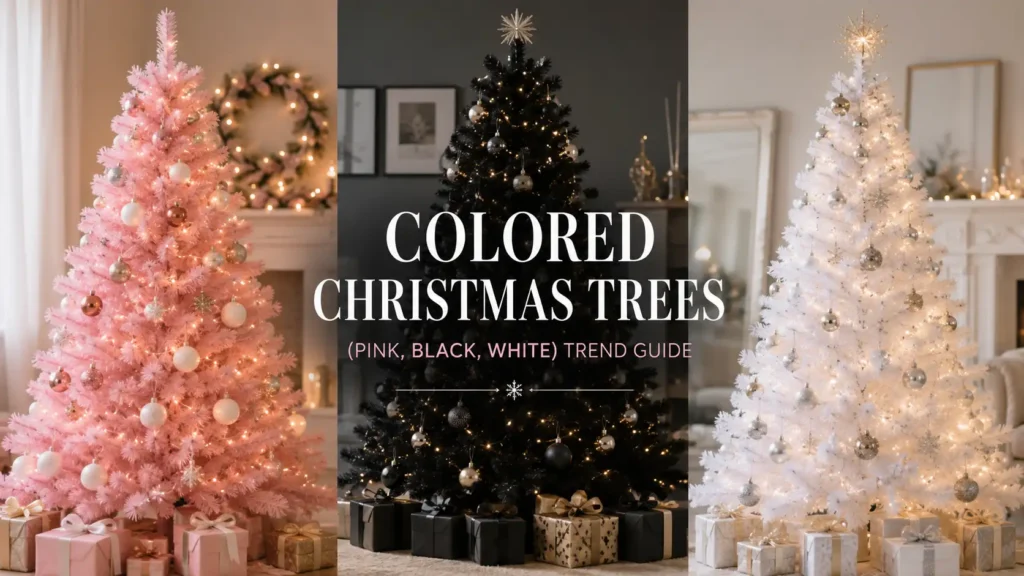
Walk through any home décor department in October and you will notice something that would have looked strange fifteen years ago. Sitting beside the traditional evergreens are trees in blush pink, matte black, snow white, and champagne gold. They are not novelty items tucked in a back corner anymore. They are front and center, and they sell out.
Green trees are not going anywhere. They still account for the overwhelming majority of trees in living rooms every December, and there is a good reason for that. But a growing number of homeowners have started treating the Christmas tree the way they treat a sofa or a statement light fixture: as part of the room, not separate from it. If your living room is built around soft neutrals, warm brass, and pale oak, a bright green artificial tree can feel like a visitor rather than a feature.
This guide covers how to choose a colored Christmas tree, how to decorate each color so it looks intentional instead of accidental, which colors suit which home styles, and whether the trend has staying power. Along the way you will find sizing benchmarks, lighting counts, and decorating advice drawn from the same reference material we use across MyChristmasTrees.online.
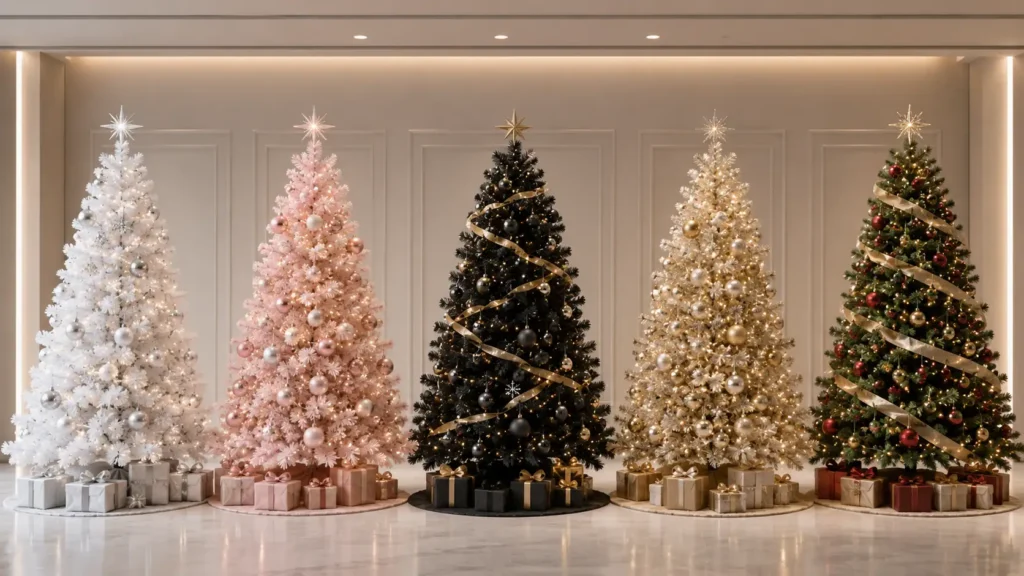
Are Colored Christmas Trees Worth Buying?
Yes, for the right home. A colored tree creates an immediate focal point and works especially well in modern, minimalist, and design-forward interiors where a traditional green tree can feel visually disconnected from the room.
The catch is that colored trees are less forgiving. A green tree hides a lot of decorating sins because green is a neutral backdrop that flatters nearly every ornament color. A black or pink tree does not. You need a tighter color palette, better lighting, and more thought about ornament finish.
Here is the short version:
- White is the most versatile colored tree and the easiest to decorate well.
- Black delivers the most drama but demands the most lighting.
- Pink is the most style-specific and works best in glam, pastel, or maximalist rooms.
- Champagne and gold read as luxury neutrals and suit formal or upscale interiors.
- Green remains the safest long-term buy if you plan to change your décor style over the next decade.
| Tree Color | Best For | Difficulty to Decorate | Ornament Palette That Works | Lighting Needed | Long-Term Appeal |
|---|---|---|---|---|---|
| White | Modern, Scandinavian, coastal, winter themes | Easy | Silver, icy blue, clear glass, warm gold | Warm white or cool white | High |
| Pink | Glam, pastel, eclectic, girls’ rooms, boutiques | Moderate | Rose gold, champagne, cream, blush, white | Warm white only | Moderate |
| Black | Contemporary, luxury, dark-walled rooms, lofts | Hard | Gold, copper, crystal, deep jewel tones | Warm white, higher density | Moderate to high |
| Champagne / Gold | Formal living rooms, neutral interiors | Moderate | Ivory, bronze, pearl, soft metallics | Warm white | High |
| Flocked Green | Rustic, farmhouse, traditional with a twist | Easy | Anything traditional plus natural textures | Warm white | Very high |
| Traditional Green | Almost every home and style | Easiest | Anything | Anything | Timeless |
Why Colored Christmas Trees Have Become Popular
Interiors Changed First
The shift did not start with Christmas trees. It started with paint colors, flooring, and furniture. Over the last decade, home interiors moved toward warmer neutrals, matte black hardware, natural wood, and softer palettes. A saturated green tree in a room built on greige, oatmeal, and brass can look like a color mismatch rather than a centerpiece.
Colored trees solved a problem homeowners already had. A white tree in a Scandinavian room does not compete with anything. A black tree in a loft with black window frames looks like it belongs there.
Apartments and Smaller Rooms
In a compact space, the tree is not one element among many. It is often the single largest decorative object in the room. That raises the stakes on color coordination considerably. A 7.5 ft slim white tree in a 400 square foot apartment reads as elegant. The same footprint in bright green can dominate the space in a way that feels heavy.
Hotels, Retail, and Public Displays
Luxury hotel lobbies and high-end retail displays have used non-green trees for years, often in white, champagne, or black with tightly controlled ornament palettes. Those displays set a visual standard that filtered down into home decorating. Once people saw a black tree with gold and crystal ornaments done well, the idea stopped seeming odd.
Social Media Accelerated Everything
Visual platforms compressed the adoption timeline. A decorating idea that once took several seasons to spread now spreads in weeks, largely because colored trees photograph exceptionally well. High contrast reads clearly on a small screen in a way that green on green often does not. If you want a broader look at how these ideas move, our roundup of viral Christmas tree trends on TikTok covers the wider phenomenon.
Personal Expression
There is also a simple reason worth stating plainly. Some people are tired of green. After a decade of decorating the same tree the same way, a color change is the cheapest possible way to make Christmas feel new again.
Types Of Colored Christmas Trees
White Christmas Trees
White is the gateway colored tree and the one we recommend most often for first-time buyers.
Why it works: White functions as a neutral. It reflects light rather than absorbing it, which means you get more visible glow from the same number of bulbs. Ornaments appear brighter and more saturated against white than against any other tree color, including green.
The aesthetic: Clean, wintry, and slightly formal. A white tree with clear glass ornaments and warm white lights looks like frost. The same tree with icy blue and silver reads Nordic. With warm gold and cream it goes upscale traditional.
Ornaments that shine: Silver, mercury glass, clear glass, pearl, icy blue, warm gold, and any ornament with a reflective or faceted surface.
Lighting note: White trees show light bleed. Cheap green wire on a white tree is very visible, so look for white or clear wire on pre-lit white models. This single detail separates expensive-looking white trees from ones that look like they came from a discount bin.
The honest drawback: White trees yellow over time, especially with sun exposure or heat. A budget white tree that lasts 3 to 5 years may look noticeably ivory by year four. Mid-range and premium constructions hold their color much longer.
Pink Christmas Trees
Pink is the most polarizing colored tree and the one most likely to be dismissed as a fad. That is not entirely fair, but it is the most style-dependent of the group.
Why it works: Pink is warm, which means it pairs naturally with gold, rose gold, and champagne rather than fighting them. In a room with blush walls, velvet upholstery, or brass fixtures, a pink tree looks like a designed choice.
Shades matter enormously. A pale blush or dusty rose tree reads sophisticated and adult. A hot or bubblegum pink tree reads playful and youthful. These are effectively two different products, and buying the wrong one for your room is the most common pink tree mistake.
Ornaments that shine: Rose gold, champagne, cream, white, soft gold, blush velvet, and pearl. Add texture through velvet bows and matte finishes rather than adding more colors.
Who it suits: Glam interiors, pastel rooms, children’s bedrooms, home offices, small secondary trees, and anyone who wants a tree that is unmistakably not traditional.
The honest drawback: Pink has the narrowest room compatibility. If you redecorate in three years toward a rustic or farmhouse palette, a pink tree will likely retire to storage.
Black Christmas Trees
Black trees produce the strongest reaction, positive or negative, of any color on this list.
Why it works: Black provides maximum contrast. Gold, copper, and crystal ornaments appear to float against a black tree in a way that no other background achieves. If you have ever seen a black tree with warm white lights and gold ornaments done properly, you know it is genuinely striking.
The aesthetic: Contemporary, dramatic, and slightly editorial. It suits lofts, homes with dark accent walls, modern homes with black window frames, and rooms with strong architectural lines.
Ornaments that shine: Gold, copper, bronze, crystal, mirrored glass, deep emerald, burgundy, and anything with a warm metallic finish. Avoid silver as your primary metal because cool silver on black can look cold rather than luxurious.
How to avoid the black hole problem. This is the single biggest issue with black trees. Black absorbs light instead of reflecting it, so a standard light count disappears into the branches. Our fix:
- Use 150 to 200 lights per foot instead of the standard 100. A 7.5 ft black tree needs roughly 1,125 to 1,500 lights rather than 750.
- Choose warm white rather than cool white. Cool white on black reads harsh and clinical.
- Wrap lights deep into the interior branches, not just the surface, so the tree glows from within.
- Load up on reflective ornaments. Every mirrored or faceted surface bounces light back out.
- Place the tree against a lighter wall. Black on black loses its shape entirely.
The honest drawback: Black trees are the most expensive to light correctly and the least forgiving of a low light count. Budget accordingly before you buy one.
Champagne And Gold Trees
Champagne, gold, and warm metallic trees occupy the space between white and traditional. They read as upscale neutrals.
Why it works: These trees carry a built-in warmth that photographs beautifully and pairs naturally with ivory, bronze, and pearl. In a formal living room with neutral walls, a champagne tree looks intentional and expensive without shouting.
Ornaments that shine: Ivory, cream, bronze, pearl, soft gold, and glass. Keep the palette tonal. Champagne trees look best when the ornaments sit within a narrow band of related tones rather than contrasting sharply.
Who it suits: Formal entryways, dining rooms, neutral interiors, and anyone who wants something non-traditional that still reads classic.
The honest drawback: Champagne trees can look washed out if the room itself is beige and the lighting is dim. They need either a contrasting wall or strong lighting to hold their shape.
Blue, Red, And Other Colored Trees
The remaining colors serve more specific purposes.
Blue works well for winter wonderland and coastal themes, especially in icy or silvery shades. Deeper navy trees can look surprisingly sophisticated with silver and white ornaments.
Red is bold and best kept small. A tabletop red tree in an entryway or home office makes a statement. A 9 ft red tree in a living room rarely does.
Purple, teal, and multicolor trees serve novelty and children’s spaces well. They are excellent second trees for a playroom or dorm room and rarely the right choice as a home’s primary tree.
| Color | Primary Use Case | Recommended Size | Style Fit | Trend Longevity |
|---|---|---|---|---|
| Blue | Winter wonderland, coastal | 6 to 7.5 ft | Themed, transitional | Moderate |
| Red | Entryway, office accent | 2 to 4 ft tabletop | Bold, festive | Moderate |
| Purple | Children’s rooms, novelty | 3 to 5 ft | Playful | Low |
| Teal | Retro, mid-century themes | 4 to 6 ft | Eclectic | Low |
| Multicolor | Playrooms, dorms | 2 to 4 ft | Fun, casual | Low |
Which Colored Tree Fits Your Home?
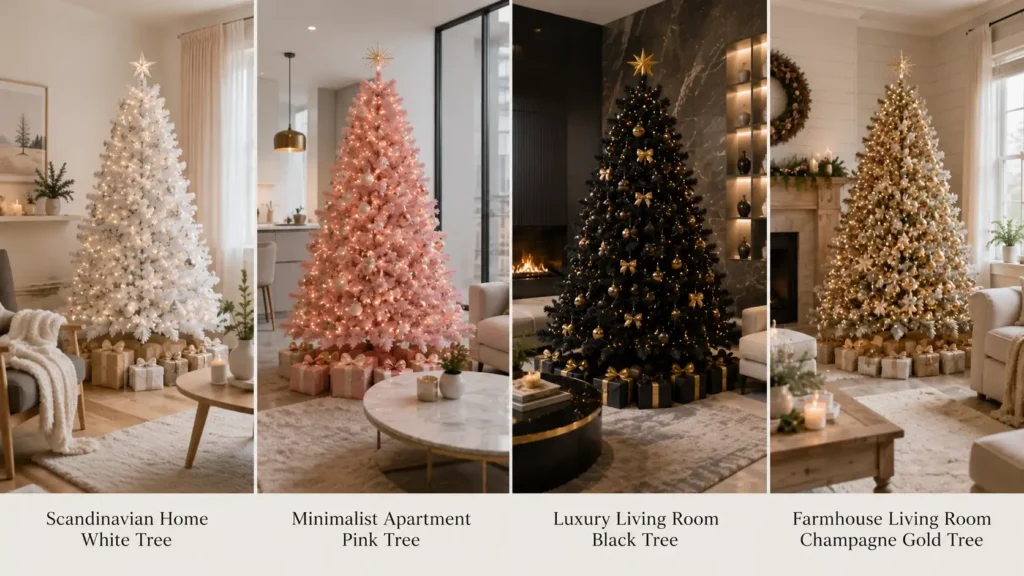
Room style should drive tree color more than personal preference alone. A tree that clashes with the room will never look good regardless of how much you spend on ornaments.
| Home Style | Best Tree Colors | Avoid | Why |
|---|---|---|---|
| Farmhouse | Flocked green, traditional green, warm white | Black, hot pink | Farmhouse relies on natural texture and warmth |
| Scandinavian | White, flocked, pale champagne | Red, multicolor | Restrained palettes and light woods dominate |
| Minimalist | White, black, champagne | Multicolor, novelty | Single-color trees support the pared-back look |
| Luxury / Formal | Black, champagne, white | Bright pink, teal | Contrast and metallics read expensive |
| Modern Apartment | White, black, slim green | Oversized full trees | Vertical impact matters more than width |
| Traditional | Green, flocked green | Black, pink | Classic palettes suit classic rooms |
| Glam / Eclectic | Blush pink, champagne, black | Plain green | Warm metallics carry the look |
Expert Recommendation
If you are unsure, buy white. It suits the widest range of interiors, is the easiest to decorate successfully, works with both warm and cool ornament palettes, and holds up best if your décor style shifts over the next several years. Black and pink are more rewarding when they land, but they land in fewer homes.
Decorating White Christmas Trees
White trees are forgiving, but there is a difference between a white tree that looks elegant and one that looks like an office lobby.
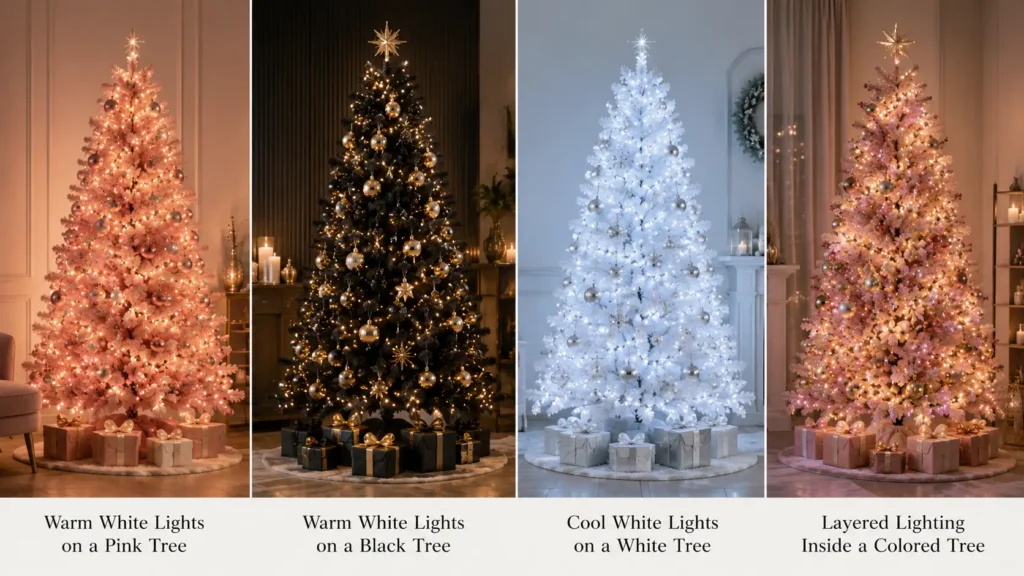
Start with lighting temperature. Warm white lights turn a white tree ivory and cozy. Cool white lights keep it crisp and icy. Neither is wrong, but mixing the two on a white tree is very obvious and looks like a mistake.
Build depth with three ornament finishes. On a white tree, use matte, glossy, and glittered ornaments in the same color family. Without that variation, the tree reads flat because there is no color contrast doing the work.
Add a dark or metallic anchor. Pure white on white can dissolve. Deep silver, pewter, charcoal ribbon, or dark green foliage picks give the eye something to land on.
Winter woodland styling works particularly well: clear glass icicles, snowy pinecones, white feather picks, silver birch accents, and a fur or knit tree skirt.
Ornament count for a 7.5 ft white tree: 75 to 100 ornaments. Because white shows gaps clearly, err toward the higher end.
Common mistake: Using only white ornaments. The tree disappears into itself. Always include at least one contrasting or reflective element.
Decorating Pink Christmas Trees
Pink trees succeed or fail on palette discipline. Two or three coordinating colors, no more.
The reliable formula: blush pink tree, warm white lights, rose gold and champagne ornaments, cream velvet ribbon, pearl accents.
Ribbon matters more here than on any other tree color. Wide champagne or blush velvet ribbon woven vertically through a pink tree adds the texture that pink alone cannot supply. For a 7.5 ft tree, plan on 30 to 40 feet of ribbon.
Lighting: Warm white only. Cool white lights turn pink slightly grey and drain the warmth out of the color. This is one of the few genuinely absolute rules in colored tree decorating.
Add texture, not more color. Velvet bows, faux fur picks, feather sprays, and matte ceramic ornaments give a pink tree richness without introducing competing hues.
Tree topper: A soft bow or a champagne star works better than a bright colored topper. Pink trees look best when the top of the tree stays within the palette.
Common mistake: Adding red or green ornaments to a pink tree in an attempt to make it feel more Christmassy. It does the opposite. Let the tree commit to its palette.
Decorating Black Christmas Trees
Black trees reward careful work and punish shortcuts.
Light first, decorate second. On a black tree, lighting is roughly 70 percent of the final effect. Get the light count right before you hang a single ornament.
Choose warm metals. Gold, copper, and bronze against black look expensive. Silver and chrome against black look cold. If you want cool tones, use crystal and mirrored glass instead of matte silver.
Use large ornaments. Small ornaments vanish on a black tree. Oversized baubles, 4 to 6 inches, hold their visual weight and reflect more light.
Add matte and glossy contrast. A black tree with all-glossy gold ornaments looks slightly cheap. Mix matte gold, polished gold, and crystal for depth.
Ribbon: Gold mesh or wide velvet in burgundy, emerald, or copper. Avoid black ribbon on a black tree unless it has a strong metallic thread.
Placement: Against a light wall, ideally with a lamp or sconce nearby providing ambient light. A black tree in a dark corner is invisible.
What We’d Choose
For a black tree in a modern living room: 1,200 warm white LEDs on a 7.5 ft frame, oversized matte and polished gold ornaments, crystal accents, wide copper ribbon, and a simple gold star. Nothing else. Restraint is what makes black trees look expensive
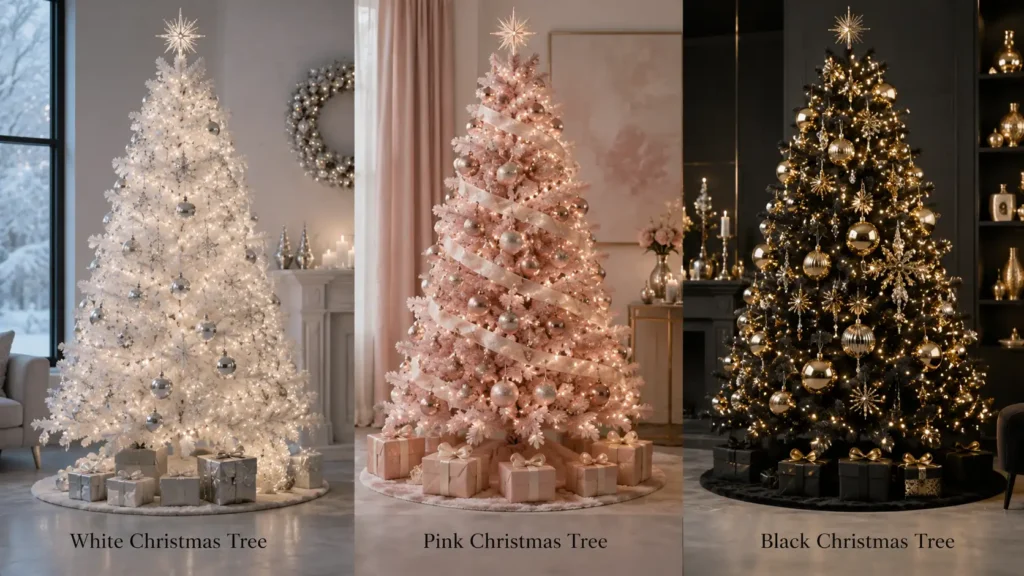
Best Lighting For Colored Trees
Lighting is more important than ornaments on every tree, and it is dramatically more important on colored trees because the tree surface itself changes how light behaves.
Warm white LEDs flatter pink, champagne, gold, black, and flocked trees. They add a golden cast that reads cozy and expensive.
Cool white LEDs suit white and blue trees when you want an icy, crisp, wintry effect. They are the wrong choice for pink and risky on black.
Colored lights generally fight a colored tree. If the tree already has a strong color, adding multicolored bulbs creates visual noise. The exception is a white tree, which functions as a neutral canvas and handles colored lights well.
Layered lighting is the professional technique. Wrap one string deep in the interior near the trunk, then a second layer on the mid-branches, then a third on the outer tips. This creates depth instead of a flat wall of light.
Reflective ornaments multiply your lighting. Every mirrored, faceted, or glass ornament effectively acts as a small secondary light source. This is why a tree with 800 lights and glass ornaments looks brighter than one with 1,000 lights and matte ornaments.
For the full technical breakdown of bulb types, wiring, and string configurations, see our Christmas tree lights and lighting guide. If you are still deciding on color temperature, our comparison of warm white vs cool white lights settles the question with side-by-side reasoning.
Light count benchmarks:
| Tree Height | Standard (100/ft) | Luxury (150 to 200/ft) | Black Tree Minimum |
|---|---|---|---|
| 4 ft | 400 | 600 to 800 | 600 |
| 6 ft | 600 | 900 to 1,200 | 900 |
| 7.5 ft | 750 | 1,125 to 1,500 | 1,125 |
| 9 ft | 900 | 1,350 to 1,800 | 1,350 |
| 10 ft | 1,000 | 1,500 to 2,000 | 1,500 |
For a deeper explanation of these numbers and how they change by tree width, read how many lights do you need for a Christmas tree, or skip the math entirely and run your dimensions through our Christmas tree light calculator.
Choosing Decorations That Match Colored Trees
Ornaments. Limit yourself to two primary colors plus one metallic. On a colored tree, a third color almost always tips the look from designed into cluttered. Ornament quantity by height: 50 to 75 for a 6 ft tree, 75 to 100 for a 7.5 ft tree, 100 to 150 for a 9 ft tree.
Ribbon. Wide ribbon, 4 inches or more, is what separates professional-looking trees from home-decorated ones. Vertical ribbon placement elongates the tree, which is especially useful on slim colored trees in apartments. Plan on 15 to 25 feet for a 6 ft tree and 40 to 60 feet for a 9 ft tree.
Tree skirts. Match the skirt to the tree’s undertone, not to the room’s floor. Warm trees get cream, gold, or faux fur. Cool trees get white, silver, or grey. Sizing: 36 to 42 inches for a 4 to 6 ft tree, 48 to 60 inches for a 7 to 8 ft tree, 60 to 72 inches for a 9 to 10 ft tree.
Picks and sprays. These are the most underused tool in colored tree decorating. Picks fill gaps, add texture, and extend the silhouette beyond the branch tips. Ten to fifteen picks transform a sparse tree.
Tree toppers. On colored trees, keep the topper tonal. A bright red bow on a champagne tree undoes the entire palette. Stars, simple bows, and metallic finials work best.
Garland. Beaded or metallic garland adds continuity between ornaments. Use it sparingly on black trees where too much garland flattens the silhouette.
To calculate exactly what you need before you shop, use our Christmas tree decoration calculator for a full inventory, or the Christmas tree ornament calculator if you only need ornament quantities.
Which Decorating Styles Work Best?
Luxury. Black and champagne trees carry luxury styling most naturally because the contrast and metallics do the work. The principles that make any tree look high-end apply here too, and our luxury Christmas tree decorating ideas breaks down the layering technique in detail.
Scandinavian. White and pale flocked trees are the obvious fit. Keep ornaments wooden, ceramic, and neutral, and resist the urge to add metallics. The restraint is the point, as covered in our Scandinavian Christmas tree style guide.
Minimalist. Colored trees and minimalism pair unusually well because the tree color itself provides interest, which means you need fewer decorations. A black tree with 40 gold ornaments and nothing else can look more finished than a green tree with 150. See minimalist Christmas tree ideas for the underlying approach.
Rustic. This is the one style where colored trees generally do not help. Rustic decorating depends on natural texture and warmth, and a black or pink tree fights that. Flocked green is the exception and works beautifully. Our rustic Christmas tree decorations guide explains why natural materials matter more than color here.
Modern glam. Blush pink and champagne trees with rose gold, velvet, and pearl. Heavy on texture, restrained on color count.
Winter wonderland. White or icy blue trees, cool white lights, silver and clear glass, artificial snow, and plenty of reflective surfaces.
Colored Trees vs Traditional Green Trees
| Factor | Colored Trees | Traditional Green Trees |
|---|---|---|
| Visual impact | Immediate and strong | Familiar and warm |
| Decorating flexibility | Limited palette required | Works with nearly any ornament |
| Room compatibility | Style-specific | Universal |
| Timelessness | Varies by color | Consistently timeless |
| Cost | Often 10 to 30 percent higher | Widest price range available |
| Resale or reuse if style changes | Lower | High |
| Ease for beginners | Moderate to hard | Easy |
| Best for | Design-led, modern, or themed homes | Almost every household |
The balanced view: a green tree is the better default and the safer long-term purchase. A colored tree is the better choice when you have a clear decorating vision and a room that supports it. Neither is objectively superior, but they are not interchangeable, and pretending otherwise leads people to buy a black tree for a farmhouse living room and wonder why it looks wrong.
Other Creative Christmas Tree Trends
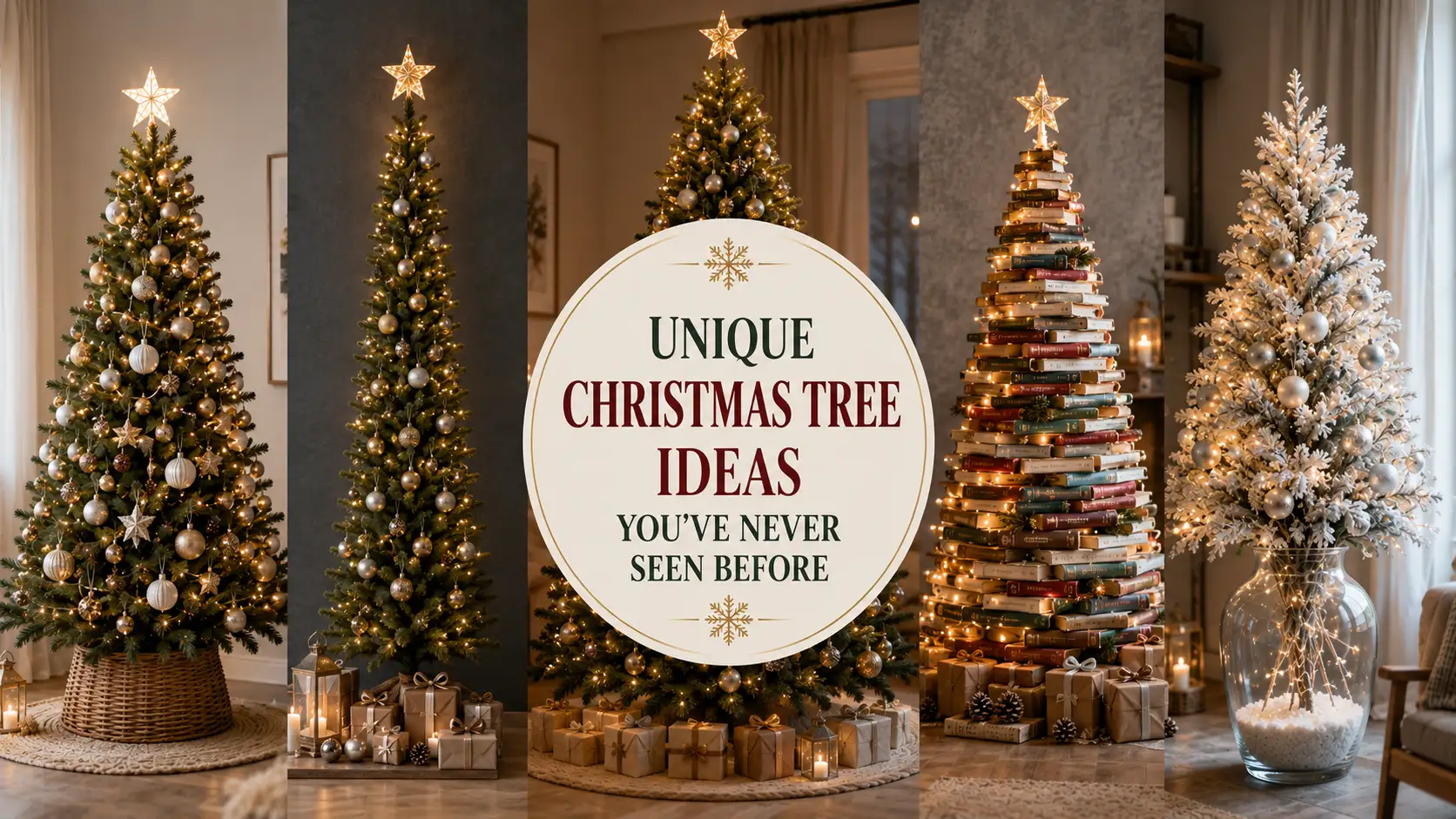
Colored trees are one piece of a broader shift toward personalized holiday decorating. People are increasingly treating the tree as a design object rather than a fixed tradition, which has produced everything from wall-mounted trees to ladder trees to trees built entirely from books.
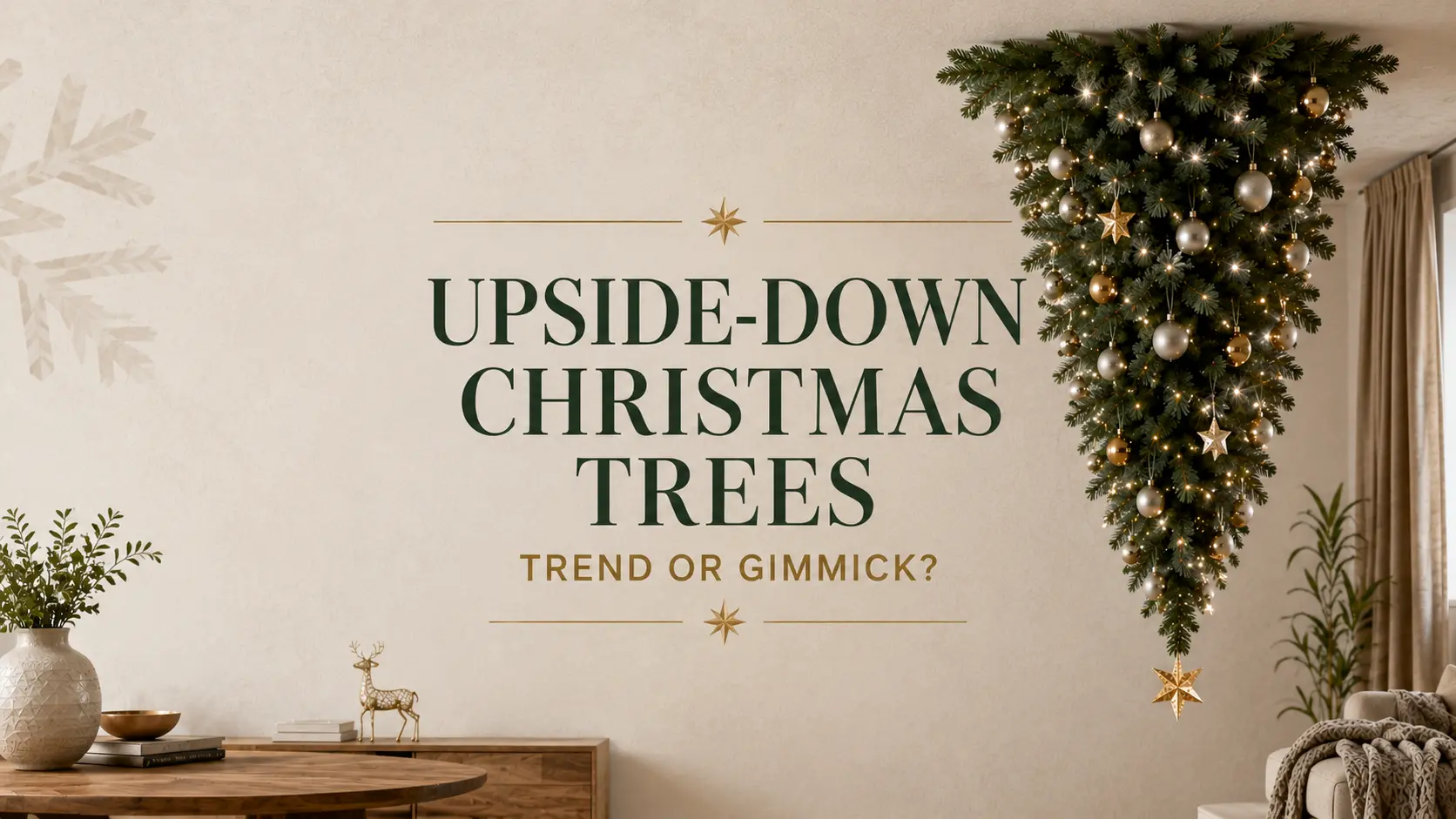
If you want to see how far this goes, our collection of unique Christmas tree ideas covers alternative formats worth considering, particularly for small spaces. And for a genuinely divisive example, our take on upside down Christmas trees examines whether the format has practical merit or is purely visual novelty.
The common thread is that the definition of a Christmas tree has loosened. Color is simply the most accessible way to participate in that.
Choosing The Right Tree
Pre-lit trees. For colored trees specifically, pre-lit is close to essential. Wrapping 1,200 lights on a black tree by hand is a genuinely unpleasant afternoon, and pre-lit models deliver more even coverage than most people achieve manually. Pre-lit trees typically save 30 to 90 minutes at setup. Check the wire color before buying: green wire on a white tree looks wrong. Our guide on how to choose the perfect pre-lit Christmas tree covers what to look for, and the ultimate guide to pre-lit Christmas trees goes further into maintenance and repair.
Flocked trees. Flocking is arguably the original colored tree and still the most durable trend of the group. A heavily flocked tree reads white while keeping the green underneath, which gives you more decorating flexibility than a true white tree. Our guide to flocked Christmas trees covers shedding, cleanup, and quality differences.
Artificial trees. Nearly all colored trees are artificial, which means the usual value math applies. A budget tree lasts 3 to 5 years, a mid-range tree 7 to 10, and a premium tree 10 to 20 or more. Given that colored trees carry a price premium and that color fading is a real issue on white and pink models, buying mid-range or better is the more economical decision over time.
Slim trees. Colored trees and slim profiles pair naturally in apartments. A slim tree measures 30 to 45 inches wide against 50 to 70 for a traditional tree, and vertical height creates more impact in small rooms than width does. See slim and pencil Christmas trees for small spaces for sizing guidance.
Sizing reminder for any color: leave 6 to 12 inches between the topper and the ceiling. On an 8 ft apartment ceiling that means a 6 to 7.5 ft tree. On a 9 ft ceiling, 7.5 to 8.5 ft. Most people buy trees that are too tall for the room.
Are Colored Trees A Passing Trend?
Partly yes, partly no, and the split falls along predictable lines.
Likely to last: White, flocked, and champagne trees. These read as neutrals rather than statements. They have been used in upscale interiors for decades and they do not depend on a specific moment in design. A white tree bought today will still look appropriate in ten years.
Likely to cycle: Black trees. Their popularity tracks the broader dark-interiors movement, matte black hardware, moody paint colors, and dramatic contrast. When interiors swing lighter again, black trees will feel dated faster than white ones. That said, contrast never fully goes out of style, so black may recede rather than disappear.
Most trend-dependent: Bright pink, teal, purple, and multicolor. These are tied closely to specific aesthetic moments. Blush and dusty pink have better odds because they function as warm neutrals rather than as bright colors.
The underlying shift, that people match trees to interiors rather than tradition, is not a trend at all. That is a durable change in how holiday decorating works, and colored trees are just its most visible expression.
Common Decorating Mistakes
Using too many ornament colors. The most frequent failure. A colored tree already contributes one strong color. Adding four ornament colors on top produces chaos. Fix: two colors plus one metallic, maximum.
Wrong light temperature. Cool white on pink, or too few lights on black. Fix: warm white for warm-toned trees, and 150 to 200 lights per foot for black.
Thin or wrong ribbon. Narrow ribbon disappears at a distance and looks like an afterthought. Fix: 4 inch or wider ribbon, placed vertically, in a tone that sits inside the existing palette.
Ignoring the room. A tree chosen without reference to wall color, flooring, and furniture will look imported. Fix: pull one color from the room and repeat it in the ornaments.
Overdecorating. Colored trees need fewer decorations than green trees because the tree is already doing visual work. Fix: decorate to about 75 percent of what you would use on a green tree, then stop and look before adding more.
Underlighting. More common than overdecorating and more damaging. Fix: buy more lights than you think you need, particularly on dark trees.
Buying the wrong shade. Hot pink when you wanted blush, or a stark bright white when you wanted ivory. Fix: check product photos in multiple lighting conditions and read the shade description carefully rather than relying on the color name.
Expert Perspective
Colored Christmas trees are not replacing traditional green trees, and the framing of one versus the other misses the point. What has actually happened is that the range of acceptable choices expanded. Twenty years ago, a black Christmas tree in a living room would have prompted questions. Today it prompts compliments in the right room.
A well-decorated white, pink, or black tree can look every bit as elegant as a classic evergreen when the color, lighting, and ornaments are coordinated with intention. Just as importantly, a poorly decorated colored tree looks worse than a poorly decorated green tree, because green forgives and color does not.
The goal is not to follow the trend. It is to choose a tree that fits the home you actually live in and creates the holiday atmosphere you actually want. If that means a traditional Fraser Fir in the corner every year, that is a completely legitimate answer.
Worth It Or Not?
Skip the colored tree if: your current green tree still looks good, your décor is rustic or traditional, you like changing ornament themes yearly, or this is your only tree and you are unsure about commitment.
Buy the colored tree if: your interior is modern, minimalist, or design-led; you want a tree that matches rather than contrasts with your room; you are adding a second tree; or you already own a settled ornament palette in metallics and neutrals.
Final Verdict: Are Colored Christmas Trees Worth Buying?
For the right home, absolutely.
Best for most people considering one: a white tree. It is the most versatile, the easiest to decorate well, the most likely to still look right in a decade, and the friendliest to a range of ornament palettes.
Best for modern and luxury interiors: black, provided you commit to 150 to 200 lights per foot and a warm gold or copper ornament palette.
Best for glam and pastel rooms: blush or dusty pink with warm white lights, rose gold ornaments, and velvet ribbon.
Best long-term value: flocked green. It delivers the wintry white effect while keeping the decorating flexibility of a green tree, and it has outlasted every colored tree trend so far.
Best safe choice: traditional green. If you are hesitating, that hesitation is information.
Whatever you choose, spend on lighting before ornaments. A colored tree with excellent lighting and modest decorations will beat a colored tree with expensive ornaments and a thin light count every single time.
Frequently Asked Questions
1. Are colored Christmas trees still popular? Yes. White and flocked trees have been consistently popular for years, and black, champagne, and blush pink trees have grown substantially as interiors moved toward neutral and contrast-driven palettes. They remain a minority of overall tree sales but a growing one.
2. What color Christmas tree is the most popular after green? White, by a clear margin. It works as a neutral, suits the widest range of interiors, and is the easiest colored tree to decorate successfully.
3. What ornaments look best on a black Christmas tree? Warm metallics. Gold, copper, and bronze, combined with crystal and mirrored glass. Use oversized ornaments of 4 to 6 inches, because small ornaments disappear against black. Avoid matte silver, which reads cold.
4. How many lights does a black Christmas tree need? Roughly 150 to 200 lights per foot rather than the standard 100. A 7.5 ft black tree needs approximately 1,125 to 1,500 lights. Black absorbs light, so a standard count looks dim.
5. Do white Christmas trees turn yellow? Budget white trees can yellow within three to five years, particularly with sun exposure or heat from nearby vents. Mid-range and premium trees hold their color far longer. Storing the tree away from heat and light slows the process considerably.
6. What color lights look best on a pink Christmas tree? Warm white. Cool white lights drain the warmth from pink and can give it a slightly grey cast. This is one of the few rules in colored tree decorating with no useful exception.
7. Can you put traditional red and green ornaments on a colored tree? Usually not successfully. A colored tree already commits to a palette, and adding traditional red and green fights it. The exception is a white tree, which functions as a neutral and handles almost any ornament color.
8. Are colored Christmas trees more expensive? Typically 10 to 30 percent more than a comparable green tree of the same size and quality, largely because of lower production volume. Black and specialty colors tend to carry the highest premium.
9. Which colored tree is best for a small apartment? A slim white tree between 6 and 7.5 ft. White reflects light and makes small rooms feel more open, and a slim profile of 30 to 45 inches preserves floor space while still delivering vertical impact.
10. Is a flocked tree considered a colored tree? Somewhat. Flocking creates a white or snowy appearance over a green base, which gives you the wintry look of a white tree while retaining more decorating flexibility. Many people consider it the most durable option in this category.
11. How many ornaments do you need for a colored tree? Slightly fewer than for a green tree, because the tree color is already providing visual interest. As a baseline, 50 to 75 ornaments for a 6 ft tree, 75 to 100 for a 7.5 ft tree, and 100 to 150 for a 9 ft tree, then reduce by around 25 percent on strongly colored trees.
12. Will a colored Christmas tree look dated in a few years? White, champagne, and flocked trees are unlikely to date. Black is tied to the current dark-interiors movement and may cycle. Bright pink, teal, and purple carry the highest risk of feeling dated. If longevity matters, choose a tree color that functions as a neutral.
Conclusion
Choosing a colored Christmas tree comes down to three decisions made in order: pick a color that fits your room rather than a color you saw online, light it properly, then keep the ornament palette tight.
White remains the most versatile choice and the one we recommend to most people considering their first non-green tree. Black delivers the strongest visual impact but demands serious lighting. Pink rewards a committed palette and warm lighting. Champagne and gold quietly do the work of a luxury neutral. And flocked green continues to offer the best balance between the wintry look and everyday decorating flexibility.
Traditional green trees are not going anywhere, and there is no obligation to abandon them. But if your home has moved toward modern, minimalist, or design-led interiors and your green tree has started to feel like it belongs to a different room, a colored tree is one of the simplest ways to make the whole space feel considered again.
Choose the color that reflects your home, your personality, and the traditions you actually care about keeping. That is the version that will still look right next December.