

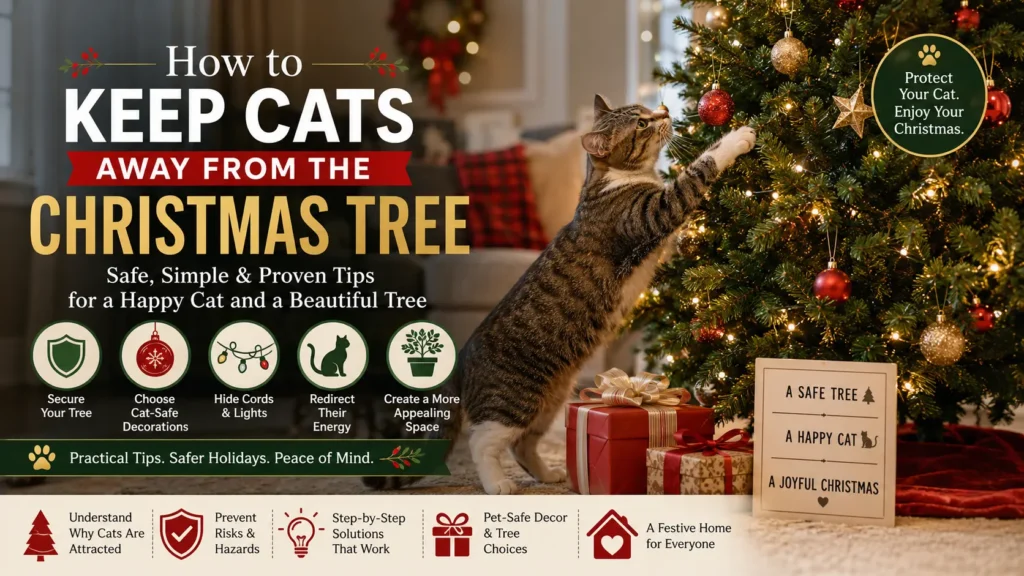
You spend an afternoon assembling and decorating the perfect Christmas tree, step back to admire it, and within hours your cat has already scaled the trunk, batted three ornaments across the floor, and is eyeing the angel on top like a personal challenge. If this sounds familiar, you are far from alone. Cats and Christmas trees have a famously complicated relationship, and a climbing, chewing, ornament-stealing cat is one of the most common holiday headaches for pet owners.
The good news is that you do not have to choose between a beautiful tree and a happy, safe cat. With a few thoughtful adjustments to where you place the tree, how you secure it, what you decorate it with, and how you redirect your cat’s energy, you can absolutely have both. Most cat owners assume the problem is hopeless, but it almost always comes down to a handful of practical fixes.
This complete guide from MyChristmasTrees.online walks through exactly why cats are drawn to Christmas trees, which decorations and materials pose real risks, and the proven, step-by-step methods to keep your cat away from the tree. You’ll also learn which tree types and styles work best for homes with cats, how to light and decorate safely, and the common mistakes that quietly make the problem worse. By the end, you’ll have a clear, pet-safe plan for a festive home everyone can enjoy.
Why Cats Love Christmas Trees
To keep your cat away from the tree, it helps to understand why the tree is so irresistible in the first place. From a cat’s point of view, you have essentially installed the greatest toy imaginable in the middle of the living room.
Curiosity and novelty. Cats are deeply curious creatures, and a Christmas tree is a brand-new object that suddenly appears in their familiar territory. Anything new must be investigated, sniffed, climbed, and tested. The tree’s sudden arrival practically demands inspection.
Climbing instincts. Cats are natural climbers who instinctively seek out high vantage points. A tree, real or artificial, mimics the exact kind of vertical structure a cat would scale in the wild. The branches look like footholds, and the height looks like a prize worth claiming.
New and interesting smells. A real tree brings the scent of sap, pine, and the outdoors directly into the home, which is endlessly fascinating to a cat’s sensitive nose. Even artificial trees carry the smell of storage, plastic, and your handling, all of which invite closer investigation.
Hanging, dangling ornaments. To a cat, a shiny ornament swaying gently on a branch is indistinguishable from a toy. Dangling objects trigger a cat’s prey drive, making them almost impossible to ignore. Every ornament looks like it was hung specifically to be swatted.
Twinkling lights. Moving points of light captivate cats. Twinkling or blinking lights mimic the small, darting movements of prey, drawing feline attention and tempting a closer look or a pounce.
Moving branches. Branches that bounce and rustle when touched provide instant feedback that encourages a cat to keep batting and climbing. The tree responds to play, which makes it even more engaging.
Understanding these motivations is the foundation of every strategy that follows. You are not fighting bad behavior; you are working with natural instincts and redirecting them.
Is It Dangerous If Cats Climb Christmas Trees?
A cat climbing the tree is not just an annoyance. It can create genuine safety risks for both the cat and your home. Knowing the hazards helps you prioritize which fixes matter most.
The biggest immediate danger is a falling tree. A determined cat climbing the branches can easily tip an unsecured tree, which can injure the cat, damage your floor, shatter decorations, and create a tangle of cords and glass. Beyond the tree itself, several decorations and materials carry their own risks.
| Hazard | Why It’s a Risk | What to Do |
|---|---|---|
| Falling tree | A climbing cat can topple an unsecured tree, causing injury and damage | Anchor the tree securely to the wall or ceiling |
| Broken ornaments | Glass shards can cut paws, mouths, and skin | Use shatterproof ornaments, especially on lower branches |
| Electrical cords | Chewing cords risks electric shock and burns | Hide, cover, and secure all cords |
| Chewing lights | Bulbs and wiring can cause shock or cuts | Keep light strands tucked into branches, away from reach |
| Tinsel | Extremely tempting to swallow; can cause serious intestinal blockages | Avoid tinsel entirely in homes with cats |
| Artificial snow and flocking | Can cause stomach upset if chewed or swallowed | Choose carefully and supervise; rinse paws if needed |
| Tree preservatives | Chemicals in real tree water can be toxic if a cat drinks it | Cover the water reservoir and block access |
| Toxic decorations | Some edible or scented decorations are harmful to cats | Avoid edible ornaments and unsafe materials |
Cat Safety Checklist for Christmas Trees
- Tree is anchored to a wall, ceiling, or weighted base
- All electrical cords are hidden and secured
- No tinsel anywhere on or near the tree
- Lower branches use only shatterproof ornaments
- Real tree water reservoir is covered and inaccessible
- No edible or toxic decorations within reach
- Fragile, sentimental ornaments placed high and secure
- Gifts with ribbon and small parts kept away until needed
Tinsel deserves special mention. It is one of the most dangerous holiday items for cats because they love to play with it and swallow it, and once ingested it can cause life-threatening intestinal blockages. The simplest solution is to skip tinsel completely if you share your home with a cat.
How to Keep a Cat Away From a Christmas Tree
Here is the heart of the guide: a detailed, step-by-step approach to keeping your cat away from the tree. No single tactic is a magic fix, but combining several of these reliably solves the problem for the vast majority of cat owners.
Choose the Right Tree Location
Placement is your first and most powerful line of defense. Position the tree away from furniture your cat uses as launch pads, such as couches, bookshelves, side tables, and cat trees. Cats love to leap onto the tree from an elevated surface, so removing those nearby takeoff points dramatically reduces access. A corner location is ideal because it limits the angles from which a cat can approach and gives the tree more structural support on two sides.
Secure the Tree Properly
If you do nothing else, secure your tree. Use a sturdy, wide, heavy base and, for extra security, anchor the top of the tree to the wall or ceiling using clear fishing line or a discreet hook. This single step prevents the worst-case scenario of a toppling tree. Anchoring is especially important for larger or top-heavy trees and for homes with energetic or large cats. A well-secured tree can withstand a curious cat far better than one balanced on a flimsy stand.
Hide Electrical Cords
Exposed cords are both a chewing hazard and a temptation. Run cords along walls and tape them down or tuck them into cord covers and protectors. Unplug the lights when you are not home or asleep to eliminate the risk of shock entirely during unsupervised hours. Bundling and concealing cords also makes your setup look cleaner, so this is a win for both safety and style.
Avoid Tempting Decorations
The fewer dangling, shiny, fluttering items at cat level, the less interested your cat will be. Keep the lowest two to three feet of the tree relatively sparse, reserving your most eye-catching ornaments for the higher branches. Skip tinsel, dangling ribbons, and edible decorations entirely. A tree that is boring at cat height is a tree your cat is far more likely to leave alone.
Create Alternative Climbing Areas
Cats climb because they need vertical territory. If the tree is the most interesting tall thing in the room, it wins by default. Provide an appealing alternative such as a tall cat tree, a window perch, or a set of wall shelves placed away from the Christmas tree. Giving your cat its own legitimate climbing outlet satisfies the instinct that would otherwise be aimed at your tree.
Use Safe Deterrents
Cats dislike certain textures and scents, and you can use this to your advantage. Placing aluminum foil or double-sided tape around the base of the tree creates an unpleasant surface cats prefer to avoid. Citrus scents are also naturally off-putting to many cats, so citrus-scented deterrents near the base can help. Always choose pet-safe deterrents and avoid anything that could harm your cat if touched or licked.
Distract With Toys
A bored cat is a tree-climbing cat. Increase play sessions during the holidays, especially in the evening when cats are most active. Interactive toys, puzzle feeders, and dedicated playtime burn off the energy that would otherwise be directed at the tree. A well-exercised, mentally stimulated cat is far less likely to see the tree as its main source of entertainment.
Introduce the Tree Gradually
Rather than presenting a fully decorated tree all at once, introduce it in stages. Set up the bare tree first and let your cat investigate it until the novelty wears off. After a few days, add lights, then ornaments. This gradual approach reduces the overwhelming excitement of a brand-new, fully loaded tree and lets your cat grow bored of it before the decorations even go on.
Which Christmas Trees Are Safest for Cat Owners?
The type of tree you choose has a real impact on safety and on how tempting the tree is to your cat. Here is how the main options compare from a pet owner’s perspective.
Artificial Trees
Artificial trees are often the better choice for cat owners. They shed no real needles, contain no sap, and require no water reservoir that a cat might drink from. They are also more stable when paired with a good base and are easy to anchor. The main caution is that some cats may chew on artificial needles, so supervision is still wise. Overall, artificial trees remove several of the hazards that come with real trees.
Real Trees
Real trees bring unbeatable fragrance and tradition, but they introduce extra risks for cats. The sap can irritate, fallen needles can be ingested or hurt paws, and the water in the stand often contains preservatives that are toxic if a cat drinks it. If you love a real tree, you can still have one safely by covering the water reservoir and cleaning up needles promptly. The trade-offs are manageable but real.
Pre-Lit Trees
Pre-lit trees are a strong option for cat households because the lights are integrated into the branches and there are fewer loose strands and exposed cords for a cat to chew. This built-in wiring is tucked deeper into the foliage and is generally harder for a cat to reach than draped light strands.
Slim Trees
Slim trees take up less floor space and present a smaller, less inviting target for climbing. With a narrower profile and fewer sprawling branches at the base, they give a cat less to grab onto. Paired with proper anchoring, a slim tree can be one of the most practical choices for a home with a curious cat.
If you are weighing your options, our complete real vs. artificial Christmas tree comparison breaks down every difference in detail. For those leaning artificial, it helps to know how long artificial Christmas trees last so you can judge long-term value, and if environmental impact matters to you, our guide on whether artificial Christmas trees are eco-friendly covers the full picture.
| Tree Type | Cat-Safety Advantage | Main Caution |
|---|---|---|
| Artificial | No sap, needles, or water; easy to anchor | Some cats chew artificial needles |
| Real | Natural and traditional | Sap, fallen needles, and toxic stand water |
| Pre-lit | Fewer exposed cords and loose light strands | Built-in lights are harder to replace if damaged |
| Slim | Smaller climbing target, less floor footprint | Holds fewer ornaments |
Are Flocked Christmas Trees Safe for Cats?
Flocked trees, with their snowy white coating, are beautiful but raise understandable questions for cat owners. The flocking itself is an artificial coating designed to mimic snow, and the main concern is what happens if a cat chews on it or swallows fallen flakes.
In small amounts, modern flocking is generally low in toxicity, but it can still cause stomach upset if a cat ingests it, and chewing on coated branches is a habit worth discouraging. The bigger nuisance is shedding, since flakes that fall to the floor can be batted around, tracked through the house, and occasionally licked off paws. For a deeper look at the materials involved, our guide on whether flocked Christmas trees are toxic explains exactly what flocking is made of and what to watch for.
If you love the snowy look but worry about your cat, it helps to understand the full picture first. Our complete guide to flocked Christmas trees covers how they’re made and how to care for them, and to minimize the mess that tempts curious cats, our tips on how to stop flocked Christmas trees from shedding snow everywhere will keep stray flakes off the floor and away from your pet. Choosing a high-quality, well-sealed flocked tree and supervising your cat goes a long way.
The Safest Christmas Tree Decorations for Homes With Cats
Your choice of ornaments matters enormously in a cat household. The right decorations stay festive while removing the temptation and danger that come with breakable, swallowable, or dangling items.
Safer choices:
- Fabric ornaments are soft, lightweight, and harmless if batted to the floor.
- Wooden ornaments are durable, natural, and won’t shatter.
- Plastic ornaments are inexpensive and shatterproof, ideal for lower branches.
- Shatterproof decorations of any material give you peace of mind if a cat sends them flying.
Decorations to avoid:
- Glass ornaments can shatter into sharp shards that cut paws and mouths.
- Tinsel is dangerously tempting and can cause serious intestinal blockages if swallowed.
- Edible decorations like candy canes, popcorn strings, and chocolate attract cats and can be toxic.
- Dangling ribbons invite chewing and can cause blockages similar to tinsel.
A smart strategy is to zone your tree. Place soft, shatterproof, inexpensive ornaments on the lower third of the tree where your cat can reach, and reserve sentimental, fragile, or glass pieces for the upper branches well out of paw’s reach. Securing ornaments firmly to branches rather than loosely hanging them also reduces how easily a cat can knock them down.
If you enjoy a coordinated, handmade look, our guide to DIY tree skirts and ornaments that match flocked trees offers ideas for crafting safe, attractive decorations that suit your style while keeping breakables to a minimum.
Cat-Friendly Christmas Tree Lighting
Lighting is one of the most important and most overlooked safety considerations for cat owners. Lights mean cords, and cords mean chewing risk, so getting your lighting right protects your cat while keeping the tree beautiful.
LED lights are the clear winner for homes with cats. They run far cooler than older incandescent bulbs, which reduces the risk of burns if a cat brushes against them, and they draw less power overall. Cord management is equally critical. Tuck light strands deep into the branches rather than draping them on the surface, run the main cord down the back of the tree, and secure everything so there are no tempting loose loops at cat level. Unplugging the lights when you are away or asleep removes the shock risk during the hours you can’t supervise.
For a complete walkthrough of bulb types, placement, and technique, our Christmas tree lights and lighting guide covers everything you need to know. If you’re deciding which bulbs to buy, our comparison of LED vs. incandescent Christmas lights explains why cooler LEDs are the safer pick for pet homes. And if you’re using a pre-lit tree, our overview of pre-lit Christmas tree fire and electrical safety will help you keep the wiring safe all season.
Best Christmas Tree Styles for Cat Owners
Beyond the tree type, the style and footprint of your tree can make a real difference in how tempting it is to a cat. Certain layouts simply give cats fewer opportunities to climb.
Slim trees offer a narrow profile that presents a smaller climbing target while still delivering full height and visual impact. For the smallest spaces, our guide to slim and pencil Christmas trees for small spaces shows the best options.
Pencil trees are even narrower, with branches that hug the trunk closely, leaving little for a cat to grab.
Tabletop trees lift the entire tree onto a stable surface, putting it out of easy reach of cats who roam the floor. Our roundup of the best tabletop Christmas trees for small spaces is a great starting point, though you’ll want to ensure the surface itself isn’t a favorite cat perch.
Wall-mounted trees remove the floor footprint entirely and place the tree out of a cat’s normal path, which can be a clever solution for determined climbers. Our wall-mounted Christmas tree ideas show how to do it without sacrificing the festive look.
Corner trees tuck the tree into a protected nook, limiting the angles of approach and adding stability. Our corner Christmas tree setup ideas explain how to make the most of this naturally cat-friendly placement.
Where Should You Place Your Christmas Tree If You Have Cats?
Placement deserves its own focused look because it influences everything else. The ideal spot for a cat household is a corner, which provides natural support on two sides and reduces the number of directions from which a cat can launch an attack.
Keep the tree away from shelves, bookcases, countertops, and any climbing furniture that a cat could use as a springboard to leap into the branches. The goal is to eliminate elevated takeoff points within jumping distance. Stable, level flooring matters too, since a tree on uneven ground is far more likely to wobble and tip when a curious cat tests it.
For larger trees, thoughtful placement becomes even more important for both safety and visual effect. Our guide on where to place a 10-foot Christmas tree for maximum impact offers principles that apply to trees of any size, helping you find a spot that is both stunning and secure.
Common Mistakes Cat Owners Make
Even well-meaning cat owners often make small mistakes that quietly undermine all their efforts. Here are the most common pitfalls and how to fix them.
| Mistake | Why It Backfires | The Fix |
|---|---|---|
| Decorating too early | Gives your cat weeks to treat the tree as a toy | Set up closer to the holiday, or introduce the tree gradually |
| Hanging ornaments too low | Puts breakable, swallowable items right at paw level | Keep the lowest branches sparse and shatterproof |
| Leaving cords exposed | Invites chewing and shock risk | Hide, cover, and unplug cords when unsupervised |
| Using glass decorations | Creates sharp shards when knocked down | Switch to shatterproof ornaments, especially down low |
| Ignoring tree stability | Allows a climbing cat to topple the whole tree | Use a heavy base and anchor the tree to the wall |
| Leaving gifts out too soon | Ribbons, bows, and small parts tempt and endanger cats | Place gifts out only when you can supervise |
Decorating too early is one of the most underestimated mistakes. The longer a fully decorated tree stands in your home, the more time your cat has to become obsessed with it. Setting up later, or revealing the tree in gradual stages, takes advantage of a cat’s tendency to lose interest once the novelty fades.
Expert Recommendations
After all of this, the most reassuring message for cat owners is this: you almost certainly do not need to give up your Christmas tree. The image of a household forced to choose between a festive home and a safe pet is simply not accurate. The overwhelming majority of cat owners solve this problem with a handful of sensible adjustments.
If we had to prioritize, four steps do most of the heavy lifting. Secure the tree so it cannot topple, choose shatterproof ornaments for the reachable branches, manage and conceal your electrical cords, and provide your cat with alternative enrichment such as a cat tree and extra playtime. Those four moves address the biggest risks and the strongest temptations at the same time.
What we would personally choose for a cat household is a well-anchored artificial or slim tree placed in a corner, lit with cool-running LED lights, decorated with shatterproof ornaments down low and sentimental pieces up high, and paired with a tall cat tree nearby to satisfy the climbing instinct. That combination delivers a beautiful tree while removing nearly every hazard and temptation. You are not fighting your cat’s nature; you are simply working around it.
Final Verdict
So, how do you keep a cat away from a Christmas tree? The answer is a layered approach rather than any single trick. Anchor the tree securely so it cannot fall, place it in a corner away from climbing furniture, keep the lower branches sparse and shatterproof, hide and unplug your cords, skip tinsel and edible decorations entirely, and give your cat its own climbing outlet and plenty of play to burn off energy.
Here is a concise action plan you can follow this week:
- Anchor the tree to the wall and use a heavy, stable base.
- Place it in a corner, away from couches, shelves, and cat trees.
- Decorate the lower third with only soft, shatterproof ornaments.
- Hide all cords, use cool LED lights, and unplug when unsupervised.
- Remove tinsel, ribbons, and edible decorations from the equation.
- Set up a cat tree nearby and schedule extra play sessions.
- Introduce the tree gradually so the novelty wears off early.
Follow those steps and you will have addressed every major risk and temptation in one coordinated plan.
Conclusion
Keeping a cat away from the Christmas tree is one of the most common holiday challenges, but it is also one of the most solvable. The behavior that frustrates you is rooted in natural feline instincts, which means the solution is never about punishing your cat. It is about anticipating those instincts and designing your tree and your room so the tree is both safe and far less tempting.
The best prevention methods come down to stability, smart decoration choices, and redirection. A securely anchored tree, ideally an artificial or slim model placed in a corner, removes the danger of toppling. Shatterproof ornaments on the lower branches and well-managed LED lighting eliminate the most common hazards. And providing your cat with its own climbing space and enrichment redirects the energy that would otherwise be aimed at your tree.
With these adjustments in place, you can stop worrying and start enjoying the season. A beautiful, festive Christmas tree and a safe, content cat are not mutually exclusive. A little planning is all it takes to give everyone in your home, two-legged and four-legged alike, a happy and safe holiday.
Frequently Asked Questions
How do you keep a cat away from a Christmas tree?
Use a layered approach: anchor the tree to the wall, place it in a corner away from climbing furniture, keep the lower branches sparse and shatterproof, hide and unplug cords, avoid tinsel and edible decorations, and give your cat an alternative climbing spot plus extra playtime to burn off energy.
Why is my cat so obsessed with the Christmas tree?
Cats are drawn to Christmas trees by curiosity, their natural climbing instinct, new smells, and the movement of dangling ornaments and twinkling lights. The tree is essentially a giant new toy that appears in their territory, triggering several instincts at once.
Is it dangerous for cats to climb Christmas trees?
Yes, it can be. The main risks are the tree toppling and injuring the cat, broken glass ornaments cutting paws, chewing on electrical cords, swallowing tinsel and causing intestinal blockages, and drinking toxic preservative water from a real tree stand.
What can I put around my Christmas tree to keep cats away?
Cats tend to avoid aluminum foil and double-sided tape around the base, as well as citrus scents, which many cats dislike. Always use pet-safe deterrents. Combining these with a sparse, boring lower section of the tree works best.
Are artificial Christmas trees safer for cats than real trees?
Generally yes. Artificial trees have no sap, no fallen needles to ingest, and no water reservoir with toxic preservatives. The main caution is that some cats may chew artificial needles, so supervision is still recommended.
Is tinsel dangerous for cats?
Tinsel is one of the most dangerous holiday items for cats. They love to play with and swallow it, and once ingested it can cause serious, potentially life-threatening intestinal blockages. The safest choice is to avoid tinsel entirely in a home with cats.
Are flocked Christmas trees safe for cats?
Modern flocking is generally low in toxicity in small amounts, but it can cause stomach upset if a cat chews or swallows it. Choosing a high-quality, well-sealed flocked tree, minimizing shedding, and supervising your cat reduces the risk considerably.
Which Christmas tree decorations are safest for cats?
Fabric, wooden, plastic, and other shatterproof ornaments are safest, especially on lower branches. Avoid glass ornaments, tinsel, edible decorations, and dangling ribbons, all of which can injure a cat or cause dangerous blockages if chewed or swallowed.
Where should I put my Christmas tree if I have cats?
Place the tree in a corner for added stability and fewer approach angles, away from couches, shelves, and other furniture a cat could leap from. Make sure it sits on stable, level flooring and is anchored to the wall to prevent tipping.
Do cats eventually lose interest in the Christmas tree?
Many cats do lose interest once the novelty fades, which is why introducing the tree gradually helps. Setting up the bare tree first and letting your cat investigate it before decorating allows the excitement to wear off before ornaments and lights are added.