
Every December, millions of homes glow a little brighter as families haul out boxes of ornaments, untangle strings of lights, and gather around a freshly decorated evergreen. The Christmas tree is one of the most instantly recognizable symbols of the holiday season anywhere in the world, yet most people who decorate one each year have never paused to ask what it actually means. Why an evergreen? Why lights? Why a star on top instead of something else entirely?
The truth is that the Christmas tree carries layers of meaning built up over centuries, blending ancient winter customs, European folk traditions, Christian symbolism, and modern family ritual into a single object standing in the corner of the living room. Understanding what the Christmas tree represents makes the tradition richer, and it often changes the way people decorate once they realize the story behind each element.
This guide from MyChristmasTrees.online walks through the complete meaning of the Christmas tree: its symbolism, its history, its religious significance, what each decoration represents, and why families keep the tradition alive year after year. By the end, you’ll understand not just what the Christmas tree represents, but why it has held such a powerful place in homes for hundreds of years.
What Does the Christmas Tree Represent?
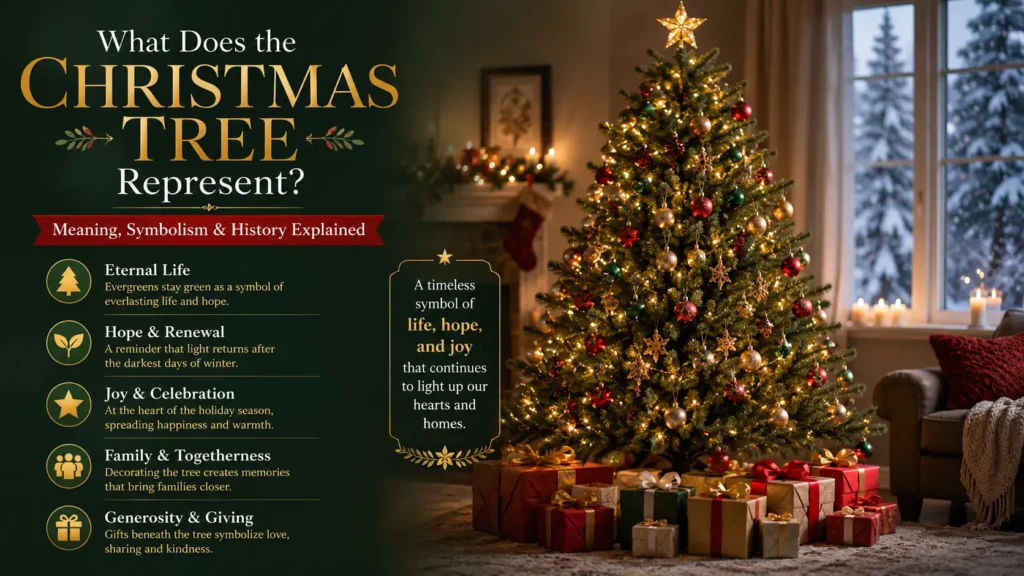
The Christmas tree represents hope, eternal life, joy, and renewal during the darkest part of the year. Because evergreens stay green when every other tree has lost its leaves, they became a natural symbol of life enduring through winter, light returning after darkness, and the promise of spring to come. Over time, those ideas merged with Christian themes of everlasting life and with the simple human joy of gathering family together to celebrate.
In modern homes, the Christmas tree symbolizes far more than any single tradition. It stands for togetherness, family memory, generosity, celebration, and the warmth of the season. The act of decorating it has become a ritual that marks the start of the holidays and gives families a shared moment to slow down and connect.
Quick Summary: What the Christmas Tree Symbolizes
- Eternal life because evergreens never lose their color
- Hope and renewal as a sign that light returns after winter
- Joy and celebration at the heart of the holiday season
- Family and togetherness through the shared act of decorating
- Light in darkness, reflected in the tradition of tree lights
- Generosity, with gifts gathered beneath the branches
The beauty of the Christmas tree is that it holds different meanings for different people. For some it is deeply religious, for others purely cultural, and for many it is simply a cherished family tradition. All of those meanings are valid, and they have coexisted comfortably for generations.
Why Evergreen Trees Became Symbols of Winter
Long before anyone strung a light on a branch, evergreen plants held a special place in human imagination. The reason is simple and powerful: in the depths of winter, when deciduous trees stood bare and the landscape looked lifeless, evergreens stayed vivid and green. To people watching the world seemingly die each autumn, a tree that refused to fade felt almost miraculous.
Ancient cultures across Europe and the Mediterranean brought evergreen boughs into their homes during the coldest months. Fir, pine, spruce, holly, and other greenery were hung over doors and windows as a reminder that life continued even when the ground was frozen. The branches symbolized survival, vitality, and the certainty that warmer days would return.
This connection between evergreens and winter survival is the foundation of the entire Christmas tree tradition. The evergreen represented the triumph of life over the harshness of the season. When the days were shortest and coldest, the unchanging green of these trees offered visual proof that nature endured. That symbolism of persistence and renewal was so universal that it survived through enormous cultural and religious change, eventually settling into the holiday tree we recognize today.
It is worth noting that evergreens also carried associations with protection and well-being in many folk traditions. A green branch in the home was thought to invite good fortune and ward off the gloom of midwinter. Whether or not people believed those ideas literally, the emotional logic is easy to understand. Bringing living green into a dark, cold house simply made the season feel more bearable and more hopeful.
The History of Christmas Trees
The decorated Christmas tree as we know it developed gradually over several centuries, with its clearest roots in Germany. Understanding the timeline helps explain how a regional folk custom became a global tradition.
| Era | Development |
|---|---|
| Ancient times | Evergreen boughs used in homes during winter festivals as symbols of life and renewal |
| Medieval Europe | “Paradise trees” decorated with apples appeared in religious plays, linking evergreens to faith |
| 16th century Germany | Devout families began bringing decorated evergreen trees into homes; candles were added |
| 18th century | The custom spread among German nobility and the upper classes across German-speaking regions |
| 1840s Victorian era | The royal family’s decorated tree popularized the tradition across Britain |
| 19th century America | German immigrants brought the custom to the United States, where it steadily spread |
| 20th century | Electric lights, artificial trees, and commercial ornaments made trees accessible to nearly everyone |
| Today | A global tradition embraced across cultures, religions, and continents |
Early European Traditions
The earliest threads of the tradition reach back to medieval Europe, where evergreens appeared in religious plays and celebrations. So-called paradise trees, decorated with apples, were used to tell the story of the Garden of Eden during winter performances. These early decorated evergreens helped cement the connection between trees and the holiday season in the popular imagination.
Germany and the Birth of the Modern Tree
Germany is widely recognized as the birthplace of the modern Christmas tree. By the 16th century, families in German-speaking regions were bringing evergreen trees indoors and decorating them with candles, fruit, nuts, and small handmade ornaments. The glow of candlelight on the branches created a warm, almost magical atmosphere that captured the spirit of the season. This is the custom that would eventually spread across the world.
The Victorian Era
The Christmas tree became fashionable far beyond Germany during the Victorian era. When the tradition was embraced by British royalty in the 1840s, illustrations of the royal family gathered around a decorated tree spread widely and made the custom aspirational. Almost overnight, the Christmas tree shifted from a regional folk practice to a symbol of warm, respectable family life that households across Britain and beyond wanted to imitate.
Global Popularity
From Britain and Germany, the tradition traveled with immigrants and through popular culture to nearly every corner of the globe. German settlers carried it to the United States, where it took firm root in the 19th century. Improvements in manufacturing eventually made ornaments, lights, and even entire artificial trees affordable for ordinary families, and the Christmas tree became the household centerpiece it remains today.
Religious Meaning of the Christmas Tree
For many people, the Christmas tree carries Christian symbolism, even though the custom itself grew out of older evergreen traditions. Over the centuries, Christian families gave the tree’s existing symbols new layers of spiritual meaning that resonate deeply during the holiday.
The evergreen itself came to represent everlasting life, a central theme in Christian belief. A tree that stays green through the deadest part of the year became a natural emblem of eternal life and enduring faith. The triangular shape of many trees has also been interpreted as a reminder of the Holy Trinity.
Several specific decorations took on religious significance as well:
- The star placed at the top recalls the Star of Bethlehem, which guided travelers to the birthplace of Jesus.
- The angel, used as an alternative tree topper, represents the angels who announced the nativity.
- The lights symbolize Christ as the light of the world and the hope that light brings into darkness.
- The evergreen branches stand for everlasting life and the continuity of faith.
It is important to present this balanced. The Christmas tree is meaningful to religious and secular families alike, and the tradition has always been broad enough to welcome both. Many households treasure the tree purely as a cultural and family custom, while others view it through a deeply spiritual lens. Neither interpretation is more correct than the other, and the tree’s enduring popularity comes precisely from its ability to hold many meanings at once.
What Different Parts of a Christmas Tree Represent
One of the most fascinating aspects of the Christmas tree is that nearly every decoration carries its own symbolism. Understanding what each element represents can make decorating feel more intentional and meaningful.
The Star
The star traditionally sits at the very top of the tree and is one of its most symbolic elements. It represents the Star of Bethlehem and, more broadly, guidance, hope, and aspiration. Even in secular homes, the star at the peak signals reaching upward and looking toward something bright.
The Angel
The angel is the most common alternative to the star as a tree topper. It represents the heavenly messengers of the nativity story and, in a wider sense, protection, peace, and goodwill. Many families pass an angel topper down through generations, adding sentimental meaning to its symbolic one.
Christmas Lights
Lights are perhaps the most emotionally powerful part of the tree. They descend from the old tradition of placing candles on the branches, and they symbolize light overcoming darkness during the longest nights of the year. The warm glow of a lit tree captures the comfort and hope at the center of the season.
Ornaments
Ornaments began as edible decorations like apples and nuts, which symbolized abundance and the gifts of nature. Today they carry personal meaning, with each ornament often tied to a memory, a person, or a milestone. Collectively, ornaments represent celebration, family history, and the accumulated stories of many Christmases.
Garland
Garland wrapped around the tree represents unity and continuity, drawing the eye in a continuous line from top to bottom. Like the evergreen itself, garland made from greenery echoes the themes of life and abundance, while beaded or ribbon garland adds a sense of festivity and movement.
Ribbon
Ribbon is a more recent decorative addition, but it carries its own gentle symbolism of gift-giving and generosity. Woven through the branches, ribbon ties the tree together visually and evokes the wrapped presents waiting beneath it.
Tree Skirt
The tree skirt at the base is partly practical and partly symbolic. Originally meant to catch dripping candle wax and fallen needles, it grew into a decorative element that frames the tree and creates a tidy, finished foundation. It represents the grounding and warmth of the home that the tree sits within.
Tree Topper
The tree topper, whether a star, an angel, or something more personal, crowns the entire display. It represents the culmination of the decorating process and the highest point of meaning on the tree. Choosing a topper is often the most personal decorating decision a family makes.
Why Families Continue the Tradition Today
If you ask people why they put up a Christmas tree, very few will mention evergreen symbolism or medieval history. They put one up because it feels like Christmas, and because doing so connects them to people they love and to memories built over a lifetime.
The tree has become a powerful vessel for family memory. Many households own ornaments that have been passed down for generations or collected from special trips and milestones. Unboxing them each year is like reopening a scrapbook, with every ornament sparking a story. That is why a slightly imperfect, sentimental tree often means more to a family than a flawless designer display.
Decorating together is itself a cherished ritual. The act of assembling the tree, stringing the lights, and hanging ornaments gives families a shared activity in an increasingly busy world. For children especially, the tree is pure magic. The anticipation, the glowing lights, and the gifts gathering underneath create the kind of excitement that becomes a core childhood memory.
Ultimately, families continue the tradition because it works. It brings people together, marks the season, delights children, and connects each new Christmas to all the ones that came before. The symbolism may run deep, but the everyday reason is simple human warmth.
How Christmas Tree Traditions Have Changed
While the meaning of the Christmas tree has stayed remarkably consistent, the way families bring trees into their homes has changed dramatically, especially over the past century.
The biggest shift has been the rise of the artificial Christmas tree. Once a novelty, artificial trees are now found in a large share of homes thanks to their convenience, reusability, and consistent shape. They allow families to enjoy the symbolism and beauty of a tree without the watering, needle cleanup, or annual repurchasing that real trees require.
Pre-lit trees have taken convenience even further. By building the lights directly into the branches, they eliminate the most frustrating part of decorating and ensure even, professional-looking light distribution. For many families, the time saved during setup makes them well worth the additional cost.
Modern decorating has also evolved stylistically. Coordinated color themes, designer ribbon, and layered techniques have made it easier than ever to create a polished look at home. At the same time, smart lights now let people control color and brightness from a phone, adding a layer of technology the Victorians could never have imagined.
Sustainability has become part of the conversation too. Families increasingly weigh the environmental trade-offs of real versus artificial trees, consider the lifespan of their decorations, and look for ways to make the tradition more responsible. What has not changed is the meaning at the center of it all. Whether the tree is real or artificial, candlelit or smart-lit, it still represents the same hope, joy, and togetherness it always has.
Choosing the Right Christmas Tree
Once you understand what the Christmas tree represents, the natural next question is which kind of tree best fits your home and your family. The two main options, real and artificial, each carry their own appeal, and the right choice depends on your priorities around fragrance, convenience, cost, and tradition.
There is no universally correct answer, but there are clearly better choices for different situations. A family that treasures the sensory experience of the holidays may lean toward a fresh-cut tree, while a household focused on convenience and long-term value may prefer artificial. If you’re weighing the decision, our detailed real vs. artificial Christmas tree comparison breaks down the trade-offs in full so you can decide with confidence.
Real Trees and Their Traditional Appeal
For many families, nothing fully replaces a real Christmas tree. The appeal is rooted in the senses and in tradition itself. A fresh evergreen fills the home with a fragrance that no candle or spray can perfectly imitate, and that scent is for many people the very smell of Christmas.
Real trees also have a natural beauty and irregularity that feels authentic. Each one is slightly different, with its own shape, character, and presence. The ritual of choosing a tree, bringing it home, and setting it up is, for some families, an irreplaceable part of the season. Different species carry different scents and appearances, and if fragrance matters to you, it’s worth learning which type of Christmas tree smells better and why it matters before you buy.
The trade-off is maintenance. Real trees need water, drop needles, and last only a few weeks indoors. Keeping one fresh and beautiful through the whole season takes a little effort, and our real Christmas tree care guide on watering and longevity covers exactly how to get the longest, healthiest life out of a fresh-cut tree.
Why Many Families Choose Artificial Trees
Artificial Christmas trees have become the default choice in a large share of homes, and the reasons are practical. Convenience is the biggest draw. There is no watering, no needle cleanup, no annual trip to a lot, and no worry about a tree drying out before the holiday is over. The tree comes out of storage, gets assembled, and is ready to enjoy.
Longevity and value are major factors too. A quality artificial tree can be reused for many years, and over time it often costs less than buying a fresh tree every season. How many seasons you’ll get depends on quality and care, and our guide to how long artificial Christmas trees last explains what to expect from budget, mid-range, and premium models.
Storage is part of the appeal as well, since a single tree can be packed away and brought out year after year. Many families also weigh environmental considerations, and the picture is more nuanced than it first appears. If sustainability matters to you, it’s worth reading whether artificial Christmas trees are eco-friendly and reviewing the full cost comparison of real vs. artificial Christmas trees over 10 years to see how the numbers actually play out over time.
Christmas Tree Lights and Their Symbolism
Of all the decorations on a Christmas tree, lights may carry the deepest symbolism. They descend directly from the old practice of placing lit candles on the branches, a custom that filled the home with a soft, flickering glow during the darkest nights of the year.
The symbolism of light is universal and ancient. Light overcoming darkness speaks to hope, guidance, and renewal, themes that sit at the very heart of the winter season. A lit tree transforms a room, creating warmth and atmosphere that no other decoration can match. This is why so many decorating experts consider lighting more important than ornaments. A beautifully lit tree with simple decorations almost always looks better than a poorly lit tree covered in expensive ornaments.
Getting the lighting right is both an art and a matter of quantity. If you want to understand bulb types, placement techniques, and the full approach to a professional glow, our complete Christmas tree lights and lighting guide covers everything you need to know. And if you simply want to know the right amount to buy, the guide to how many lights you need for a Christmas tree gives clear benchmarks based on tree height.
Decorating a Meaningful Christmas Tree
Once you understand the symbolism behind the tree, decorating becomes about more than just filling the branches. It becomes a chance to tell your family’s story. The most meaningful trees are rarely the most expensive ones. They are the ones layered with personal history and intention.
Family ornaments are the soul of a meaningful tree. Pieces handed down through generations, collected on trips, or marking milestones turn the tree into a living scrapbook. Handmade decorations, especially those made by children, carry enormous sentimental weight and often become the most treasured pieces of all.
A thoughtful color theme can elevate the whole display. Choosing a cohesive palette helps even a collection of mismatched ornaments feel intentional and polished. Memory ornaments, those tied to specific people or moments, give the tree emotional depth that no store-bought set can replicate. The goal is balance between beauty and meaning.
If you want to plan a cohesive look, our complete guide to Christmas tree decoration styles and themes walks through palettes and approaches for every taste. To get the quantities right, the Christmas tree decoration calculator helps you plan exactly how much you need, and the Christmas tree ornament calculator takes the guesswork out of how many ornaments will fill your tree beautifully.
Does Tree Size Change the Meaning?
A common question is whether a small tree means less than a large one. The answer is a clear no. The symbolism of the Christmas tree remains exactly the same regardless of size. A two-foot tabletop tree in a studio apartment carries every bit as much meaning as a towering display in a grand home.
What changes with size is the practical impact, not the symbolic one. In small apartments, a slim or tabletop tree preserves valuable floor space while still delivering the hope, joy, and togetherness the tree represents. In large homes, a full-sized tree can serve as a dramatic centerpiece, but it does not hold more meaning simply because it is bigger.
For family gatherings, what matters most is the gathering itself. A modest tree surrounded by loved ones embodies the spirit of the season far better than an enormous, impersonal display. The meaning lives in the people around the tree, not in its height.
That said, choosing the right size for your space genuinely improves the result. Most people actually buy trees that are too large for their rooms. If you want to get the proportions right, our guide on what height Christmas tree you should buy for your home offers clear recommendations, and for tighter spaces, the guide to small-space and apartment Christmas trees shows how to create a stunning display without sacrificing room.
Common Misconceptions About Christmas Trees
Because the Christmas tree has such a long and layered history, several misconceptions have grown up around it. Clearing these up helps people appreciate the tradition more accurately.
Misconception: The Christmas tree is purely pagan. It is often claimed that the Christmas tree is simply a repackaged pagan ritual. The reality is more nuanced. While ancient cultures did use evergreens in winter customs, the decorated indoor Christmas tree as we know it developed much later in Christian Europe. The tradition draws on older evergreen symbolism but is not a direct continuation of any single ancient ceremony.
Misconception: You must be religious to have a Christmas tree. Many people assume the tree is strictly religious, but it has always been embraced by secular and religious families alike. For countless households, the tree is a cultural and family tradition with no specific religious requirement at all.
Misconception: Artificial trees are not “real” Christmas trees. Some believe only a fresh-cut tree counts. In truth, an artificial tree carries exactly the same symbolism and meaning. The hope, joy, and togetherness a tree represents do not depend on whether its needles are living.
Misconception: Modern trees have lost their meaning. With smart lights, designer themes, and artificial materials, some worry the tree has become hollow or commercial. But the core meaning has proven remarkably durable. Families still gather, still decorate together, and still build memories. The technology has changed; the heart of the tradition has not.
Interesting Christmas Tree Facts
The Christmas tree has accumulated plenty of fascinating history and trivia over the centuries. Here are some highlights worth knowing.
- The tradition of the decorated indoor Christmas tree is most strongly associated with Germany, which is widely regarded as its birthplace.
- Early Christmas trees were lit with real candles, which made them beautiful but also a significant fire hazard before electric lights arrived.
- The earliest tree decorations were often edible, including apples, nuts, and sweets, symbolizing abundance and the gifts of nature.
- The Victorian era was a turning point that transformed the Christmas tree from a regional custom into a fashionable, widely imitated tradition.
- German immigrants were largely responsible for spreading the Christmas tree tradition to the United States in the 19th century.
- Record-breaking Christmas trees, both real and artificial, have reached extraordinary heights, with some towering displays exceeding the height of multi-story buildings.
- Many cities around the world host famous public Christmas trees that draw enormous crowds and have become beloved seasonal landmarks.
- The shift to electric lights in the 20th century made trees dramatically safer and helped fuel the explosion of elaborate home decorating.
Expert Perspective
After centuries of evolution, the Christmas tree has settled into a role that transcends any single origin story. While its roots reach into ancient evergreen symbolism and its branches hold deep religious meaning for many, the tree today functions primarily as a symbol of togetherness, generosity, hope, and cherished family tradition.
What makes the Christmas tree so enduring is its flexibility. It welcomes every family to bring their own meaning to it. A household can honor a deep religious faith, celebrate a purely cultural holiday, or simply create a warm space for children to feel the magic of the season, and the tree accommodates all of it gracefully. That openness is its quiet genius.
Our view is that the meaning of a Christmas tree is ultimately shaped by the people who gather around it. The symbolism gives the tradition its depth, but the family gives it its warmth. When you decorate with intention, choosing ornaments that mean something and lighting the tree with care, you are not just following a custom. You are adding your own chapter to a story that has been unfolding for hundreds of years.
Final Verdict
So, what does the Christmas tree represent? At its core, the Christmas tree represents hope, eternal life, joy, and renewal, symbolized by an evergreen that stays vibrant through the darkest, coldest part of the year. Historically, it grew from ancient evergreen winter customs into the decorated indoor tree born in Germany, spread by the Victorians, and carried around the world by immigrants and popular culture.
Culturally and spiritually, the tree carries layers of meaning. For Christian families it speaks to everlasting life and the light of the season, with the star, the angel, and the lights all holding religious significance. For others it is a beloved cultural tradition. And for nearly everyone, regardless of belief, it represents the same enduring values: togetherness, generosity, celebration, and the warmth of family.
The Christmas tree endures because it means something real to the people who put it up. Its symbolism is rich, its history is deep, and its emotional power is timeless.
Conclusion
The Christmas tree is far more than a seasonal decoration. It is a symbol shaped by centuries of history, carrying meanings that range from the ancient promise of life surviving winter to the modern joy of a family gathered in a glowing room. From its origins in German homes to its spread through the Victorian era and across the globe, the tree has consistently represented hope, renewal, light, and togetherness.
What makes the tradition so remarkable is how well it has held its meaning through enormous change. Candles became electric lights, real trees gained artificial counterparts, and simple handmade ornaments now share branches with smart bulbs and designer ribbon. Yet through all of it, the heart of the tree has stayed the same. It still brings families together, still delights children, and still marks the season with warmth and wonder.
Whether your tree is real or artificial, towering or tabletop, religious or simply festive, it carries the same enduring message. The Christmas tree represents the best of the season: hope in the darkness, joy in togetherness, and the timeless comfort of celebrating with the people you love. Understanding that meaning is the surest way to make every tree you decorate feel a little more special.
Frequently Asked Questions
What does the Christmas tree represent?
The Christmas tree represents hope, eternal life, joy, and renewal. Because evergreens stay green through winter, they symbolize life enduring through the darkest season. Today the tree also stands for togetherness, family memory, and the warmth of the holidays.
Why do we have Christmas trees?
We have Christmas trees thanks to a tradition that grew out of ancient evergreen winter customs and developed into the decorated indoor tree in 16th-century Germany. The custom spread through the Victorian era and around the world, becoming the holiday centerpiece it is today.
Is the Christmas tree religious?
The Christmas tree carries religious meaning for many people, with the evergreen symbolizing everlasting life and decorations like the star and angel holding Christian significance. However, it is also embraced as a purely cultural and family tradition by countless secular households.
What does the star on top of the Christmas tree mean?
The star represents the Star of Bethlehem, which in the nativity story guided travelers to the birthplace of Jesus. More broadly, it symbolizes hope, guidance, and aspiration, which is why it crowns the very top of the tree.
What do the lights on a Christmas tree symbolize?
Christmas tree lights descend from the old tradition of placing candles on the branches. They symbolize light overcoming darkness during the longest nights of the year, representing hope, guidance, and the warmth of the season.
Are Christmas trees pagan in origin?
While ancient cultures used evergreens in winter customs, the decorated indoor Christmas tree as we know it developed later in Christian Europe. The tradition draws on older evergreen symbolism but is not a direct continuation of any single pagan ceremony.
What is the difference in meaning between a real and an artificial tree?
There is no difference in meaning. A real tree and an artificial tree carry exactly the same symbolism of hope, joy, and togetherness. The choice between them is practical, based on fragrance, convenience, cost, and tradition, not on symbolic value.
Does the size of a Christmas tree change its meaning?
No. The symbolism of a Christmas tree is identical regardless of size. A small tabletop tree in an apartment carries just as much meaning as a large tree in a spacious home. The meaning lives in the people who gather around it.
Why are evergreen trees used for Christmas?
Evergreens are used because they stay green through winter when other trees lose their leaves. This made them a natural symbol of life enduring through the cold and dark, representing survival, hope, and the certainty that spring would return.
What do ornaments on a Christmas tree represent?
Ornaments originally came from edible decorations like apples and nuts that symbolized abundance and nature’s gifts. Today they represent celebration and family history, with many ornaments tied to specific memories, people, or milestones that make each tree personal.