

Living in a studio apartment does not mean giving up on a proper Christmas tree. It means making a smarter decision about which tree you bring home. The wrong choice, usually a wide, full-bodied tree bought without measuring, turns a cozy apartment into an obstacle course for the entire month of December. The right choice, a slim or pencil Christmas tree sized for your actual ceiling height and floor space, can make a studio apartment feel genuinely festive without sacrificing the room you need to live in.
Slim christmas trees have surged in popularity over the past several years, and it is not hard to see why. Apartment living is the norm for millions of people, and that number keeps growing. Alongside it, the demand for trees that fit a real apartment layout has pushed manufacturers to produce better, more attractive narrow options at every price point. You can find mychristmastrees.online that cover everything from budget-friendly options to beautifully detailed premium trees in slim profiles.
This guide is written specifically for studio apartment dwellers. It covers how to choose the right slim tree, where to put it, how to decorate it so it does not look sparse, and what mistakes to avoid. By the end, you will have a clear picture of exactly what you need.
Why Slim Christmas Trees Are Perfect for Studio Apartments
A studio apartment is one room doing the work of three. Your living area, sleeping area, dining space, and often a workspace all share the same square footage. Every piece of furniture and every decorating decision affects how the whole room feels. Adding a Christmas tree to that equation requires more thought than it does in a house with a dedicated living room.
Limited Floor Space
The average studio apartment in most cities sits between 300 and 500 square feet. A traditional full-bodied Christmas tree with a 5-foot diameter base claims a significant portion of that. A slim tree with an 18 to 24-inch base diameter takes up roughly one-fifth of the floor space of its traditional counterpart. That difference is not trivial. It is the difference between a tree that fits naturally and a tree that requires moving furniture every time you walk past it.
Multi-Purpose Living Areas
In a studio, the area beside the sofa is also often beside the bed, beside the dining table, or beside the desk. There is no room that exists solely for sitting and watching television. A slim tree can be positioned in a corner or against a wall without disrupting the function of the areas around it. A wide tree cannot.
Easier Furniture Layouts
Slim trees are easier to incorporate into existing furniture layouts because they require so little clearance. You can place a pencil tree beside a console table, between a bookshelf and a window, or in the corner behind an armchair without moving anything else. This is a genuine daily quality-of-life advantage during the holiday season.
Better Traffic Flow
In a small apartment, blocked pathways create a surprising amount of daily frustration. A tree that forces you to squeeze past it every morning quickly loses its charm. Slim trees sit close enough to walls and corners that the primary traffic paths through the room stay clear.
Storage Advantages
After Christmas, the tree has to go somewhere. Full-size trees with wide profiles require large, awkward storage boxes that take up significant closet space. Slim and pencil trees pack down to a notably smaller footprint, making off-season storage far less painful in an apartment with limited closet space.
What Is a Slim Christmas Tree?
The term “slim tree” covers a range of narrower-than-standard artificial Christmas trees, but within that category there are meaningful differences worth understanding before you shop.
A traditional full-bodied Christmas tree has a diameter roughly equal to 60 to 65 percent of its height. A 7-foot traditional tree, for example, spreads about 50 to 55 inches wide at the base. A slim tree narrows that base diameter to somewhere between 30 and 40 inches for the same height. A pencil tree narrows it further still, to 18 to 24 inches or less.
| Tree Type | 6 ft Height | Base Diameter | Best For |
|---|---|---|---|
| Full/Traditional | 6 ft | 46 to 55 inches | Large living rooms |
| Slim | 6 ft | 28 to 36 inches | Medium to small rooms |
| Pencil | 6 ft | 16 to 24 inches | Studios, hallways, tiny spaces |
| Tabletop | 1.5 to 3 ft | 12 to 20 inches | Desks, counters, shelves |
The distinction between slim and pencil matters when you are shopping. A slim tree still has enough branch spread to hold a reasonable number of ornaments and look full from a distance. A pencil tree has a more architectural, sculptural quality where the shape itself is part of the aesthetic. Both work well in studios, but they suit different decorating styles and room sizes.
The best place to browse the range of available profiles is this slim and pencil christmas tree collection, which shows exactly how much width and branch density varies across the category.
Slim Trees vs Traditional Christmas Trees
Understanding the practical differences between slim and traditional trees helps you make a decision you will be happy with a month into the holiday season, not just on the day you set it up.
| Feature | Slim Tree | Traditional Tree |
|---|---|---|
| Base diameter (6 ft) | 18 to 36 inches | 46 to 55 inches |
| Floor space needed | 2 to 3 sq ft | 12 to 16 sq ft |
| Ornament capacity | Moderate | High |
| Visual impact at distance | Strong | Very strong |
| Apartment suitability | Excellent | Poor to moderate |
| Storage size | Compact | Large |
| Setup ease | Easy to moderate | Moderate |
| Price range | Similar to traditional | Comparable |
The visual impact difference is worth addressing directly because it is the most common objection. A slim tree does have less visual mass than a wide traditional tree. But in a small room, that mass would be overwhelming rather than impressive. Slim trees suit small rooms the same way properly scaled furniture does. A loveseat does not look like a compromise in a studio apartment; it looks right. The same logic applies to trees.
The ornament capacity reduction is also real but manageable. A 6-foot slim tree typically holds 100 to 150 ornaments comfortably, compared to 200 or more on a traditional tree. For most apartment dwellers, that is still more ornament space than their collection requires.
How to Choose the Right Slim Tree for a Studio Apartment
Several factors shape which slim tree will actually work in your space.
Ceiling Height
This is the first number you need. Standard apartment ceilings are 8 to 9 feet tall. You want at least 12 inches of clearance above the tree topper, so the practical maximum tree height in a standard apartment is around 7 to 7.5 feet. In apartments with 8-foot ceilings, a 6 to 6.5-foot tree is the comfortable maximum. Going even 6 inches too tall makes the room feel cramped rather than festive. This guide on what height christmas tree you should buy walks through the ceiling-to-topper calculation in detail.
Room Dimensions
Measure the actual space where the tree will go before purchasing. Check both width and depth, since a corner placement needs clearance in both directions. A pencil tree needs roughly 18 to 24 inches of clearance in all directions from the trunk, while a slim tree needs 24 to 30 inches.
Furniture Placement
Think through how the tree placement interacts with your existing furniture arrangement. The best positions put the tree where it is visible from the main seating area and entryway without creating a navigation obstacle. Corner placements nearly always satisfy both conditions simultaneously.
Storage Availability
Before buying a floor tree, confirm you actually have somewhere to store it in January. Measure your available closet floor space and check the storage dimensions of any tree you are considering. Some slim trees pack into surprisingly compact boxes; others still require substantial storage space.
Decorating Style
Slim trees suit certain aesthetics better than others. Minimalist, Scandinavian, and modern styles play naturally to the slim silhouette. Traditional and heavily layered styles can work but require thoughtful ornament selection. Decide on your general aesthetic before choosing a tree profile, since a pencil tree and a slim tree call for different decorating approaches.
Best Heights for Studio Apartment Christmas Trees
Height is the variable most people get wrong, either undershooting and ending up with a tree that looks too small for the room, or overshooting and creating a tree that crowds the ceiling and makes the room feel smaller.
4 to 5 Foot Trees
These are the right choice for studios with 8-foot ceilings where you want maximum breathing room, for loft spaces with low ceiling sections, or for placement on furniture rather than the floor. A 4.5-foot slim tree on a console table effectively becomes a 6-foot display and looks intentional rather than small. If you go this route, make sure the surface the tree sits on is sturdy and level.
6 to 7 Foot Trees
This is the sweet spot for most studio apartments with standard 8 to 9-foot ceilings. A 6.5-foot slim tree is tall enough to have genuine presence and hold a meaningful number of ornaments, while staying well within a safe clearance range for the ceiling and topper. For most studio dwellers, this is the height range to start from.
8 to 9 Foot Trees
These can work in studios with higher ceilings, typically lofts, converted warehouse units, or newer construction with 10-foot or higher ceilings. In the right space, a tall slim or pencil tree in this range creates a dramatic, statement-making display that uses the vertical space the room offers. If you have the ceiling height, an 8 or 9-foot tree in a slim profile takes up no more floor space than a shorter version. Browse 9-foot christmas tree options to see what is available at this height in slim profiles.
Oversized Statement Trees
For truly high-ceiling studios, 10-foot trees create an extraordinary focal point. The key is that the narrow profile keeps them manageable even at impressive heights. The floor space requirement for a 10-foot pencil tree is essentially the same as for a 6-foot version. If your apartment has the vertical clearance, 10-foot christmas tree options show what a tall, narrow tree can look like in practice.
Best Places to Put a Slim Tree in a Studio Apartment
Placement is as important as the tree itself. A great tree in a poor location creates daily friction; a modest tree in the right spot can anchor the whole room’s holiday aesthetic.
Living Room Corners
Corners are the single best location for a slim tree in a studio apartment. They use space that would otherwise be unused, they require no furniture to move, and they position the tree at an angle where it is visible from most points in the room. The corner acts as a natural frame that makes even a narrow tree feel like a focal point.
Near Windows
Placing a tree near a window creates a beautiful effect both inside and outside. From outside, the illuminated tree visible through the window adds to the building’s collective holiday atmosphere. Inside, natural daylight during the day and the contrast of darkness at night both make the tree look more dramatic. Avoid blocking the window entirely; position the tree beside rather than directly in front of the glass.
Beside Entertainment Centers
A slim tree beside a TV unit or entertainment center creates a natural holiday vignette. The tree and the screen anchor the wall together, and the asymmetry can actually improve the composition of that side of the room. Keep the tree on the same side as any existing side table or lamp for a balanced arrangement.
Entry Areas
If your studio has a defined entry or hallway area, a slim tree there creates an immediate festive impression the moment anyone walks in. Entry placements also keep the tree out of the main living area entirely, which is ideal if floor space is extremely limited. A pencil tree is particularly well-suited to hallway or entryway placements.
Bedroom Corners
In a studio where the sleeping area occupies one end of the room, a tree in the bedroom corner creates a warm, intimate atmosphere. The soft glow of Christmas lights in a sleeping area is genuinely comforting. Just make sure the tree is fully switched off before bed if you are a light-sensitive sleeper.
Home Office Spaces
If you have a dedicated desk area in your studio, a slim tree in the corner nearest to it makes your workspace feel festive without disrupting it. A tabletop tree on the desk itself is another option if floor space near the desk is unavailable.
Corner Placement Strategies
Corner placement deserves its own section because doing it well requires more than simply putting a tree in a corner and walking away.
The goal is to make the corner feel intentional rather than like you ran out of better options. Start by clearing the corner completely before setting up the tree. Remove any furniture, objects, or clutter that has accumulated there. A tree in a clean corner looks purposeful; a tree wedged between a lamp and a stack of boxes does not.
Consider adding a small tree skirt or base cover that extends slightly beyond the tree’s footprint. This defines the tree’s territory within the room and makes the placement feel grounded rather than precarious. A simple round skirt in a solid color or subtle pattern works well without competing with the tree.
When a corner placement works, it naturally creates a focal point that draws the eye toward the back of the room and makes the overall space feel larger. For detailed strategies on corner tree setups including how to arrange furniture around them, these corner christmas tree setup ideas cover the most effective approaches.
Decorating a Slim Christmas Tree Without Making It Look Sparse
The main aesthetic challenge with slim trees is that their reduced branch spread can make decoration feel thin if you approach it the same way you would a full-bodied tree. The solution is not to use more decorations; it is to use the right decorations in the right way.
Light Placement
Start with lights and work from the inside out. Weave lights from the trunk toward the branch tips rather than just wrapping them around the exterior. Interior lighting creates depth and makes the tree look fuller because it illuminates the inner branches rather than just the outer surface. Use warm white lights rather than cool white or multicolored if your goal is a sophisticated, cohesive look. Warm white reads as cozy and intentional; other color temperatures tend to read as bright and slightly chaotic in a small space.
Ribbon Techniques
A continuous ribbon woven through the branches from top to bottom adds significant visual volume to a slim tree. Choose a ribbon that complements rather than matches your ornament colors, with a contrasting texture like velvet against glass ornaments or a wired ribbon against matte ones. Wired ribbons hold their shape through the branches and create natural-looking cascades.
Ornament Sizing
This is the single most common mistake on slim trees. Large ornaments, 4 inches or more in diameter, overwhelm the narrow silhouette and leave gaps between them. Scale down to ornaments in the 1.5 to 2.5-inch range. You can still use one or two slightly larger anchor ornaments at eye level, but the majority of your decorations should be compact.
Layering Decorations
Push some ornaments deeper into the branches, close to the trunk, rather than hanging everything at the branch tips. This creates layers of depth and makes the tree look three-dimensional from the side rather than flat. Vary the depth of each ornament intentionally rather than hanging everything at the same distance from the exterior.
Creating Visual Depth
Alternate between matte and glossy ornament finishes. Glossy ornaments reflect light and create sparkle; matte ornaments absorb light and create depth. When you mix the two, the tree has natural visual complexity that reads as fullness even when the branch spread is narrow.
Alternative Small-Space Tree Options
Slim floor trees are not the only solution. Depending on your specific apartment layout, one of these alternatives might actually serve you better.
Tabletop Trees
Tabletop trees place the tree on a piece of furniture rather than the floor. This is ideal for studios where even a slim floor tree would create traffic problems, or for decorating secondary spaces like a kitchen counter, desk, or dining table. A well-decorated tabletop tree at 24 to 36 inches tall can have more visual impact in the right setting than a larger floor tree in the wrong one. This guide to tabletop christmas trees for small spaces covers how to choose and style them effectively.
Wall-Mounted Trees
Wall trees take the tree completely off the floor by creating the tree’s shape on the wall itself. Options range from flat-profile artificial trees that mount like wall art to DIY arrangements of lights, garlands, or painted designs. These are particularly useful for renters who cannot afford to lose any floor space, or for rooms where furniture placement makes a floor tree genuinely impossible. For creative approaches to this format, these wall-mounted christmas tree ideas show what is achievable in a small apartment setting.
Half Trees
Half trees are flat on one side and designed to sit flush against a wall. They look complete from the front but extend only a few inches in depth, making them ideal for tight spaces where even a slim tree would stick out too far from the wall. The trade-off is that they look distinctly flat when viewed from an angle, so they work best against a solid wall rather than in a corner or visible from the side.
Hanging Trees
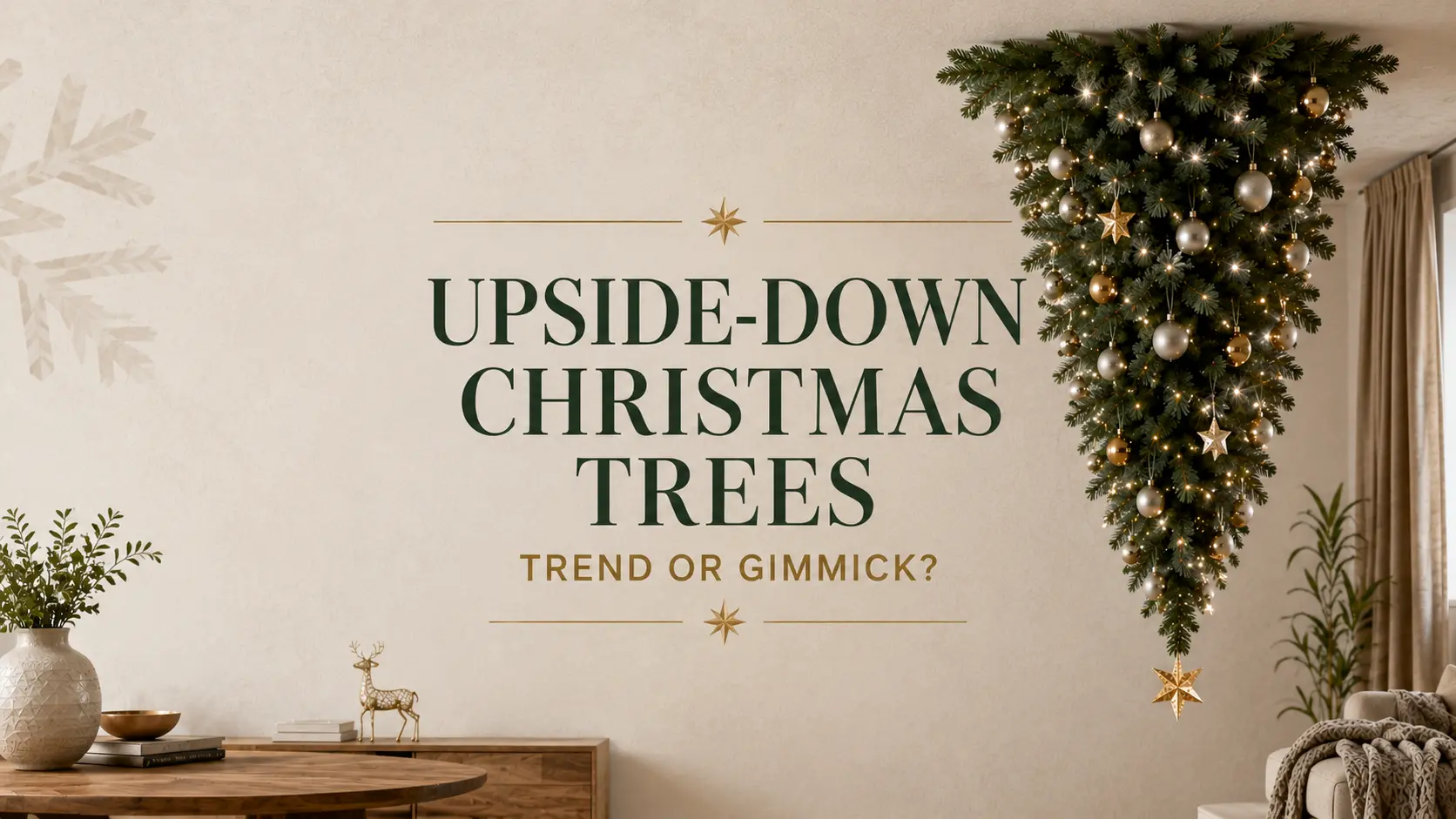
A hanging tree is a cone-shaped or branch-based structure suspended from the ceiling. It takes up zero floor space and creates a genuinely dramatic holiday installation when done well. The setup requires a solid ceiling anchor point and is better suited to lofts and higher-ceiling studios than standard apartments.
Space-Saving Christmas Decorating Strategies
Getting the tree right is only part of the picture. The rest of your holiday decorating choices should complement the tree while continuing to respect the room’s limited square footage.
Vertical decorating is the most important principle. Instead of spreading holiday decor across horizontal surfaces where you need functional space, use walls and height. Hanging ornaments from the ceiling at different heights, mounting a wreath above the sofa, or stringing lights along the top of a wall near the ceiling all create festive atmosphere without touching floor space or tabletops.
Furniture arrangement around the tree matters too. Once you have placed the tree, take a fresh look at whether furniture near it needs to shift slightly. Sometimes moving a side chair six inches or rotating a table by a small angle transforms the tree placement from functional to elegant.
For a comprehensive collection of strategies that go beyond just the tree itself, this guide to space-saving christmas tree hacks covers apartment decorating from multiple angles.
Best Decor Styles for Slim Christmas Trees
Slim trees are versatile across decorating aesthetics, but they suit some styles more naturally than others.
Minimalist
Minimalism and slim trees are practically made for each other. The narrow silhouette already suggests restraint, and a minimalist decorating approach leans into that. Two strands of warm white lights, a dozen matte white or metallic ornaments, and a simple geometric star topper are all you need. The empty space between ornaments is intentional, not sparse. For specific minimalist ideas that look deliberately styled rather than underdone, this collection of minimalist christmas tree ideas is worth exploring.
Scandinavian
Scandinavian Christmas style pairs beautifully with slim trees. Natural materials such as wooden ornaments, dried orange slices, woven straw stars, and birch bark details create warmth and texture without adding visual clutter. White and red are the dominant colors, with natural wood tones rounding out the palette. This style looks deliberate on a pencil tree in a way that feels both modern and traditional.
Farmhouse
Farmhouse decorating on a slim tree works well when you lean into texture over ornament count. Buffalo check ribbon, wooden bead garlands, cotton ball stems, and simple clip-on birds create a warm, handmade quality. The trick is choosing a single consistent color palette, typically white, cream, and one warm accent, and sticking to it throughout.
Rustic
Rustic decorating suits slim trees because the style’s emphasis on natural materials works at any branch density. Pinecones, dried florals, burlap bows, and wood-slice ornaments look right on a pencil tree with minimal branch spread. A rustic slim tree in the corner of a studio apartment creates a cozy, cabin-inspired feeling that suits the intimate scale of small-space living.
Luxury
Luxury styling on a slim tree requires restraint in quantity and investment in quality. A handful of glass ornaments, velvet ribbon, and a statement topper outperform fifty cheap ornaments every time. Rich jewel tones, deep greens and burgundies, or a monochromatic silver and gold palette all work for a sophisticated look that suits the proportions of a narrow tree.
Traditional
Traditional Christmas decorating can work on a slim tree with some adjustments. Choose smaller versions of classic elements: mini glass balls, small tinsel garlands, and a compact topper. Maintain the traditional color palette of red, gold, and green while scaling every element down to fit the tree’s narrower profile.
Common Slim Tree Decorating Mistakes
Using Oversized Ornaments
A 4 or 5-inch ornament on a slim tree looks like a watermelon on a wire. The ornament overwhelms the branch, makes the tree look unstable, and leaves the surrounding branches looking empty by comparison. Stick to ornaments under 3 inches for slim trees and under 2 inches for pencil trees.
Uneven Decoration Placement
It is easy to unconsciously cluster decorations on the front-facing branches and leave the sides sparse. Walk around the tree as you decorate and distribute ornaments evenly from all angles. This matters especially in corner placements where two sides of the tree are visible.
Poor Lighting Choices
Two common mistakes: too few lights and lights strung only on the outer branches. Both make the tree look flat and two-dimensional. Use enough lights to illuminate the inner branches, and work from the trunk outward rather than from the outside in.
Incorrect Tree Sizing
A tree that is too short looks out of proportion in a room with high ceilings, while a tree that nearly touches the ceiling creates anxiety rather than festivity. Measure your ceiling height and leave appropriate clearance.
Ignoring Room Proportions
The tree should complement the room’s scale, not compete with it. A very narrow pencil tree in a relatively generous studio can look slightly absurd; a slim tree with a bit more body would suit the room better. Match the tree’s overall volume to the room size.
Storage and Maintenance Tips
Taking care of your slim tree properly extends its life significantly and makes each subsequent setup easier.
Shape maintenance between seasons. Before packing the tree away, fold branches gently inward rather than forcing them into the box. Artificial branches have a memory that can be damaged by rough packing. When you set the tree up the following year, give branches time to settle before decorating, typically 24 hours.
Storage containers. Invest in a proper tree storage bag rather than reusing the original cardboard box, which degrades quickly. Slim and pencil trees often fit into narrower bags than traditional trees, which makes closet storage more manageable.
Protecting branch tips. The wire tips of artificial branches can scratch each other during storage. Wrap the tree loosely in the storage bag rather than compressing it tightly, and store it away from heavy items that might crush the branches.
Annual inspection. Before setting up the tree each year, check for any bent or damaged branches and reshape them gently. If the tree has integrated lights, test every section before decorating to identify and address any issues before ornaments are hanging.
Are Slim Christmas Trees Worth It?
Advantages
The practical advantages are substantial. Slim trees fit apartment living genuinely well, not as a compromise but as the right tool for the environment. They store easily, set up quickly, and with thoughtful decorating look every bit as festive as larger alternatives in the right setting.
Drawbacks
The main limitations are ornament capacity and the adjustment required in decorating approach. If you have a large collection of ornaments accumulated over many years, a slim tree simply cannot hold all of them. You will need to edit your display each year. Some people find this liberating; others find it frustrating.
Best Use Cases
Slim trees are the right choice for studios, one-bedroom apartments, condos with compact living rooms, home offices, and any space where the tree needs to coexist with functional furniture arrangements rather than dominate the room.
Long-Term Practicality
A quality artificial slim tree lasts 10 years or more with proper storage. The upfront investment, typically comparable to a traditional artificial tree of similar quality, pays off many times over compared to buying a real tree each season.
Slim Trees vs Tabletop Trees vs Wall Trees
| Feature | Slim Floor Tree | Tabletop Tree | Wall Tree |
|---|---|---|---|
| Floor space required | 2 to 4 sq ft | Zero | Zero |
| Height range | 4 to 10 ft | 1 to 3 ft | Any |
| Ornament capacity | Moderate to high | Low | Low to moderate |
| Visual impact | Strong | Moderate | Moderate to high |
| Setup time | 30 to 60 min | 5 to 15 min | 30 to 90 min |
| Storage size | Compact | Very compact | Minimal |
| Renter-friendly | Yes | Yes | Yes (removable hooks) |
| Cost | Medium to high | Low to medium | Low to medium |
| Traditional feel | Yes | Partial | No |
For most studio apartment dwellers, a slim floor tree is the right primary choice. Tabletop trees work brilliantly as secondary displays in kitchens, offices, or bedrooms. Wall trees are the best option when floor space is genuinely unavailable.
The Best Slim Christmas Tree for a Studio Apartment
There is no single universally correct answer, but here is clear guidance based on different studio situations.
For renters: A quality slim artificial tree in the 6 to 6.5-foot range is the best long-term investment. Choose a pre-lit version to simplify setup and minimize the tangle of extra light strands in a small space. Position it in a corner using removable hooks and a simple tree skirt for a damage-free setup.
For students: A 4 to 5-foot slim tree or a generous tabletop tree is the practical choice. The lower cost, smaller storage footprint, and faster setup suit the often temporary and space-challenged nature of student living.
For young professionals: A 6.5 to 7-foot pencil or slim tree with a sophisticated minimalist or Scandinavian decorating approach creates a genuinely stylish holiday display that suits a modern apartment aesthetic without looking like a childhood holdover.
For couples: A 6 to 7-foot slim tree with enough ornament capacity to hold meaningful decorations from both people works well. Prioritize branch density slightly over profile narrowness so the tree can carry two ornament collections without looking overcrowded.
For minimalists: A pencil tree with a simple, edited decoration scheme is the definitive choice. The silhouette itself is part of the aesthetic. For styling guidance tailored specifically to this approach, this article on how to style a pencil christmas tree in a corner is the most relevant resource.
Conclusion
Choosing the right slim christmas tree for a studio apartment comes down to three things: getting the height right for your ceiling, getting the profile width right for your available floor space, and decorating in a way that suits the tree’s narrower silhouette rather than fighting against it.
The most important sizing decision is height. Measure your ceiling, subtract 12 to 18 inches for topper clearance, and that is your maximum. For most standard apartments, that puts you comfortably in the 6 to 7-foot range, which happens to be where the best selection of slim and pencil trees exists.
On placement, corners are almost always the right answer in studios. They use space that would otherwise be dead, they naturally frame the tree, and they keep the primary movement paths through the room clear.
On decorating, the adjustment from a traditional to a slim tree is mainly about scale. Use smaller ornaments, work lights from the inside out, add ribbon for volume, and layer decoration depth rather than just density. The result is a tree that looks purposeful and styled rather than sparse.
A quality slim christmas tree is not a compromise. In a studio apartment, it is the right choice.
Frequently Asked Questions
1. What is the best height slim christmas tree for a studio apartment with 8-foot ceilings? A 6 to 6.5-foot slim tree is the ideal range for 8-foot ceilings. This leaves 18 to 24 inches of clearance above the tree topper, which prevents the ceiling from feeling closed in while still giving the tree enough presence to anchor the room.
2. How wide is a slim christmas tree? Most slim trees have a base diameter of 18 to 36 inches depending on height. A 6-foot slim tree typically measures 24 to 30 inches at the widest point. Pencil trees are narrower still, usually 16 to 22 inches in diameter at the base.
3. Can a slim tree hold as many ornaments as a traditional tree? Not quite. A 6-foot slim tree typically holds 100 to 150 ornaments comfortably, compared to 200 or more on a traditional tree of the same height. However, with properly scaled ornaments and layered placement techniques, a slim tree can look just as full.
4. Where is the best place to put a slim tree in a studio apartment? Corner placement is almost always the best option. It uses otherwise unused space, frames the tree naturally, and keeps traffic paths through the room clear. Near a window is the second-best option for the lighting effect it creates both inside and outside.
5. Are pre-lit slim trees worth it for apartments? Yes, especially for small spaces. Pre-lit trees eliminate the extra light strands that create clutter and storage challenges in a compact apartment. They also ensure even lighting distribution through the branches, which is harder to achieve manually on a narrow profile.
6. What ornament size should I use on a slim or pencil christmas tree? Use ornaments between 1.5 and 2.5 inches for slim trees and between 1 and 2 inches for pencil trees. You can use one or two slightly larger focal ornaments at eye level, but the majority of your decoration should be compact and proportionate to the branch spread.
7. Do slim christmas trees look good in small apartments or do they look like a compromise? When properly decorated and correctly placed, slim trees look intentional and sophisticated in small apartments rather than like a compromise. The key is matching the decorating approach to the silhouette and choosing a tree height that suits the room’s proportions.
8. How do I store a slim christmas tree in a small apartment? Slim and pencil trees typically pack into boxes with a significantly smaller footprint than traditional trees. Most fit under a bed, on a closet shelf, or in a storage bag hung vertically in a closet. Measure the packed box dimensions before purchasing to confirm it fits your available storage.