
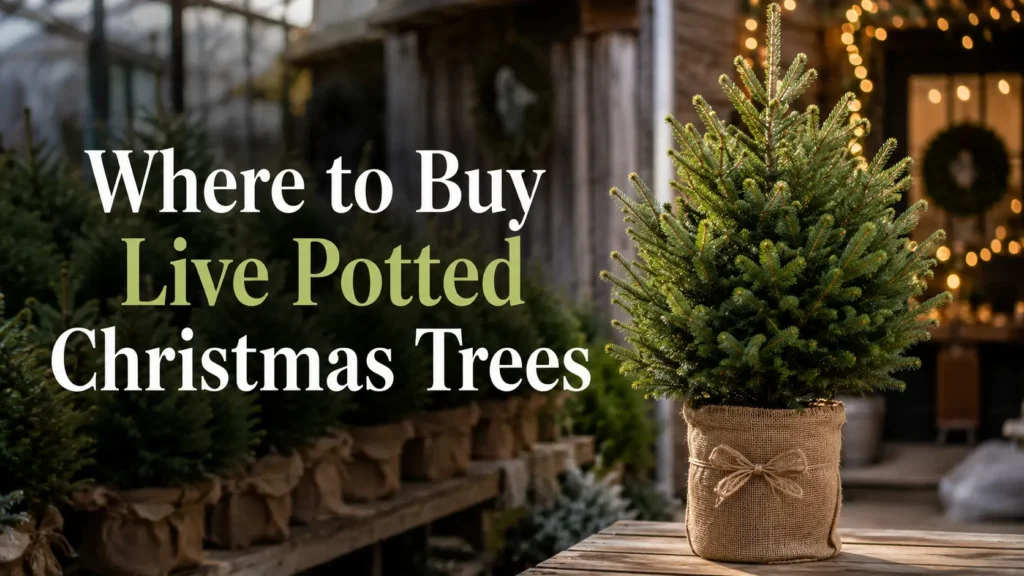
There is something undeniably appealing about a Christmas tree that does not end up at the curb in January. A live potted Christmas tree gives you the scent, the texture, and the tradition of a real evergreen, and then keeps living afterward, either as a houseplant, a patio specimen, or a permanent addition to your garden. For a growing number of households, that combination of holiday charm and lasting value makes the living tree the most satisfying choice of all.
But buying one is not quite the same as grabbing a cut tree off a lot. A living tree comes with roots, a heavy container, real care requirements, and a narrower window of time it can spend indoors. Knowing where to buy a live potted Christmas tree, how to pick a healthy one, and what to expect afterward makes the difference between a tree that thrives for decades and one that quietly declines by February.
This guide covers everything: where to shop, which species perform best, how to judge a healthy tree, how living trees compare to cut and artificial options, how to care for and decorate one indoors, and how to plant it successfully when the season ends. For more seasonal tree resources and care guides, you can explore the full library at MyChristmasTrees.online.
By the end, you will know exactly where to find a living tree, how to choose one with confidence, and whether it is the right fit for your home and lifestyle.
Quick Answer: Where Can You Buy a Live Potted Christmas Tree?
You can buy a live potted Christmas tree at local garden centers, independent nurseries, Christmas tree farms, home improvement stores, regional growers, and seasonal holiday markets. Availability depends heavily on your location and climate, since living trees are grown and sold regionally rather than shipped long distances like cut trees often are.
The best sources are usually local nurseries and garden centers, because they stock species suited to your climate and the trees have not traveled far, which means healthier roots and better odds of surviving the move outdoors later. Christmas tree farms that offer balled-and-burlapped or container trees are another excellent option, especially if you want a larger specimen.
| Where to Buy | Best For | What to Expect |
|---|---|---|
| Local garden centers | Climate-suited species, healthy stock | Good selection, knowledgeable staff |
| Independent nurseries | Quality and variety | Premium trees, planting advice |
| Christmas tree farms | Larger living trees | Balled-and-burlapped or potted |
| Home improvement stores | Convenience and price | Limited species, variable care |
| Regional growers | Locally adapted trees | Best survival odds outdoors |
| Seasonal markets | Last-minute availability | Variable quality, inspect closely |
Because living trees are heavy and perishable, buying locally is almost always better than ordering online. Online options exist, but shipping a rooted, soil-filled container is expensive and stressful for the tree.
What Is a Live Potted Christmas Tree?
A live potted Christmas tree is a real, living evergreen sold with its root system intact, either growing in a container of potting soil or with its roots wrapped in a soil ball and burlap, known in the trade as balled-and-burlapped. Unlike a cut tree, which is harvested at the trunk and slowly dies over the holiday season, a living tree remains alive and can continue growing for years if cared for properly.
Container-grown trees have spent their lives in a pot, so their roots are already adapted to that environment, which generally makes them easier to keep alive indoors and to transplant later. Balled-and-burlapped trees were grown in the ground and dug up, root ball and all, shortly before sale. These can be larger and more impressive, but the digging disturbs the roots, so they need prompter planting and more careful handling.
The defining feature in both cases is the root ball, the mass of roots and soil that keeps the tree alive. Protecting that root ball, keeping it moist and undisturbed, is the single most important thing you will do as the owner of a living tree.
The advantages are real. You get a genuine evergreen with authentic scent and texture, a tree you can plant and enjoy for years, and a more sustainable cycle than buying and discarding a cut tree annually. The limitations are equally real. Living trees are heavy, they can only tolerate a short stint indoors, they cost more upfront than many cut trees, and they require outdoor space and a willingness to plant and maintain them afterward.
Where to Buy Live Potted Christmas Trees
Knowing the type of seller helps you set expectations for selection, quality, and price. Here is how the main sources compare and what to look for at each.
Local Garden Centers
Garden centers are often the best all-around choice. They stock evergreens chosen to thrive in your local climate, the staff can usually tell you whether a given species will survive in your area after planting, and the trees are typically well cared for before sale. Selection peaks in late November and early December, so shop early for the healthiest specimens and the widest choice of species and sizes.
Independent Nurseries
A dedicated nursery is where you find the highest-quality living trees and the most knowledgeable advice. Nursery staff handle living plants year-round, so they can guide you on species selection, pot size, and aftercare planting. Trees here may cost more, but the health and survival odds tend to justify the price, especially if you intend to plant the tree permanently.
Christmas Tree Farms
Some Christmas tree farms offer living trees alongside their cut stock, usually as balled-and-burlapped specimens or larger container trees. A farm is a good source if you want a sizable living tree and the satisfaction of choosing it in person. Confirm in advance that the farm sells living trees, since many farms deal only in cut trees.
Home Improvement Stores
Big home improvement and hardware stores often carry potted evergreens during the holidays. The appeal is convenience and price, but selection is usually limited to a few common species, and the level of care the trees received before reaching the shelf can vary. Inspect any tree from these stores carefully for needle health and soil moisture before buying.
Local Plant Growers
Buying directly from a regional grower gives you trees that are locally adapted and have not endured long-distance shipping. These trees often have the best survival odds when planted outdoors because they are already suited to your soil and climate. Growers may sell at their own location, at farmers markets, or through local plant sales.
Seasonal Christmas Markets
Holiday and Christmas markets sometimes feature living trees from regional vendors. Quality varies widely, so treat these as a place to inspect carefully rather than assume health. The advantage is the festive setting and the chance to support local sellers.
Online Retailers
Online options exist, particularly for smaller container trees and tabletop living evergreens, but shipping a rooted, soil-filled tree is costly and hard on the plant. If you order online, choose a reputable specialist, expect to pay a premium for shipping, and inspect the tree immediately on arrival. For full-size living trees, local sources are almost always the better route.
Whichever seller you choose, the qualities of a reputable one are the same: healthy-looking stock with green, pliable needles, moist soil in the pots, clear information about the species and its hardiness, and staff willing to explain aftercare. A seller who cannot tell you what species a tree is or whether it will survive in your region is one to approach with caution.
Best Species for Live Potted Christmas Trees
Species choice affects appearance, how well the tree tolerates time indoors, and whether it will thrive outdoors in your climate afterward. Here are the most popular and reliable options.
Norway Spruce
The classic European Christmas tree, the Norway spruce has a traditional conical shape and rich green needles. It is widely grown, affordable, and fast-growing, which makes it a common container choice. Its needle retention indoors is moderate, so keep its time inside short. It transplants well in cool, temperate climates and grows into a large tree, so plan for space.
Blue Spruce
Prized for its striking silvery-blue needles and dense, symmetrical form, the blue spruce makes a beautiful and slightly more unusual living tree. It is hardy and tolerates cold climates well, and it transplants reliably. The needles are stiff and sharp, so handle with care when decorating. Growth is slow, which is an advantage if you want to keep it potted on a patio for a few years.
Fraser Fir
A favorite for its excellent needle retention, pleasant scent, and soft, sturdy branches that hold ornaments beautifully, the Fraser fir is one of the best firs for a living tree experience. It tolerates indoor conditions better than many species. It prefers cooler climates and well-drained soil, so confirm it suits your region before planning to plant it.
Douglas Fir
Soft-needled, fragrant, and full, the Douglas fir is a beloved Christmas tree species and works well as a living tree in suitable climates. It has a fresh evergreen scent and a pleasing pyramid shape. It needs room to grow and does best in regions with mild, moist conditions.
White Pine
The eastern white pine offers soft, feathery blue-green needles and a graceful appearance. It is gentle to handle, holds light decorations well, and adapts to a range of soils. Its branches are flexible, so use lightweight ornaments. It grows quickly and large, making it a good long-term landscape tree.
Colorado Blue Spruce
Closely related to the blue spruce and often sold under this name, the Colorado blue spruce is exceptionally hardy, drought-tolerant once established, and famous for its blue coloration. It is one of the most reliable choices for cold-climate gardeners who want a living tree that will thrive outdoors for decades.
| Species | Needle Retention | Outdoor Hardiness | Best Climate | Handling |
|---|---|---|---|---|
| Norway Spruce | Moderate | Good | Cool, temperate | Easy |
| Blue Spruce | Good | Excellent | Cold | Sharp needles |
| Fraser Fir | Excellent | Good | Cool | Soft, sturdy |
| Douglas Fir | Good | Moderate | Mild, moist | Soft |
| White Pine | Good | Good | Wide range | Soft, flexible |
| Colorado Blue Spruce | Good | Excellent | Cold to temperate | Sharp needles |
The most important factor is matching the species to your local climate. A tree that will not survive your winters outdoors defeats much of the purpose of buying living, so check the species hardiness against your region before you buy.
How to Choose a Healthy Living Christmas Tree
A living tree only delivers on its promise if it is healthy when you buy it. Because the whole point is keeping it alive, a few minutes of inspection at purchase pays off enormously. Run through this checklist before committing.
- Check the needles. They should be vibrant green (or blue, depending on species), flexible, and firmly attached. Run your hand along a branch; minimal needle drop is the goal. Browning, yellowing, or heavy shedding signals stress or poor health.
- Inspect the soil. The potting soil should be moist, not bone dry and not waterlogged. Dry soil suggests neglect, while a sour smell or standing water suggests root rot.
- Examine the trunk and base. The trunk should be straight and sturdy, and the tree should sit firmly in its pot without wobbling, which indicates an established root system.
- Assess the root situation. For container trees, roots should not be circling tightly around the surface or escaping the drainage holes in dense mats, both signs of a root-bound, stressed tree. For balled-and-burlapped trees, the root ball should be firm, intact, and adequately sized for the tree.
- Look for pests and disease. Check for webbing, sticky residue, visible insects, or unusual spots on needles and branches.
- Match the pot size to the tree. A tree that is far too large for its pot has likely outgrown its roots and will struggle. A reasonable balance between canopy and container is a good sign.
| Health Indicator | Good Sign | Warning Sign |
|---|---|---|
| Needles | Green, flexible, firmly attached | Browning, dropping, brittle |
| Soil | Evenly moist | Bone dry or waterlogged |
| Trunk | Straight, firmly rooted | Wobbly, loose in pot |
| Roots | Healthy, not circling | Root-bound, escaping pot |
| Pests | None visible | Webbing, insects, residue |
| Proportion | Balanced tree to pot | Oversized tree, tiny pot |
Buy from a seller who lets you inspect freely and answers questions about the tree’s history. A tree that has been well watered and properly stored before sale gives you the best foundation for success.
Live Tree vs Cut Tree vs Artificial Tree
Deciding whether a living tree is right for you means weighing it against the two main alternatives. Each has a genuine place, and the best choice depends on your priorities, space, and willingness to maintain a real plant.
A living tree wins on longevity and the unique ability to be planted afterward, but it demands the most care and outdoor space. A cut tree delivers the classic real-tree scent and look with less commitment but ends up discarded. An artificial tree offers convenience and reusability with no watering, but lacks the authenticity and the planting payoff.
| Factor | Live Potted Tree | Cut Tree | Artificial Tree |
|---|---|---|---|
| Appearance | Authentic, living | Authentic, fresh | Synthetic, consistent |
| Upfront cost | Higher | Moderate | Higher initial |
| Lifespan | Years (if planted) | Weeks | Many years |
| Maintenance | High | Moderate | Very low |
| Reusability | Yes, as a plant | No | Yes |
| Indoor display | Short (limited days) | Several weeks | Unlimited |
| Outdoor planting | Yes | No | No |
| Sustainability | High (if it survives) | Renewable but discarded | Reusable, synthetic |
If you are still weighing real against artificial in general, our full breakdown in real vs artificial Christmas trees covers the trade-offs in depth. To understand the long-term money side, the cost comparison of real vs artificial trees over 10 years lays out the numbers. And if environmental impact is your main concern, our look at whether artificial Christmas trees are eco-friendly provides useful context for comparing the sustainability of each option against a living tree.
How Long Can a Live Potted Christmas Tree Stay Indoors?
This is the question that catches most first-time buyers off guard. A living tree is a dormant outdoor plant during winter, and bringing it into a warm, dry living room is genuinely stressful for it. The general rule is to keep a living Christmas tree indoors for no more than about seven to ten days.
The reason is that indoor warmth can trick the tree into breaking dormancy, encouraging it to start growing. When you then move it back into freezing outdoor conditions, that tender new growth gets damaged and the shock can kill the tree. The shorter its indoor stay, the better its odds of surviving outdoors afterward.
Conditions indoors matter as much as duration. Keep the tree away from heat sources like radiators, fireplaces, and heating vents, which dry it out rapidly. A cooler room is better than a warm one. Maintaining some humidity helps, since indoor heating strips moisture from the air and the needles. Above all, keep the soil consistently moist, checking it daily, because a potted tree in a warm room dries out fast.
To ease the transition, acclimate the tree in stages. Move it from outdoors to a sheltered, cool space like a garage or porch for a few days before bringing it inside, and reverse the process when the holidays end. This gradual shift reduces shock at both ends.
Watering a living tree follows the same principles as keeping any real tree hydrated, and our real Christmas tree care guide on watering and longevity covers the fundamentals. For how frequently to check and replenish moisture, see our guide on how often to water a Christmas tree, and for the practical technique of watering a potted or stand-mounted tree without overdoing it, how to water a Christmas tree walks through the method.
How to Decorate a Live Potted Christmas Tree
Decorating a living tree calls for a lighter touch than a cut or artificial tree, because you are working with a plant whose health you want to protect and whose branches may be more delicate.
Choose lightweight ornaments. Living trees, especially younger container specimens, have softer, more flexible branches than a mature cut tree, so heavy glass ornaments can bend and damage them. Shatterproof, lightweight ornaments distribute weight more kindly and are safer around a tree you plan to keep.
Use LED lights rather than older incandescent strands. LEDs run cool, which is important because warm bulbs can dry out needles and stress a living tree. They also draw far less power and are gentler on the foliage during the days the tree spends indoors. Our complete Christmas tree lights and lighting guide explains bulb types and layering, which helps you get a full look without overloading a delicate living tree.
Keep the quantity of lights reasonable for the tree’s size. To find the right number for your specific tree height, the targets in how many lights do you need for a Christmas tree are a helpful starting point, and you can calculate an exact figure with the Christmas tree light calculator. To plan ornaments, ribbon, and other decorations in proportion to a smaller living tree, the Christmas tree decoration calculator helps you avoid weighing the branches down.
A lightweight topper and a small amount of ribbon finish the look without burdening the tree. The guiding principle is restraint: decorate enough to celebrate, but lightly enough to keep the plant healthy for its life outdoors.
Planting Your Christmas Tree After the Holidays
The reward for all the care is planting your tree and watching it grow for years. Done thoughtfully, this is where a living Christmas tree truly pays off. Done carelessly, it is where many living trees fail, so realistic expectations matter.
Timing is everything. Move the tree back outdoors as soon as the holidays end, reacclimating it in stages through a sheltered cool space first. If the ground is frozen or deep winter has set in, you may not be able to plant immediately. In that case, keep the tree in a protected outdoor spot, well watered, until conditions allow planting, ideally in early spring.
Prepare the planting hole in advance if you can, before the ground freezes, since digging frozen soil is difficult. Dig a hole roughly twice as wide as the root ball but no deeper, so the tree sits at the same level it grew in the pot. Loosen the surrounding soil to help the roots spread.
When planting, handle the root ball gently and keep it intact. Remove the tree from its container, or for balled-and-burlapped trees follow the seller’s guidance on removing wrapping and ties. Set the tree in the hole, backfill with native soil mixed with a little compost, firm it gently to remove air pockets, and water thoroughly.
Mulch generously around the base, keeping the mulch a few inches away from the trunk itself, to retain moisture and insulate the roots through the rest of winter. Continue watering whenever the soil is not frozen, since newly planted evergreens need consistent moisture to establish.
Be honest with yourself about the odds. Not every potted Christmas tree survives the indoor stint and transplant, especially if it was indoors too long, near heat, or planted into unsuitable climate or soil. Choosing a climate-appropriate species, limiting indoor time, and planting carefully all improve your chances, but a successful living tree is a project, not a guarantee.
Common Mistakes Buyers Make
A few recurring errors account for most living-tree disappointments. Avoiding them dramatically improves your success.
Keeping the tree indoors too long. This is the most common and most fatal mistake. Beyond about ten days, the warm indoor environment risks breaking dormancy and dooming the tree when it goes back outside. Keep the indoor stay short.
Buying an unhealthy tree. Skipping the inspection and buying a stressed, root-bound, or dried-out tree sets you up for failure. Use the health checklist before purchasing.
Forgetting to water. A potted tree in a heated room dries out fast, and a single missed day can cause damage. Check the soil daily and keep it consistently moist.
Placing the tree near heat sources. Radiators, vents, fireplaces, and even strong sunlight through a window dry out and stress a living tree. Position it in the coolest practical spot, away from heat.
Choosing the wrong species. Buying a tree that will not survive your local winters, or one too large for your space, undermines the whole purpose. Match the species to your climate and your available planting area.
Are Live Potted Christmas Trees Worth It?
A living tree is genuinely worth it for the right buyer, and genuinely the wrong choice for others. Being honest about which group you fall into saves money and disappointment.
Living trees are best for gardeners who enjoy plant care and have a place to plant the tree afterward, families who want a meaningful tradition of planting and watching a tree grow, sustainability-minded buyers who want to avoid the annual cut-and-discard cycle, and homeowners with outdoor space suited to an eventual large evergreen.
They are not ideal for apartment dwellers with no planting space, since a living tree that can never go in the ground will eventually outgrow any container and struggle. They are also poorly suited to buyers who want a zero-maintenance holiday, since living trees need daily attention indoors and careful planting afterward. And anyone who wants the tree up for the entire month of December will find the short indoor window frustrating.
If your situation matches the first group, a living tree is one of the most rewarding ways to celebrate the season. If it matches the second, a cut tree or a quality artificial tree will serve you better with far less stress.
Recommendations
A live potted Christmas tree offers a holiday experience nothing else can match, because the tree keeps living and growing after the season if you care for it well. Watching a tree you decorated one December mature in your garden over the following years is a genuinely special kind of tradition.
That said, a living tree asks more of you than either a cut tree or an artificial one. It requires planning before you buy, daily attention while it is indoors, and a careful transition and planting afterward. The right reason to choose one is that it suits your lifestyle and you have the space and willingness to plant it, not simply because it seems more environmentally friendly. A living tree that dies after the holidays is no greener than a cut tree, so the sustainability benefit only materializes if the tree actually survives and grows.
What we would recommend for most first-time buyers is to start with a smaller container-grown tree of a climate-appropriate species, keep it indoors for under a week, and plan the planting before you buy. That approach maximizes survival odds and lets you build confidence before investing in a larger specimen.
Final Verdict: Where Is the Best Place to Buy a Live Potted Christmas Tree?
The best places to buy a live potted Christmas tree are local nurseries, garden centers, Christmas tree farms, regional growers, and, for convenience, home improvement stores. Among these, independent nurseries and local growers stand out because they carry climate-appropriate species, the trees have not endured long shipping, and the staff can advise you on care and planting, all of which improve your tree’s chances of thriving outdoors afterward.
Buying locally is almost always better than ordering online, because living trees are heavy, perishable, and stressed by shipping. Shop in late November or early December for the healthiest stock and the best selection, inspect any tree carefully before buying, and match the species to your climate and your planting space.
The buyers who benefit most are gardeners and homeowners with outdoor space who want a real tree that becomes a lasting part of their landscape. For them, a living tree is the most rewarding option available.
Conclusion
A live potted Christmas tree blends the beauty and scent of a real evergreen with the lasting value of a tree you can plant and enjoy for years. The keys to success are choosing a healthy, climate-appropriate tree from a reputable local source, keeping it indoors only briefly, watering it consistently, decorating it lightly with cool LED lights and lightweight ornaments, and planting it carefully when the holidays end.
It is more work than a cut tree and more involved than an artificial one, but for gardeners and homeowners with the space and willingness to care for it, that effort is the whole point. Choose the right species, follow the care steps, and your Christmas tree can grow alongside your family for decades to come.
Frequently Asked Questions
Where can I buy a live potted Christmas tree near me? Start with local garden centers, independent nurseries, and Christmas tree farms that offer living trees, plus regional growers and some home improvement stores during the holidays. Local sources are best because they stock species suited to your climate and the trees have not endured long shipping, which improves their health and survival odds.
Are live potted Christmas trees better than cut trees? They are better if you want a tree you can plant and keep for years and you have the space and willingness to care for it. Cut trees are simpler, can stay up longer indoors, and cost less to commit to, but they end up discarded. The right choice depends on your priorities and lifestyle.
Can I plant my potted Christmas tree after Christmas? Yes, that is the main appeal, but success depends on choosing a climate-appropriate species, limiting indoor time to about a week, and planting carefully. Reacclimate the tree outdoors in stages, plant at the same depth it grew in the pot, mulch, and water consistently. Not every tree survives, so realistic expectations help.
How long can a live Christmas tree stay indoors? Generally no more than seven to ten days. Longer than that risks the warm indoor air breaking the tree’s dormancy, which leads to damage and shock when it returns to cold outdoor conditions. The shorter the indoor stay, the better the tree’s chances of surviving outside afterward.
Which species is best for a living Christmas tree? It depends on your climate. Norway spruce, blue spruce, Fraser fir, Douglas fir, white pine, and Colorado blue spruce are all popular. Fraser fir tolerates indoor conditions well, while blue and Colorado blue spruce are exceptionally hardy outdoors. Always match the species to your local climate so it can thrive after planting.
How much do live potted Christmas trees cost? They typically cost more upfront than cut trees because you are paying for a living, rooted plant in a container. Prices vary by species, size, and region. While the initial outlay is higher, a living tree that survives and is planted can deliver lasting value as a landscape tree for many years.
How do I keep a potted Christmas tree alive indoors? Keep it in the coolest practical spot away from radiators, vents, and fireplaces, check the soil daily and keep it consistently moist, maintain some humidity, use cool LED lights, and limit the indoor stay to about a week. Acclimate it in stages when moving it in and out.
Can I keep a potted Christmas tree in its pot permanently? For a few years, yes, with regular watering, feeding, and occasional repotting into a larger container as it grows. Eventually most evergreens outgrow any practical pot and do best planted in the ground. Apartment dwellers without planting space should consider whether a permanently potted tree is realistic before buying.
What is the difference between container-grown and balled-and-burlapped trees? Container-grown trees have spent their lives in a pot, so their roots are adapted to that environment and they transplant relatively easily. Balled-and-burlapped trees were grown in the ground and dug up shortly before sale, with roots wrapped in soil and burlap. The latter can be larger but need prompter, more careful planting.
Are live potted Christmas trees more eco-friendly? They can be, but only if the tree survives the holidays and is successfully planted, where it then absorbs carbon and benefits the landscape for years. A living tree that dies after the season offers no environmental advantage over a cut tree. The sustainability benefit depends entirely on the tree thriving long-term.