

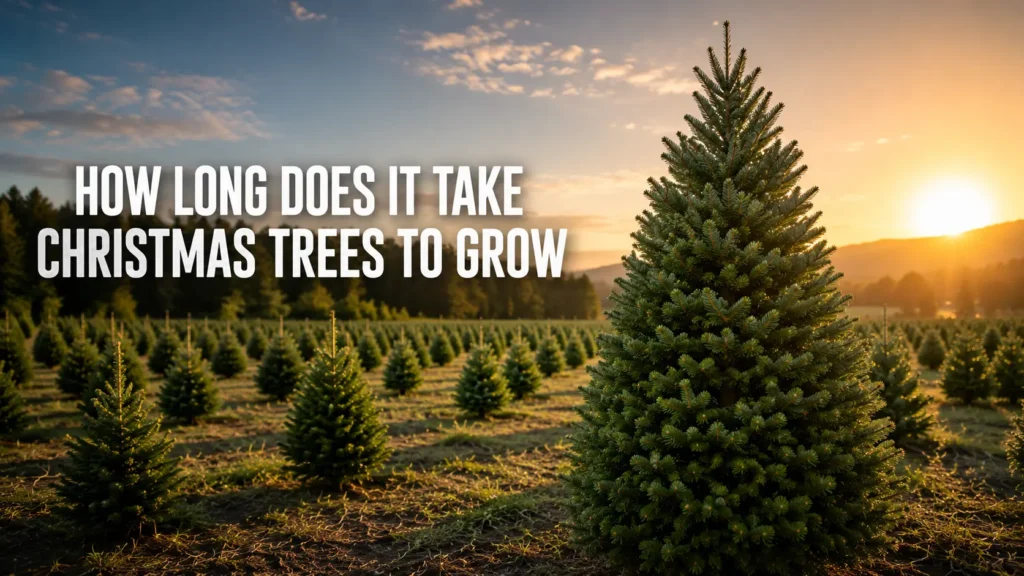
Walk onto a Christmas tree lot in December, look at a perfectly shaped seven-foot fir, and you would be forgiven for assuming it sprouted, filled out, and arrived in a season or two. The reality surprises almost everyone. That tree very likely started as a tiny seedling close to a decade before you ever saw it, and it passed through years of planting, weeding, pruning, and patient tending before it was ready to stand in someone’s living room.
Christmas tree farming is one of the slowest forms of agriculture there is. A farmer who plants a field of seedlings this spring will not harvest most of those trees until their own children are years older. That long horizon shapes everything about how the industry works, why trees cost what they do, and why the craft deserves more appreciation than it usually gets.
This guide walks through the entire journey, from seed to seedling to the tree you bring home, explaining how long each stage takes, why growth cannot simply be rushed, how different species compare, and what really goes into producing a beautiful tree. For more seasonal tree resources, buying guides, and care advice, you can explore the full library at MyChristmasTrees.online.
By the end, you will understand exactly how long a Christmas tree takes to grow, why the timeline varies, and what nearly a decade of cultivation means for the tree you choose this year.
How Long Does It Take a Christmas Tree to Grow?
Most Christmas trees take between 7 and 12 years to grow from a young seedling to a harvestable tree of about six to seven feet. The average across the industry sits around 8 to 10 years for a typical retail-sized tree, though the exact timeline depends on several factors working together.
Species is the biggest variable, since some evergreens naturally grow faster than others. Beyond that, climate, soil quality, rainfall, elevation, sunlight, and the farm’s management practices all influence how quickly a tree reaches the right size and shape. A tree grown in ideal conditions with attentive care can hit harvest size years sooner than the same species struggling in poor soil or a harsh climate.
| Tree Size | Typical Growing Time | Notes |
|---|---|---|
| 2–3 feet | 3–5 years | Tabletop size, faster turnaround |
| 5–6 feet | 6–8 years | Popular smaller retail size |
| 6–7 feet | 8–10 years | Most common retail size |
| 8–9 feet | 10–12 years | Larger trees, longer cultivation |
| 10+ feet | 12–15+ years | Premium large trees, significant time |
It is worth remembering that these years are not idle waiting. Every season demands planting, weeding, shaping, pruning, pest monitoring, and fertilizing, which is why a Christmas tree represents far more labor than its price tag often suggests.
The Complete Christmas Tree Growing Timeline
To really understand the process, it helps to follow a tree through its life stage by stage. Here is what happens across the years from seed to harvest.
Year 1: Seeds, Nursery, and Seedlings
The journey begins long before a tree reaches a field. Seeds are collected from cones of mature, high-quality parent trees, often selected for desirable traits like good color, strong needle retention, and pleasing shape. These seeds frequently need a period of cold, moist conditioning, mimicking winter, before they will germinate.
Germinated seeds are raised in a nursery, where they spend their earliest and most vulnerable time under controlled, attentive care. In the nursery, tiny seedlings are protected from harsh weather, weeds, and pests while their first roots and needles develop. This nursery phase commonly lasts two to four years before the young trees, now called transplants, are sturdy enough to survive being moved to an open field. Some growers buy these transplants from specialized nurseries rather than starting from seed themselves, since nursery production is a specialized skill of its own.
Years 2–3: Young Saplings and Root Development
Once moved to the field, or while still in nursery beds, the young trees focus their energy below ground as much as above it. These early years are dominated by root development, because a strong, established root system is what allows a tree to take up water and nutrients efficiently for the rest of its life.
Above ground, growth during this stage is modest and sometimes barely noticeable year to year. The trees are establishing themselves, settling into the soil, and building the foundation for the faster growth to come. They remain vulnerable to drought, competition from weeds, and browsing animals, so this is a high-maintenance, high-attention period for the farmer even though the visible payoff is small.
Years 4–6: Shape Training, Pruning, and Active Growth
By the middle years, the trees enter their period of vigorous upward and outward growth, and this is when the farmer’s craft becomes most visible. Left alone, evergreens do not naturally grow into the dense, symmetrical cone shape people expect from a Christmas tree. They tend to be leggy, gappy, and uneven.
To create the classic full shape, growers begin annual shearing and pruning during these years. By carefully trimming the new growth each season, usually in summer, farmers encourage the tree to grow denser and fuller, producing the tight, even form that makes a tree look complete. Weed management remains critical throughout, since weeds compete fiercely for water and nutrients and can stunt or kill young trees. This stage is labor-intensive and demands skill, because how a tree is sheared in these years largely determines its final quality.
Years 7–12: Harvest, Species Differences, and Grading
After years of patient cultivation, trees reach harvestable size, typically starting around year seven or eight for smaller trees and extending to twelve or more for larger ones. The exact timing depends heavily on species, as faster-growing varieties reach the finish line sooner than slow growers like the noble fir.
As trees approach harvest, they are assessed and graded for quality based on shape, density, color, and overall health. Premium-grade trees command higher prices, while trees with flaws may be sold at a discount or used for other purposes like greenery and wreaths. When a tree is selected for harvest, it is cut, and importantly, the farmer plants new seedlings to replace harvested trees, keeping the cycle going.
| Stage | Years | Main Activity | Visible Growth |
|---|---|---|---|
| Seed and nursery | Year 1 (plus 2–4 in nursery) | Germination, seedling care | Minimal |
| Sapling establishment | Years 2–3 | Root development | Slow |
| Shaping and growth | Years 4–6 | Pruning, shearing, weed control | Moderate to fast |
| Maturity and harvest | Years 7–12 | Final shaping, grading, harvest | Reaches full size |
Why Christmas Trees Take So Long to Grow
A reasonable question is why the process cannot simply be sped up. The answer lies in the fundamental biology of evergreen trees and the conditions they need, none of which respond well to being rushed.
Evergreens grow on a seasonal cycle. Most of their growth happens in a relatively short window during spring and early summer, when conditions are right, after which they slow down and effectively pause through the colder months. A tree only gets one meaningful growth flush per year, so adding height and density is inherently a year-by-year process that cannot be compressed into a single season.
Climate sets the pace. Trees in regions with longer, milder growing seasons can put on more growth annually than those in short-season or harsh climates. Soil quality matters enormously too, because trees in rich, well-drained soil grow more vigorously than those struggling in poor, compacted, or nutrient-deficient ground. Rainfall and irrigation determine whether a tree has the steady water supply it needs, and sunlight drives the photosynthesis that fuels all growth.
Fertilization can support healthy, steady growth, but it cannot force a tree to defy its natural rhythm. Push a tree too hard and you risk weak, leggy growth that produces a poor-quality shape, defeating the entire purpose. Good farmers work with the tree’s biology rather than against it, which is precisely why patience is built into the profession. There is no shortcut that produces a dense, well-formed, healthy Christmas tree in a fraction of the time.
How Christmas Tree Farms Grow Trees
Understanding the full farming process reveals just how much deliberate work surrounds those years of growth. A Christmas tree farm is a long-term agricultural operation with a sequence of carefully managed stages.
It begins with soil preparation. Before planting, growers assess and prepare the land, addressing drainage, soil fertility, and pH so the seedlings have the best possible start. Good site preparation pays off for years afterward.
Planting follows, usually in early spring while the ground is moist and the weather is cool, giving transplants time to establish before summer heat. Seedlings are spaced to allow each tree room to develop its full shape and to let farm equipment pass between rows.
Irrigation and water management keep trees hydrated, especially in their early years and during dry spells, though many established farms rely largely on natural rainfall once trees are well rooted. Weed control is a constant battle, because weeds steal water, nutrients, and sunlight from young trees, and farmers manage them through mowing, mulching, or careful herbicide use.
Pest and disease management protects the investment, as insects, fungal diseases, and animal browsing can all damage or kill trees, so growers monitor their fields and intervene when needed. Annual pruning and shearing, as described earlier, shape the trees into their desirable form over several seasons.
Finally comes harvest, and crucially, replanting. Sustainable Christmas tree farms operate on a continuous cycle: for every tree harvested, growers plant new seedlings to take its place. This is one of the most misunderstood aspects of the industry. Far from depleting a resource, well-managed Christmas tree farms are renewable operations that continually replace what they harvest, maintaining a steady rotation of trees at every stage of growth across their fields.
Growth Rates by Tree Species
Not all Christmas trees grow at the same pace, and species choice has a major effect on the timeline. Here is how the most popular varieties compare.
Fraser Fir
One of the most popular Christmas trees, the Fraser fir is prized for excellent needle retention, a pleasant scent, and a beautiful shape with soft, sturdy branches that hold ornaments well. It is a moderate to slow grower, typically taking around 7 to 10 years to reach harvest size. It thrives in cooler, higher-elevation regions with well-drained soil.
Douglas Fir
A classic, full, soft-needled tree with a fresh evergreen fragrance, the Douglas fir is widely grown and beloved. It is a relatively faster grower among the popular species, often reaching harvest size in about 7 to 9 years under good conditions. It does best in regions with mild, moist climates.
Noble Fir
Valued for its strong, well-spaced branches and striking blue-green color, the noble fir is a premium tree often used for heavier ornaments and for high-quality greenery. It is a slower grower, frequently needing 10 to 12 years or more to mature, which contributes to its higher price. It prefers cool, high-elevation conditions.
Balsam Fir
Famous for its rich, traditional Christmas scent and dark green needles, the balsam fir is a longtime favorite, especially in colder northern regions. It grows at a moderate pace, generally taking around 8 to 10 years to reach harvest size, and it is well suited to cold climates.
Scotch Pine
Long one of the most widely planted Christmas trees, the Scotch pine is hardy, holds its needles well even when dry, and has stiff branches. It is a comparatively fast grower, often reaching harvest size in roughly 6 to 8 years, and it adapts to a wide range of soils and climates, which is part of its enduring popularity.
White Pine
The eastern white pine offers soft, flexible blue-green needles and a graceful, full appearance with little fragrance. It is a fast grower, often ready in about 6 to 8 years, and its gentle needles make it popular with those who want a softer tree, though its flexible branches suit lighter ornaments.
Blue Spruce
The Colorado blue spruce is admired for its striking silvery-blue color and stiff, symmetrical form, and its sharp needles hold ornaments firmly. It is a slow grower, frequently taking 10 years or more to mature, and it is exceptionally cold-hardy, thriving in northern and high-elevation areas.
| Species | Average Harvest Age | Growth Speed | Needle Retention | Ideal Region |
|---|---|---|---|---|
| Fraser Fir | 7–10 years | Moderate to slow | Excellent | Cool, high elevation |
| Douglas Fir | 7–9 years | Moderate to fast | Good | Mild, moist |
| Noble Fir | 10–12+ years | Slow | Excellent | Cool, high elevation |
| Balsam Fir | 8–10 years | Moderate | Good | Cold, northern |
| Scotch Pine | 6–8 years | Fast | Very good | Wide range |
| White Pine | 6–8 years | Fast | Good | Wide range |
| Blue Spruce | 10+ years | Slow | Moderate | Cold, high elevation |
The pattern is clear: pines tend to grow fastest, true firs vary from moderate to slow, and premium slow growers like noble fir and blue spruce take the longest. This growth speed is one reason different species sit at different price points.
Why Some Christmas Trees Cost More
Once you understand the timeline, the price of a quality Christmas tree starts to make a lot more sense. The cost reflects nearly a decade of investment, labor, and risk, not just the act of cutting a tree.
Years of labor are the foundation of the cost. Every tree requires annual attention across its entire life, including planting, weeding, shearing, pruning, pest monitoring, and fertilizing. A premium fir that took ten years to grow absorbed ten years of that work, and slower-growing species naturally accumulate more.
Land costs factor in heavily, because a farmer dedicates acreage to a crop that produces no income for the better part of a decade. That land must be paid for, maintained, and taxed throughout the long wait. Pruning and shaping are skilled, time-consuming tasks that directly determine tree quality, and that expertise has value.
Equipment, from planting and mowing machinery to harvesting and baling tools, represents significant investment, and transportation costs add up as trees move from farm to distributor to retail lot, sometimes across long distances. Perhaps most significantly, losses from weather, drought, pests, and disease mean that not every seedling planted survives to harvest. Farmers must price the trees that make it to account for those that did not, since a hailstorm or drought can wipe out years of work in a single season.
Premium trees like noble fir and Fraser fir command higher prices because they grow slowly, demand careful cultivation, and offer qualities like superior needle retention and shape that buyers value. When you pay more for a premium tree, you are paying for the additional years and care it required.
Can You Grow Your Own Christmas Tree?
Many people, charmed by the idea, wonder whether they could grow their own Christmas tree in the backyard. The answer is yes, with realistic expectations, and it can be a rewarding long-term project.
The most important reality is patience. As this guide has made clear, even a modest six-foot tree takes the better part of a decade to grow, so backyard growing is a commitment measured in years, not seasons. If you plant a seedling expecting a usable tree in two or three years, you will be disappointed.
Space and climate matter. You need enough room for a tree to develop its full shape without crowding, and you need to choose a species suited to your local climate and soil. A species that thrives in cool high elevations will struggle in a hot, dry yard, and vice versa. Matching the tree to your conditions is essential for success.
Maintenance is ongoing. To get a well-shaped tree rather than a leggy, uneven one, you will need to prune and shear it annually, control weeds around it, water it during dry spells, and protect it from pests, exactly the work that professional growers do. The shaping in particular takes some skill and a willingness to learn.
For the right person, growing your own can be deeply satisfying, and many families plant several so they can harvest one each year on a rotation once established. Just go in understanding that you are signing up for a years-long horticultural project, not a quick holiday solution. For most households, buying from a farm remains far more practical, but growing your own offers a unique connection to the tradition.
What Happens After Harvest?
The years of growing end with harvest, but the tree’s journey to your living room has a few more stages. Understanding this path explains why freshness and timing matter when you buy.
Once cut, trees are typically run through a netting or baling machine that wraps the branches tightly, making the tree easier to handle, transport, and protect from damage. This is why trees often arrive at lots looking compact before they relax open once the netting is removed.
From the farm, trees enter distribution. Many move through wholesale channels, traveling by truck to distributors and then to retail lots, garden centers, and seasonal stands, sometimes hundreds or thousands of miles from where they grew. This transportation is part of why trees sold far from growing regions can cost more and why freshness varies depending on how long ago and how far a tree traveled.
Trees reach buyers through several channels. Retail lots and garden centers offer convenience and selection in populated areas. Choose-and-cut farms let families select and harvest their own tree directly, which is both fresher and a beloved tradition. Local markets and farm stands often sell trees grown nearby, offering excellent freshness with a shorter journey.
The shorter the path from harvest to your home, the fresher the tree, which is one of the strongest arguments for buying locally or cutting your own. A tree cut yesterday at a nearby farm will almost always outperform one cut weeks ago and shipped across the country.
Real Trees vs Artificial Trees
The long growing timeline naturally invites comparison with artificial trees, which are manufactured rather than grown. The two could hardly be more different in how they come into being.
A real tree represents 7 to 12 years of agricultural growth, sunlight, and care, and it is a renewable, biodegradable product that returns to the earth after use. An artificial tree is manufactured in a factory, typically from metal and plastic, in a matter of days, and it can be reused for many years but does not biodegrade. Real trees need watering and shed needles; artificial trees need no watering and store away each year. Each approach has genuine trade-offs in cost, convenience, tradition, and environmental impact.
For a complete side-by-side breakdown of these differences, our detailed comparison of real vs artificial Christmas trees covers every angle. If the financial side interests you most, the cost comparison of real vs artificial trees over 10 years lays out the long-term numbers. Those weighing environmental impact will find our examination of whether artificial Christmas trees are eco-friendly useful, and to understand the lifespan side of the artificial option, our guide on how long artificial Christmas trees last explains what you get for the investment. Rather than repeat all of that here, the key point is simply that a real tree’s value is bound up in the years of growth behind it.
Why Fresh Tree Care Matters
After all those years of growth and the journey from farm to home, how you care for a real tree determines how long it stays beautiful. A freshly cut tree is still drawing on its stored moisture, and proper care preserves that freshness for weeks.
The single most important factor is water. A cut tree continues to absorb water through its trunk, and keeping it well hydrated prevents premature needle drop and keeps the foliage supple and fragrant. A tree that runs dry, even once, can seal over its cut surface and stop drinking, after which it declines quickly. Giving a tree a fresh cut at the base before placing it in water and keeping the reservoir consistently full make an enormous difference.
For the complete fundamentals of keeping a real tree fresh through the season, our real Christmas tree care guide on watering and longevity covers everything an owner needs. To get the rhythm right, see our guide on how often to water a Christmas tree, and for the practical technique of watering without spills or missed days, how to water a Christmas tree walks through the method step by step.
Respecting the care needs of a freshly harvested tree honors the years of growth that produced it, and rewards you with a tree that looks its best right through the holidays.
Choosing the Right Christmas Tree Size
The growing timeline directly affects size, since taller trees take more years to produce. Choosing the right size for your home is both a practical decision and a way to appreciate what a larger tree represents.
Start with your ceiling height. You want enough clearance for a topper and a comfortable gap above it, so measure your ceiling and subtract room for the stand and topper before settling on a tree height. A tree squeezed too tightly under the ceiling looks cramped, while one with proper proportions looks balanced and impressive.
Consider your room size and layout too, since a tree’s width matters as much as its height in a given space. At the farm or lot, remember that a larger tree took more years to grow, which is reflected in both its presence and its price.
For a thorough walkthrough of matching tree height to your space, our guide on what height Christmas tree you should buy for your home helps you measure and decide with confidence. And if you are deciding between two large options, our comparison of 9 vs 10 foot Christmas trees explains which fits best in different rooms, keeping in mind that those extra feet represent additional years of cultivation.
Visiting a Christmas Tree Farm
Few holiday traditions connect families to the growing process as directly as visiting a farm to choose a tree. It is also one of the best ways to get a fresh tree and to appreciate the work behind it.
The best time to visit is typically late November through mid-December, with the earliest weekends offering the widest selection and the freshest trees. Going early means more choice of size, species, and shape, while later visits may offer better bargains but a thinner selection.
When choosing a healthy tree at a farm, look for vibrant color, flexible needles that do not fall off easily when you run your hand along a branch, and a sturdy, straight trunk. On a choose-and-cut farm, you are seeing the tree in its freshest possible state, still rooted in the ground until the moment you harvest it.
Choose-and-cut, or U-cut, farms let families select and cut their own tree, which is a cherished tradition and guarantees maximum freshness. Many farms make a full day of it with hot drinks, wagon rides, and other festivities, turning tree selection into a memorable family outing. To find a farm where you can do this near you, our guide on where to cut a Christmas tree down near you helps you locate choose-and-cut options. And if budget and timing are part of your planning, our guide on the best time to buy a 9-foot Christmas tree on clearance covers the seasonal buying patterns worth knowing.
Growing a Beautiful Tree Takes More Than Time
It would be a mistake to think a great Christmas tree is simply the result of waiting long enough. Time is necessary, but skilled annual maintenance is what turns a plain evergreen into the dense, symmetrical tree people want.
Pruning and shearing are the heart of the craft. Each year, growers trim the new growth to encourage density and guide the tree toward its ideal cone shape. Done well, this produces the full, even form that makes a tree look complete; done poorly or skipped, a tree grows gappy and irregular no matter how many years pass.
Weed control protects young trees from losing the water, nutrients, and light they need to grow. Pest and disease monitoring catches threats before they damage or kill trees, safeguarding years of investment. Fertilization, applied thoughtfully, supports healthy color and steady growth without forcing weak, leggy development.
All of this happens every year, across every tree in the field, for the better part of a decade. When you appreciate that a single beautiful tree absorbed perhaps ten rounds of this seasonal care, the craftsmanship behind Christmas tree farming comes into focus. The tree you choose is the product of both patience and genuine agricultural skill.
Common Myths About Christmas Tree Farming
Misconceptions about how Christmas trees are grown are widespread. Clearing them up gives a more accurate and appreciative picture of the industry.
Myth: Trees are cut without replacement. Reality: Sustainable Christmas tree farms replant for every tree harvested, maintaining a continuous cycle. Far from depleting trees, farms keep fields stocked with trees at every stage of growth.
Myth: Christmas trees are harvested from natural forests. Reality: The overwhelming majority of Christmas trees are grown as an agricultural crop on dedicated farms, planted and tended specifically for that purpose, not cut from wild forests.
Myth: Trees grow in only a few years. Reality: As this guide details, most trees take 7 to 12 years to reach harvest size. The idea that they grow quickly underestimates the long-term nature of the work.
Myth: Christmas tree farms damage the environment. Reality: Working tree farms provide green space, support soil stability, produce oxygen, offer wildlife habitat, and grow a renewable, biodegradable product. Well-managed farms are an environmentally positive use of agricultural land.
Understanding the truth behind these myths reveals Christmas tree farming as a sustainable, skilled, long-term form of agriculture rather than the quick or destructive process some imagine.
Expert Perspective
A Christmas tree represents years of careful planning rather than a single holiday season. Behind every tree on a lot or in a living room is nearly a decade of cultivation, including planting, weeding, shaping, pruning, and constant attention through seasons of growth, weather, and risk.
This long view changes how you see the tree. The farmer who planted the seedlings made a bet on conditions and markets the better part of a decade in advance, nurtured the trees through every season, and accepted the losses that nature inevitably imposed. The dense, symmetrical shape that makes a tree beautiful did not happen on its own; it was created through skilled annual shearing over many years.
Understanding this process helps families appreciate both the craftsmanship of Christmas tree farming and the value of choosing a quality tree. When you recognize that a premium fir is the product of ten years of skilled work, its price and its beauty both make more sense. There is real artistry and patience embedded in every well-grown tree, and that is worth honoring as part of the tradition.
Final Verdict: How Long Does It Take Christmas Trees to Grow?
Most Christmas trees take between 7 and 12 years to grow from a young seedling to a harvestable tree, with the typical retail-sized tree of six to seven feet representing roughly 8 to 10 years of cultivation. Smaller tabletop trees can be ready in fewer years, while large premium trees may take twelve or more.
The exact timeline depends on species and conditions. Fast-growing pines reach harvest size soonest, true firs vary from moderate to slow, and premium slow growers like noble fir and blue spruce take the longest. Climate, soil, rainfall, sunlight, and farm management all push the timeline faster or slower.
Above all, Christmas tree farming is a long-term commitment. It is one of the slowest forms of agriculture, demanding patience, skill, and steady annual care across nearly a decade for every tree that reaches a living room. That long horizon is the defining truth of how Christmas trees grow.
Conclusion
The next time you stand in front of a Christmas tree, you will know it as the product of years rather than a single season. Most trees take 7 to 12 years to grow, passing through nursery care, root establishment, vigorous growth, and years of careful shaping before they are ready for harvest.
Species shape the timeline, with fast-growing pines at one end and slow premium firs and spruces at the other. The farming process behind it all, from soil preparation and planting through weed control, pest management, annual pruning, harvest, and replanting, is a renewable, skilled cycle that continually replaces what it produces. Quality trees take time precisely because dense, symmetrical, healthy growth cannot be rushed.
That appreciation is the real takeaway. A beautiful Christmas tree is a small agricultural triumph, the result of nearly a decade of patience and craftsmanship, and understanding the journey makes choosing and caring for your tree all the more meaningful.
Frequently Asked Questions
How long does it take a Christmas tree to grow to full size? Most Christmas trees take 7 to 12 years to reach a typical harvest size of six to seven feet, with around 8 to 10 years being average. Larger trees of nine feet or more can take 12 to 15 years or longer, while smaller tabletop trees may be ready in just 3 to 5 years.
Which Christmas tree species grows the fastest? Pines generally grow fastest among popular Christmas trees. Scotch pine and white pine often reach harvest size in about 6 to 8 years. Among firs, Douglas fir is relatively quick at around 7 to 9 years, while slow growers like noble fir and blue spruce can take 10 to 12 years or more.
Why do Christmas trees take so long to grow? Evergreens grow mostly during a short spring and early-summer window each year, so they add height and density only one season at a time. Growth depends on climate, soil, rainfall, and sunlight, none of which can be forced. Pushing a tree too hard produces weak, poorly shaped growth, so patience is essential.
Are Christmas trees grown on farms or cut from forests? The vast majority of Christmas trees are grown as an agricultural crop on dedicated farms, planted and tended specifically to become Christmas trees. They are not cut from wild natural forests. Farms replant new seedlings for every tree harvested, maintaining a continuous, renewable cycle.
How many years before a Christmas tree can be harvested? A Christmas tree is usually harvested between 7 and 12 years after the seedling stage, depending on the species and growing conditions and the size desired. Faster-growing species and smaller target sizes shorten this, while premium species and larger trees extend it.
Can I grow my own Christmas tree at home? Yes, but it requires patience and ongoing care. Even a modest six-foot tree takes the better part of a decade. You will need adequate space, a species suited to your climate, and a willingness to prune, shear, weed, water, and protect the tree annually to achieve a well-shaped result. It is a years-long project rather than a quick solution.
Why are real Christmas trees so expensive? The price reflects nearly a decade of investment: years of labor, land dedicated to a slow crop, skilled pruning and shaping, equipment, transportation, and losses from weather, pests, and disease. Premium slow-growing species cost more because they require more years and care to reach harvest.
Do Christmas tree farms replant after harvesting? Yes. Sustainable Christmas tree farms plant new seedlings to replace every tree they harvest, keeping their fields stocked with trees at every stage of growth. This continuous replanting cycle makes Christmas tree farming a renewable form of agriculture rather than a depleting one.
How are Christmas trees shaped into that classic cone form? Growers shear and prune the trees annually, usually in summer, trimming the new growth to encourage density and guide the tree toward a full, symmetrical cone. Evergreens do not naturally grow into that shape, so this skilled annual work over several years is what creates the appearance people expect.
Which Christmas tree species is the most popular? Fraser fir and Douglas fir are among the most popular, prized for needle retention, scent, and shape. Noble fir is a premium favorite, while Scotch pine and white pine have long been widely grown for their hardiness and value. Popularity varies by region based on climate and tradition.
Does growing a Christmas tree harm the environment? Well-managed Christmas tree farms are environmentally beneficial. They provide green space, produce oxygen, support soil stability and wildlife habitat, and grow a renewable, biodegradable product. Because farms replant continuously, they maintain rather than deplete tree cover on the land they use.
How does freshness relate to how a tree was grown and harvested? The fresher a tree, the better it holds up at home. A tree cut recently and grown nearby travels a shorter path, so it retains more moisture and needles than one cut weeks earlier and shipped far. Choose-and-cut farms and local sources offer the freshest trees because the journey from harvest to home is short.